


Sleep and 24 hour body temperatures: a comparison in young men, naturally cycling women and women taking hormonal contraceptives
- PMID: 11158285
- PMCID: PMC2278431
- DOI: 10.1111/j.1469-7793.2001.0565k.x
Sleep and 24 hour body temperatures: a comparison in young men, naturally cycling women and women taking hormonal contraceptives
Abstract
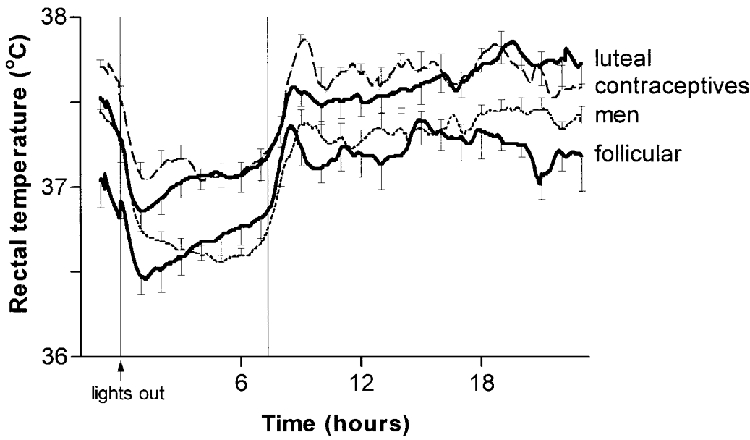
Body temperature has a circadian rhythm, and in women with ovulatory cycles, also a menstrual rhythm. Body temperature and sleep are believed to be closely coupled, but the influence on their relationship of gender, menstrual cycle phase and female reproductive hormones is unresolved. We investigated sleep and 24 h rectal temperatures in eight women with normal menstrual cycles in their mid-follicular and mid-luteal phases, and in eight young women taking a steady dose of oral progestin and ethinyl oestradiol (hormonal contraceptive), and compared their sleep and body temperatures with that of eight young men, sleeping in identical conditions. All subjects maintained their habitual daytime schedules. Rectal temperatures were elevated throughout 24 h in the luteal phase compared with the follicular phase in the naturally cycling women, consistent with a raised thermoregulatory set-point. Rectal temperatures in the women taking hormonal contraceptives were similar to those of the naturally cycling women in the luteal phase. Gender influenced body temperature: the naturally cycling women and the women taking hormonal contraceptives attained their nocturnal minimum body temperatures earlier than the men, and the naturally cycling women had blunted nocturnal body temperature drops compared with the men. Sleep architecture was essentially unaffected by either menstrual cycle phase or gender. The women taking hormonal contraceptives had less slow wave sleep (SWS), however, than the naturally cycling women. Gender, menstrual cycle phase and hormonal contraceptives significantly influenced body temperature, but had only minor consequences for sleep, in the young men and women in our study.
Figures
References
-
- Andersch B, Milsom I. An epidemiologic study of young women with dysmenorrhea. American Journal of Obstetrics and Gynecology. 1982;144:655–660. - PubMed
-
- Armitage R. The distribution of EEG frequencies in REM and NREM sleep stages in healthy young adults. Sleep. 1995;18:334–341. - PubMed
-
- Baehr EK, Revelle W, Eastman CI. Individual differences in morningness-eveningness and the phase and amplitude of the circadian temperature rhythm. Sleep. 1999;22(suppl.):S164. - PubMed
-
- Baker FC, Driver HS, Rogers G, Paiker J, Mitchell D. High nocturnal body temperatures and disturbed sleep in women with primary dysmenorrhea. American Journal of Physiology. 1999;277:E1013–1021. - PubMed
-
- Baker FC, Selsick H, Driver HS, Taylor SR, Mitchell D. Different nocturnal body temperatures and sleep with forced-air warming in men and in women taking hormonal contraceptives. Journal of Sleep Research. 1998;7:175–181. - PubMed
Publication types
MeSH terms
Substances
LinkOut - more resources
Full Text Sources
Other Literature Sources
