. 2001 Feb;21(4):1011-23.
doi: 10.1128/MCB.21.4.1011-1023.2001.

Splicing factor slt11p and its involvement in formation of U2/U6 helix II in activation of the yeast spliceosome

Affiliations

Splicing factor slt11p and its involvement in formation of U2/U6 helix II in activation of the yeast spliceosome

D Xu et al. Mol Cell Biol. 2001 Feb.

Abstract

Slt11p is a new splicing factor identified on the basis of synthetic lethality with a mutation in the 5' end of U2 snRNA, a region that is involved in intermolecular U2/U6 helix II interaction. Slt11p is required for spliceosome assembly. Our genetic results suggest that Slt11p is involved in the base-pairing interaction of U2/U6 helix II in vivo. We showed that the recombinant protein binds to RNAs with some degree of structural specificity. Slt11p also anneals RNA and binds to the resulting duplexes, which contain two separated helical regions. These RNA structures are reminiscent of U2/U6 helix II, which is formed concomitantly with U4/U6 stem II, and suggest that Slt11p facilitates the cooperative formation of helix II in association with stem II in the spliceosome. We show that Slt11p and Slu7p, a second-step factor, interact with each other both in vivo and in vitro and that the binding of Slu7p to Slt11p impairs the RNA-binding activity of the latter. These results suggest that the function of Slt11p is regulated by Slu7p in the spliceosome.


Figures
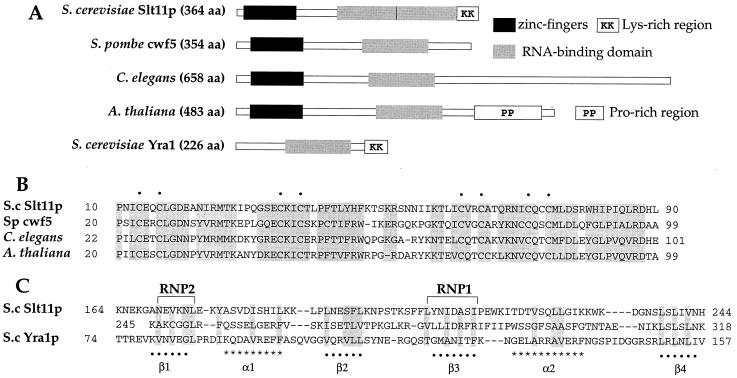
FIG. 1
FIG. 1
Slt11p protein sequence and motifs. (A) Schematic of Slt11p and related proteins from S. pombe cwf5 (AL023592), C. elegans (Z69384), A. thaliana (AC004561), and S. cerevisiae Yra1p (U72633). (B) Alignment of the Slt11p zinc fingers with other proteins with similar motifs. Dots indicate conserved cysteine residues. (C) Alignment of the two potential RBDs in Slt11p with the RBD in Yra1p. The RNP core and other structural motifs are shown according to the work of Burd and Dreyfuss (6). In panels B and C, the conservation at a particular position among the aligned proteins is indicated by grey shading.
FIG. 2
FIG. 2
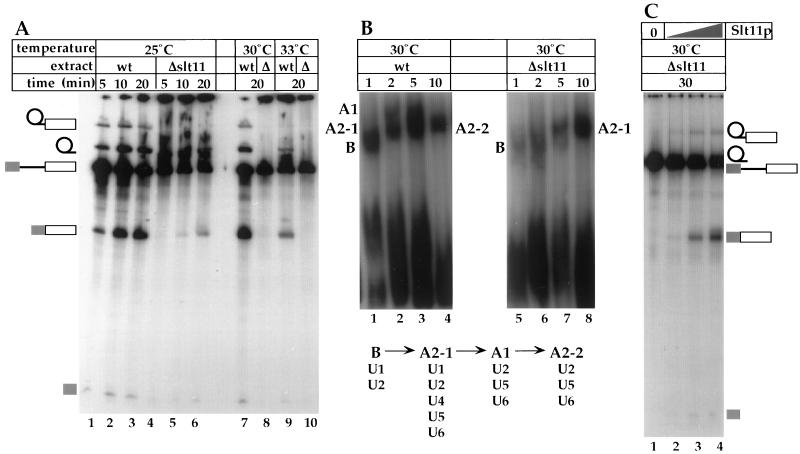
Slt11p is a splicing factor. (A) In vitro splicing assay of yeast pre-actin RNA with wild type (lanes 1 to 3, 7, and 9) and Δslt11 (lanes 4 to 6, 8, and 10) at 25°C (lanes 1 to 6), 30°C (lanes 7 and 8) and 33°C (lanes 9 and 10) for the indicated incubation times. (B) Spliceosome assembly in wild-type (lanes 1 to 4) and Δslt11 (lanes 6 to 8) extracts at 30°C and schematic of spliceosome assembly and snRNA content (based on data in reference 32). (C) Rescue of splicing activity of Δslt11 extract by recombinant Slt11p. Increasing amounts of His6-Slt11p (1, 10, and 100 ng [lanes 2, 3, and 4, respectively]) were added to a Δslt11 extract (lane 1), which was preincubated for 10 min at 25°C prior to a splicing reaction at 30°C. Note that the lariat intron ran very close to precursor RNA in this gel.
FIG. 3
FIG. 3
Slt11p is involved in U2/U6 helix II interaction in vivo. (A) Inter- and intramolecular RNA interactions in the yeast spliceosome. Two conserved intron elements, the 5′-SS and the BPS (BPS int.), are recognized by U6 and U2 snRNAs, respectively. Both snRNAs can form two intermolecular base-pairing interactions (helices I and II) and an intramolecular interaction (Brow stem). (B) Substitution mutations in the helix II regions of U2 and U6 snRNAs. U2-γ is a control mutation. (C) Yeast strains with a double deletion of U2 and U6 genes (top) and a triple deletion of U2, U6 and SLT11 genes (bottom) used in genetic tests. Since SLT11 is not essential at ≤30°C, the maintenance plasmid for both strains contains only wild-type U2 and U6 genes. (D) Genetic interactions between U2 and U6 snRNA mutations in SLT11 (rows 1, 3, and 5) and Δslt11 (rows 2, 4, and 6) backgrounds. Panels a and b show 2-day growth (at 30 and 37°C, respectively) of the strain with the combination of U2 and U6 snRNA mutations in the SLT11 background on selective medium in the absence of the maintenance plasmid. Panels c and d show 2-day growth on 5-FOA-containing medium (at 25 and 30°C, respectively) of the strain with the combination of U2 and U6 snRNA mutations in the Δslt11 background. WT, wild type.
FIG. 4
FIG. 4
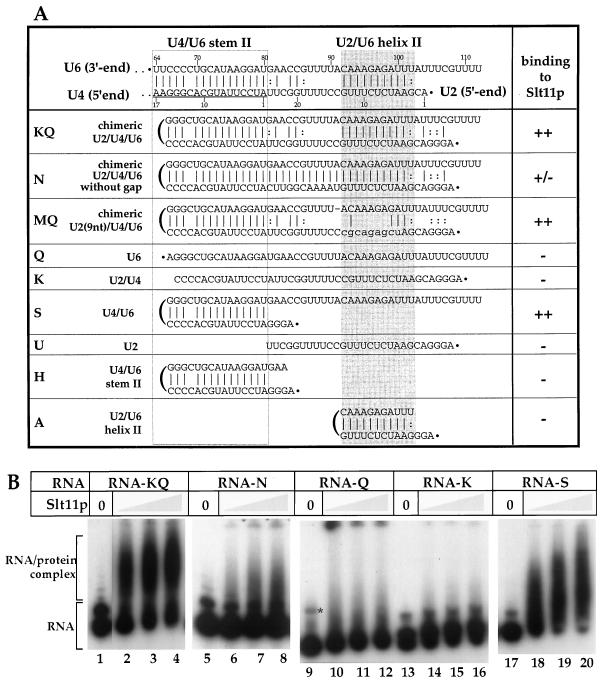
RNA-binding activities of Slt11p. (A) Summary of RNA-binding activities of Slt11p to different synthetic RNAs. Shown on the top is the base-pairing interaction between the 3′ end of U6 snRNA with the 5′-end regions of U2 and U4 (underlined) snRNAs. The U2/U6 helix II-corresponding interaction is indicated by a grey box and U4/U6 stem II is indicated by an open box. All the synthetic RNAs were made according to the sequence shown on the top, and potential secondary structures are drawn on the basis of primary sequence. The 5′ end is indicated by a dot. ++, binding; +/-, weak binding; −, no binding. (B) RNA-binding activities of Slt11p to RNA-KQ, -N, -Q, -K, and -S. Three amounts (5, 10, and 20 ng) of Slt11p were tested for binding to 32P-labeled RNA (approximately 1 fmol). In the absence of Slt11p, all native RNAs ran as two bands in a nondenaturing gel. They likely represent different RNA conformations. The asterisk in lane 9 indicates a small portion of RNA-Q with a different conformation resulting from repeated freezing and thawing.
FIG. 5
FIG. 5
RNA-annealing activities of Slt11p. (A) Schematic of the U2/U6 helix II interaction in association with U4/U6 stem II in spliceosome assembly. (Top) While the 5′-SS and the BPS are recognized by conserved elements in U6 (black box) and U2 (grey box) snRNAs, the 5′ end of U2 snRNA can interact with the 3′ end of U6 snRNA, forming helix II, prior to the disruption of U4/U6 stem II. (Bottom) Concomitant formation of U2/U6 helix II and U4/U6 stem II. (B) Schematic of RNA-annealing assay. Slt11p was first mixed with 32P-labeled RNA (black) and unlabeled RNA (grey) and kept at 25°C for 20 min; then proteinase K was added, and incubation was continued for another 15 min. The resulting RNA duplex was then resolved on a nondenaturing gel. (C) Annealing of RNA-Q–RNA-K duplex. [32P]RNA-Q was mixed with increasing amounts of unlabeled RNA-K in the presence or absence of Slt11p in the annealing assay. The two controls were [32P]RNA-Q alone and mixed with Slt11p. Increasing amounts of unlabeled RNA-K were mixed with [32P]RNA-Q in the thermal annealing reaction (65°C for15 min → 42°C for15 min → 25°C) (lanes 8 to 11). The RNA sequences and potential base pairing are shown at the bottom. (D) Competition of annealing activities. Increasing amounts of unlabeled RNA-R and -Q or excess amounts of yeast tRNA (t) or control RNA (transcribed from pBluescript) (p) were added to the annealing assay (with [32P]RNA-Q, RNA-K and Slt11p) in the beginning. Lanes 2 to 6, 20-min annealing assay with increasing amounts of Slt11p; lane 1, [32P]RNA-Q alone.
FIG. 6
FIG. 6
Characterization of the RNA-annealing and -binding activities of Slt11p. (A and D) Sequences and potential base-pairing of synthetic RNAs used in panels B and C and panels E and F, respectively. (B and E) Annealing of RNAs by Slt11p. Approximately 1 fmol of 32P-labeled RNAs was mixed with increasing amounts of unlabeled RNA and 10 ng of Slt11p in the RNA-annealing assay (Fig. 5C). The resulting RNA duplexes, after proteinase K digestion, were analyzed in 6% nondenaturing gels. The controls include [32P]RNA alone, with 10 ng of Slt11p, and with unlabeled RNAs in the absence of Slt11p. a, b, and c (panel B, lanes 7 to 9) indicate the complexes formed between RNA-Q and -M with altered configurations. In panel E, U′ indicates RNA-U with a different conformation and mobility. (C and F) Binding of Slt11p to RNA duplexes formed in B and E, respectively. Approximately 1 fmol of 32P-labeled RNAs was mixed with increasing amounts of unlabeled RNAs and 100 ng of Slt11p. The mixtures were first incubated at 25°C for 20 min and kept on ice for another 20 min prior to loading onto 4% nondenaturing gels. The controls include [32P]RNAs with unlabeled RNAs only and with 100 ng of Slt11p only. Note that RNA-K and -M ran as triplets and doublets, respectively, on nondenaturing gels. The asterisk indicates a protein-RNA-RNA ternary complex. In panel C, the arrow indicates an RNA duplex (lanes 1 to 4) observed in lanes 3 to 6 in panel B. Similar duplexes were not observed in lanes 7 to 9, 12 to 14, or 17 to 19, due partially to smearing. The formation of the Slt11p–RNA-M–RNA-R ternary complex is further indicated by the reduction of free RNA-M (lanes 17 to 19).
FIG. 7
FIG. 7
Slt11p forms a homodimer in vitro in the absence of RNA. An immunoblot of fractions from the glycerol gradient (10 to 40%) sedimentation of Slt11p probed with rabbit anti-Slt11p antibodies is shown.
FIG. 8
FIG. 8
Slt11p-Slu7p interaction and its effects on RNA-binding and -annealing activities of Slt11p. (A) Protein-protein interaction between Slt11p and Slu7p as determined by affinity chromatography. Western blots of flowthrough (lanes 2, 6, 10, and 14), 0.5 M NaCl (lanes 3, 7, 11, and 15), 1 M NaCl (lanes 4, 8, 12, and 16), and 1% SDS (S, lanes 5, 9, 13, and 17) eluates of four minicolumns with the indicated ligand concentrations were probed with rabbit anti-Slt11p antibody. (B) Effects of Slu7p on the RNA-binding activity of Slt11p. Approximately 1 fmol of [32P]RNA-KQ was mixed with increasing amounts of Slt11p and incubated for 20 min at 25°C; 20 or 40 ng of GST-Slu7p and 20 ng of GST were then added to the mixture and incubated for another 20 min. The mixtures were then loaded onto 4% nondenaturing gels. The controls include [32P]RNA alone, with 20 and 40 ng of GST-Slu7p, and with 20 ng of GST. (For binding of Slt11p to RNA-KQ, see Fig. 4B, lanes 2 to 4.) (C) Effects of Slu7p on the RNA-annealing activity of Slt11p. Twenty nanograms of Slt11p was mixed with 20, 40, or 60 ng of GST-Slu7p and 20 ng of GST and incubated for 20 min at 25°C. Approximately 1 fmol of [32P]RNA-Q and 2 mol of RNA-K were then added, and the mixtures were incubated for another 20 min, after which proteinase K was added for 15 min. The mixtures were then loaded onto 6% nondenaturing gels. The controls include [32P]RNA-Q alone, mixed with RNA-K only, or mixed with RNA-K and 40 or 60 ng of GST-Slu7, 20 ng of GST, and 20 ng of Slt11p.
FIG. 9
FIG. 9
Model for Slt11p function. Slt11p forms a homodimer in the absence of RNA. One of the subunits recognizes and binds to U4/U6 stem II. The other subunit facilitates the formation of U2/U6 helix II through its RNA-annealing function. The Slt11p dimer then binds to the resulting RNA structures with both helix II and stem II to maintain structural integrity. Stem II is divided by an unpaired bulge into two parts, including the helix II-proximal part (U4 nt 1 to 11 with U6 nt 70 to 80), which consists of 11 bp. Helix II also contains 11 bp.

References

    1. Abovich N, Rosbash M. Cross-intron bridging interactions in the yeast commitment complex are conserved in mammals. Cell. 1997;89:403–412. - PubMed
    1. Abovich N, Liao X C, Rosbash M. The yeast MUD2 protein: an interaction with PRP11 defines a bridge between commitment complexes and U2 snRNP addition. Genes Dev. 1994;8:843–854. - PubMed
    1. Adams A, Gottschling D E, Kaiser C A, Stearns T. Methods in yeast genetics. Cold Spring Harbor, N.Y: Cold Spring Harbor Laboratory Press; 1997.
    1. Brow D A, Vidaver R M. An element in human U6 RNA destabilizes the U4/U6 spliceosomal RNA complex. RNA. 1995;1:122–131. - PMC - PubMed
    1. Brys A, Schwer B. Requirement of SLU7 in yeast pre-mRNA splicing is dictated by the distance between the branchpoint and the 3′ splice site. RNA. 1996;2:707–717. - PMC - PubMed

Publication types

MeSH terms