. 2001 Jan 30;98(3):842-7.
doi: 10.1073/pnas.98.3.842. Epub 2001 Jan 23.

AB-polymer networks based on oligo(epsilon-caprolactone) segments showing shape-memory properties

Affiliations

AB-polymer networks based on oligo(epsilon-caprolactone) segments showing shape-memory properties

A Lendlein et al. Proc Natl Acad Sci U S A. .

Abstract

Although shape-memory metal alloys have wide use in medicine and other areas, improved properties, particularly easy shaping, high shape stability, and adjustable transition temperature, are realizable only by polymer systems. In this paper, a polymer system of shape-memory polymer networks based on oligo(epsilon-caprolactone) dimethacrylate as crosslinker and n-butyl acrylate as comonomer was introduced. The influence of two structural parameters, the molecular weight of oligo(epsilon-caprolactone) dimethacrylate and the weight content of n-butyl acrylate, on macroscopic properties of polymer networks such as thermal and mechanical properties has been investigated. Tensile tests above and below melting temperature showed a decrease in the elastic modulus with increasing comonomer weight content. The crystallization behavior of the new materials has been investigated, and key parameters for the programming procedure of the temporary shape have been evaluated. Shape-memory properties have been quantified by thermocyclic experiments. All samples reached uniform deformation properties with recovery rates above 99% after 3 cycles. Whereas strain recovery increased with increasing n-butyl acrylate content, strain fixity decreased, reflecting the decreasing degree of crystallinity of the material.


Figures
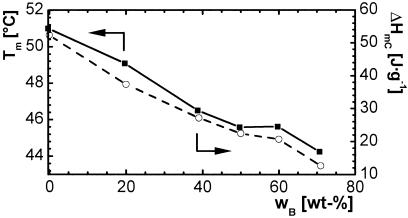
Figure 1
Figure 1
Melting temperature Tm (■) and partial heat of fusion ΔHmC (○) of thermosets prepared from PCLDMA10000 and n-butyl acrylate as a function of comonomer content of n-butyl acrylate wB in weight percent.
Figure 2
Figure 2
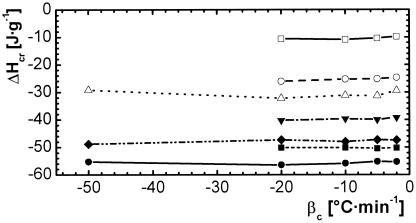
Crystallization enthalpy ΔHcr as a function of cooling rate βc for thermosets based on oligo(ɛ-caprolactone)-dimethacrylates or oligo(ɛ-caprolactone)-dimethacrylate/n-butyl acrylate. ▴, C2, Mn of macromonomer: 2,000 g⋅mol−1; ■, C3, Mn of macromonomer: 3,500 g⋅mol−1; ●, C6, Mn of macromonomer: 6,500 g⋅mol−1; ⧫, C10, Mn of macromonomer: 10,000 g⋅mol−1; ▵, C10B(39), wB = 39 wt %, Mn of macromonomer: 10,000 g⋅mol−1; ○, C10B(50), wB = 50 wt %, Mn of macromonomer: 10,000 g⋅mol−1; □, C10B(71), wB = 71 wt %, Mn of macromonomer: 10,000 g⋅mol−1.
Figure 3
Figure 3
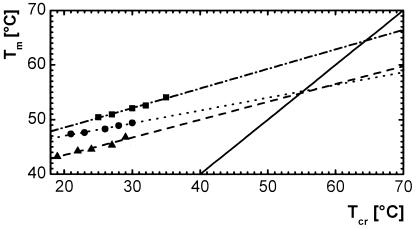
Hoffmann–Weeks plot of isothermal crystallization processes. ▴, C3, Mn of macromonomer: 3,500 g⋅mol−1; ■, C10, Mn of macromonomer: 10,000 g⋅mol−1; ●, C10B(39), wB = 39 wt %, Mn of macromonomer: 10,000 g⋅mol−1; —, Tm = Tcr.
Figure 4
Figure 4
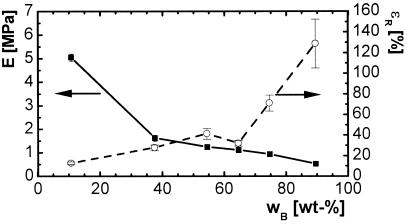
Tensile properties of copolymerisates of PCLDMA2000 and n-butyl acrylate as a function of comonomer content wB at room temperature. ■, Young's modulus E; ○, elongation at break ɛR.
Figure 5
Figure 5
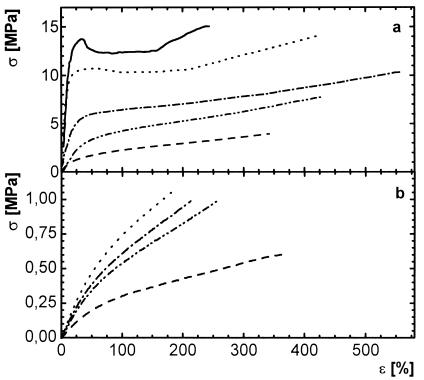
Stress–strain plots for copolymerisates of PCLDMA10000 and n-butyl acrylate of different comonomer content wB: (a) at room temperature; (b) at 70°C. —-, C10, wB = 0 wt %; ⋅⋅⋅⋅, C10B(20), wB = 20 wt %; -⋅-⋅, C10B(39), wB = 39 wt %; ⋅⋅-⋅⋅, C10B(50), wB = 50 wt %; - - -, C10B(71), wB = 71 wt %.
Figure 6
Figure 6
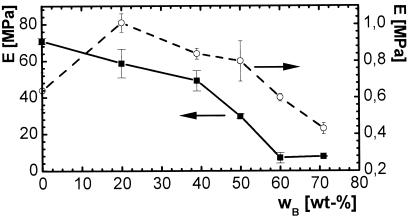
Young's modulus E of copolymerisates of PCLDMA10000 and n-butyl acrylate as a function of comonomer content wB: ■, at room temperature; ○, at 70°C.
Figure 7
Figure 7
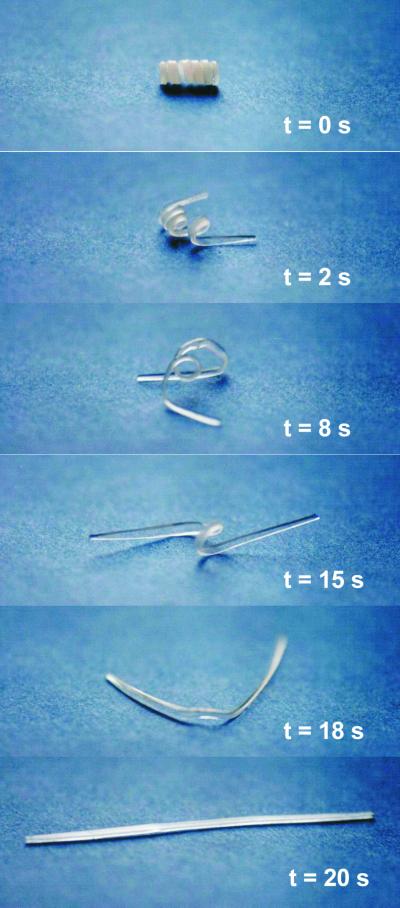
Series of photographs showing the macroscopic shape-memory effect of AB-polymer networks. Permanent shape is a rod, temporary shape is a spiral. The pictures show the transition from temporary to permanent shape at 70°C.
Figure 8
Figure 8
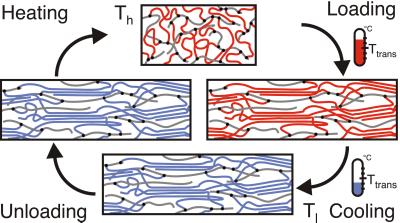
Molecular mechanism of the shape-memory effect of AB-polymer networks containing crystallizable switching segments. Ttrans is the temperature of the shape transition [oligo(n-butyl acrylate) segments: gray, oligo(ɛ-caprolactone) segments: blue/red].
Figure 9
Figure 9
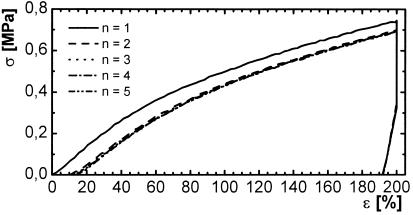
Thermocyclic tensile experiment of C10B(50), Mn of macromonomer: 10,000 g⋅mol−1, wB = 50 wt % with Th = 70°C, Tl = 0°C, ɛm = 200%. —, cycle number n = 1; - - -, n = 2; ⋅⋅⋅⋅, n = 3; -⋅-⋅, n = 4; -⋅⋅-⋅⋅, n = 5.
Figure 10
Figure 10
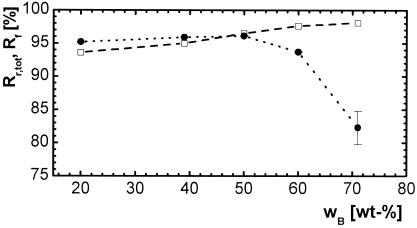
Thermomechanical properties of copolymerisates of PCLDMA10000 and n-butyl acrylate as a function of comonomer content wB at Th = 70°C, Tl = 0°C, ɛm = 200%. □, total strain recovery rate Rr,tot; ●, average strain fixity rate f.

References

    1. Duerig T W, Pelton A R, Stöckel D. Biomed Mater Eng. 1996;6:255–266. - PubMed
    1. Roff W J, Scott J R, Pacitti J. Handbook of Common Polymers. London: Butterworth; 1971.
    1. Shalaby S W, Johnson R A. In: Biomedical Polymers. Shalaby S W, editor. New York: Hansa; 1994. pp. 1–34.
    1. Laurencin C T, Sobrasua I E M, Langer R S. In: Biomedical Applications of Synthetic Biodegradable Polymers. Hollinger J O, editor. Boca Raton: CRC; 1995. pp. 59–101.
    1. Kohn J, Langer R. In: Biomaterials Science. Ratner B D, Hoffmann A S, Schoen F J, Lemons J E, editors. San Diego: Academic; 1996. pp. 64–73.

LinkOut - more resources