. 2001 Jan 30;98(3):944-9.
doi: 10.1073/pnas.98.3.944.

Molecular clocks

Affiliations

Molecular clocks

N E Robinson et al. Proc Natl Acad Sci U S A. .

Abstract

A convenient and precise mass spectrometric method for measurement of the deamidation rates of glutaminyl and asparaginyl residues in peptides and proteins has been developed; the rates of deamidation of 306 asparaginyl sequences in model peptides at pH 7.4, 37.0 degrees C, 0.15 M Tris.HCl buffer have been determined; a library of 913 amide-containing peptides for use by other investigators in similar studies has been established; and, by means of simultaneous deamidation rate measurements of rabbit muscle aldolase and appropriate model peptides in the same solutions, the use of this method for quantitative measurement of the relative effects of primary, secondary, tertiary, and quaternary protein structure on deamidation rates has been demonstrated. The measured rates are discussed with respect to the hypothesis that glutaminyl and asparaginyl residues serve, through deamidation, as molecular timers of biological events.


Figures
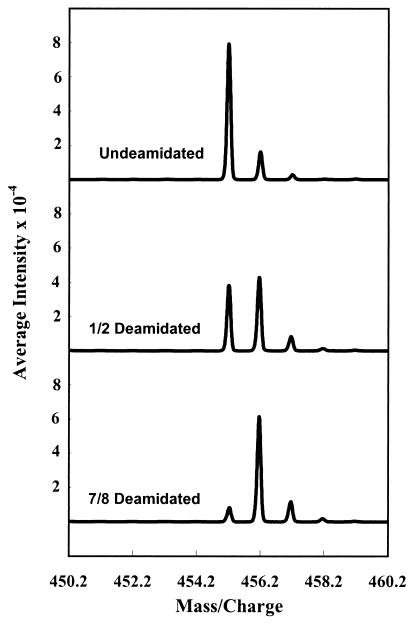
Figure 1
Figure 1
Representative averaged zoom scans from direct 50-μl loop injection of the peptide Gly-Ala-Asn-His-Gly into the LCQ mass spectrometer. Scans are from the first, sixth, and fifteenth points of the deamidation experiment. Deamidation solutions were 1.0 × 10⁻³ M peptide, 0.15 M Tris⋅HCl, pH 7.4, and 37.0°C. Injected solution was 2 × 10⁻⁶ M peptide and 3 × 10⁻⁴ M Tris⋅HCl buffer. The graphs shown are actual and typical unsmoothed experimental data. The graphical base lines have been omitted to show the quality of these results.
Figure 2
Figure 2
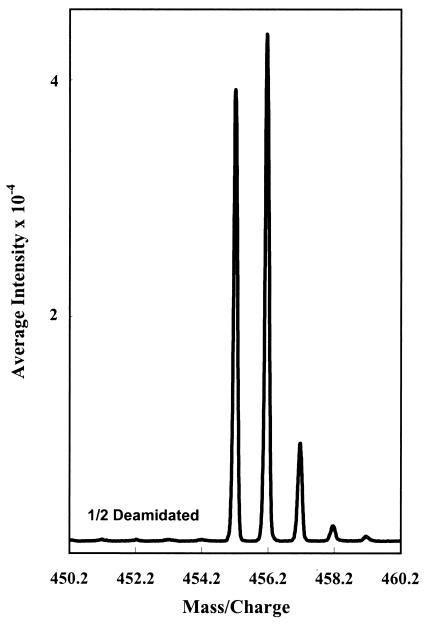
Unsmoothed and uncorrected experimental data for averaged zoom scans of the sixth deamidation point in the deamidation of Gly-Ala-Asn-His-Gly. This graph is typical of actual experimental data obtained for the 306 peptides in these experiments.
Figure 3
Figure 3
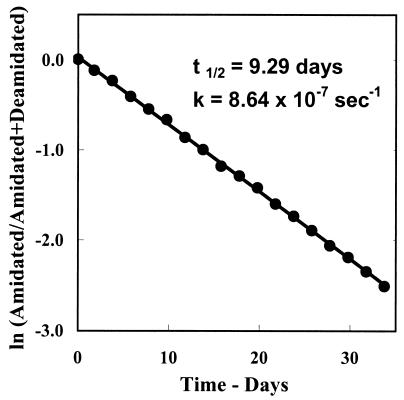
First-order rate plot of the deamidation of the peptide Gly-Ala-Asn-His-Gly. Deamidation half time for the 1.0 × 10⁻³ M peptide in 0.15 M Tris⋅HCl, at pH 7.4, and 37.0°C was calculated to be 9.3 days, and the first-order rate constant k = 0.86 × 10⁻⁶⋅sec−1.
Figure 4
Figure 4
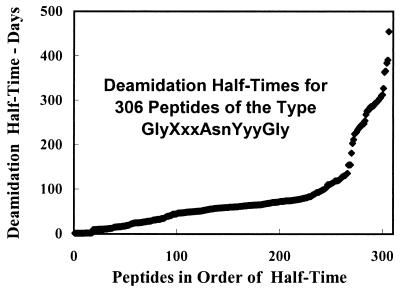
Distribution function of deamidation half times for the 306 asparaginyl pentapeptides of the type Gly-Xxx-Asn-Yyy-Gly listed in Table 1. Half times are for 1.0 × 10⁻³ M peptide in 0.15 M Tris⋅HCl, pH 7.4, and 37.0°C.

References

    1. Robinson A B, McKerrow J H, Cary P. Proc Natl Acad Sci USA. 1970;66:753–757. - PMC - PubMed
    1. Robinson A B. Proc Natl Acad Sci USA. 1974;71:885–888. - PMC - PubMed
    1. Robinson A B, Rudd C. Curr Top Cell Regul. 1974;8:247–295. - PubMed
    1. Robinson A B. Mech Ageing Dev. 1978;9:225–236. - PubMed
    1. Flatmark T. Acta Chem Scand. 1964;18:1656–1666.

Publication types

LinkOut - more resources