Comparative Study
. 2001 Jan 30;98(3):1224-9.
doi: 10.1073/pnas.98.3.1224.

An Epstein-Barr-related herpesvirus from marmoset lymphomas

Affiliations
Comparative Study

An Epstein-Barr-related herpesvirus from marmoset lymphomas

Y Cho et al. Proc Natl Acad Sci U S A. .

Abstract

Epstein-Barr virus (EBV) is implicated in the development of human B cell lymphomas and carcinomas. Although related oncogenic herpesviruses were believed to be endemic only in Old World primate species, we now find these viruses to be endemic in New World primates. We have isolated a transforming, EBV-related virus from spontaneous B cell lymphomas of common marmosets (Callithrix jacchus). Sequencing of two-thirds of the genome reveals considerable divergence from the genomes of EBV and Old World primate EBV-related viruses, including differences in genes important for virus-induced cell growth transformation and pathogenesis. DNA related to the C. jacchus herpesvirus is frequently detected in squirrel monkey peripheral blood lymphocytes, indicating that persistent infection with EBV-related viruses is prevalent in both New World primate families. Understanding how these more divergent EBV-related viruses achieve similar biologic outcomes in their natural host is likely to provide important insights into EBV infection, B cell growth transformation, and oncogenesis.


Figures

Figure 1
Figure 1
Schema of the partial CalHV-3 genome and comparison with EBV and KSHV. Solid boxes represent ORFs common among all gammaherpesviruses, and the role for the conserved ORFs is shown where known. CalHV-3 ORFs with homologues restricted to EBV and other LCVs are shown as shaded boxes. ORFs unique to CalHV-3, EBV, or KSHV are shown as open boxes, wavy boxes, or hatched boxes, respectively. The size of the coding and intergenic regions is not proportional to the actual genome sequences. The schema represents approximately 105 kbp, 96 kbp, and 84 kbp of the CalHV-3, EBV, and KSHV genomes, respectively, absent the terminal repeats (TR).
Figure 2
Figure 2
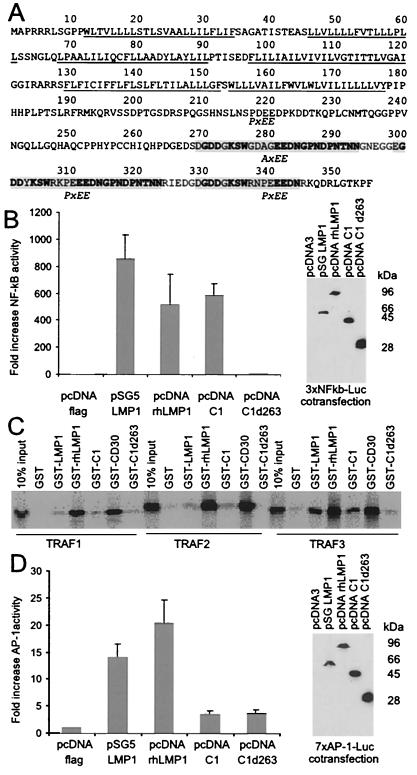
CalHV-3 C1 amino acid sequence, activation of NF-κB, TRAF interaction, and lack of AP-1 induction. (A) The six hydrophobic transmembrane domains are underlined. Repeat elements in the carboxy terminus containing putative TRAF-binding sequence motifs (P/AxEE) are indicated by shading, with conserved residues shown in bold. (B) C1 induces NF-κB activity. A luciferase reporter gene under the control of three NF-κB-responsive elements (3xNFkB-Luc) was cotransfected into 293 cells with flag epitope-tagged expression vectors for EBV LMP1 (pSG5 LMP1), rhesus LCV LMP1 (pcDNA rhLMP1), CalHV-3 C1 (pcDNA C1), and a CalHV-3 C1 mutant truncated at aa 263 (pcDNA C1d263). Data were normalized for β-galactosidase expression and reported as fold induction versus transfection of 3xNFkB-Luc with the pcDNA-Flag as vector control DNA. Results represent the average of four independent transfections. Expression levels for LMP1 and C1 were confirmed after each transfection by Western blots probed with an anti-flag antibody (M2). A representative immunoblot is shown. (C) The C1 carboxy-terminal cytoplasmic domain can bind to TRAF proteins. GST fusion proteins with the complete (aa 179–355: GST-C1) or truncated (aa 179–263: GST-C1d263) C-terminal cytoplasmic domain of C1 were used to precipitate in vitro translated, 35S-labeled TRAF1, TRAF2, or TRAF3 proteins. TRAF binding to GST fusion proteins with EBV LMP1 (GST-LMP1), rhesus LCV LMP1 (GST-rhLMP1), and CD30 (GST-CD30) were included as positive controls. (D) C1 does not induce AP-1 activity. The same expression constructs as in B were cotransfected with a luciferase reporter gene under the control of seven AP-1-responsive elements (7xAP-1-Luc).
Figure 3
Figure 3
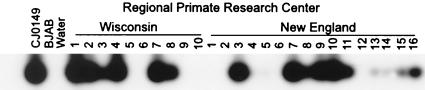
Prevalence of persistent CalHV-3 infection in two different common marmoset colonies. CalHV-3-specific primers for the DNA polymerase gene were used for nested PCR amplification of PBL genomic DNA from common marmosets at the WRPRC and NERPRC. The EBV-negative human B cell line BJAB and water were used as negative controls.
Figure 4
Figure 4
LCV infection in squirrel monkeys (Saimiri scireus) and phylogenetic relationship of LCVs and RVs in human and primates. (A) Herpesvirus DNA polymerase sequences detected in squirrel monkey PBLs. Degenerative oligonucleotide primer sets targeted to highly conserved regions of the herpesvirus DNA polymerase were used in nested PCR reactions with squirrel monkey PBL genomic DNA (5). The consensus sequence from a putative LCV in squirrel monkeys, Saimiriine herpesvirus-3, is shown at the top, and amino acid differences are shown for each clone sequenced from four animals. Conserved and missing amino acid residues are indicated by dots and dashes. Amino acid differences between animal 4, clone 2, and the RV Saimiriine herpesvirus-2 DNA polymerase sequence in GenBank (X64346) are underlined. (B) Phylogenetic relationship of LCVs from New World primates to other LCVs (EBV: V01555; baboon LCV: AF091051; rhesus LCV: AF091053) and RV (KSHV: U75698, HVS:X64346; RRV: 2625044; MHV-68: U97553). The New World primate LCVs are shown in italics.

References

    1. Frank A, Andiman W A, Miller G. Adv Cancer Res. 1976;23:171–201. - PubMed
    1. Ramer J C, Garber R L, Steele K E, Boyson J F, O'Rourke C, Thomson J. Comp Med. 2000;50:59–68. - PubMed
    1. Franken M, Devergne O, Rosenzweig M, Annis B, Kieff E, Wang F. J Virol. 1996;70:7819–7826. - PMC - PubMed
    1. Mitchell T, Sugden B. J Virol. 1995;69:2968–2976. - PMC - PubMed
    1. VanDevanter D R, Warrener P, Bennett L, Schultz E R, Coulter S, Garber R L, Rose T M. J Clin Microbiol. 1996;34:1666–1671. - PMC - PubMed

Publication types

MeSH terms

Associated data

LinkOut - more resources