. 2001 Feb;69(2):832-7.
doi: 10.1128/IAI.69.2.832-837.2001.

Lipopolysaccharide-induced gelatinase granule mobilization primes neutrophils for activation by galectin-3 and formylmethionyl-Leu-Phe

Affiliations

Lipopolysaccharide-induced gelatinase granule mobilization primes neutrophils for activation by galectin-3 and formylmethionyl-Leu-Phe

J Almkvist et al. Infect Immun. 2001 Feb.

Abstract

We have earlier shown that galectin-3, a lactose-binding mammalian lectin that is secreted from activated macrophages, basophils, and mast cells, induces activation of the NADPH oxidase in exudated but not in peripheral blood neutrophils (A. Karlsson, P. Follin, H. Leffler, and C. Dahlgren, Blood 91:3430-3438, 1998). The alteration in responsiveness occurring during extravasation correlated with mobilization of the gelatinase and/or specific granules to the cell surface, indicating a role for mobilizable galectin-3 receptors. In this study we have investigated galectin-3-induced NADPH oxidase activation, measured as superoxide production, in lipopolysaccharide (LPS)-primed neutrophils. Upon galectin-3 challenge, the LPS-primed cells produced superoxide, both extracellularly and intracellularly. A primed extracellular response to formylmethionyl-Leu-Phe (fMLF) was also achieved. The exposure of complement receptors 1 and 3 as well as the formyl peptide receptor on the cell surface was markedly increased after LPS treatment, indicating that granule fusion with the plasma membrane had occurred. Further assessment of specific markers for neutrophil granules showed that the LPS treatment had mobilized the gelatinase granules but only a minor fraction of the specific granules. We thus suggest that the mechanism behind LPS priming lies at the level of granule (receptor) mobilization for galectin-3 as well as for fMLF.


Figures
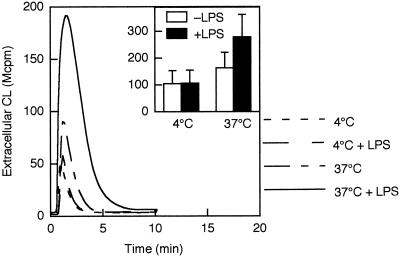
FIG. 1
FIG. 1
fMLF-induced extracellular release of oxygen radicals in LPS-primed and unprimed neutrophils. Cells were preincubated for 30 min at 4 or 37°C in the presence or absence of LPS (10 μg/ml), after which they were stimulated with fMLF (10−7 M). The extracellular release of superoxide anion was measured by isoluminol-amplified CL in the presence of HRP, and the CL responses are given as 106 cpm (Mcpm). Kinetics of a representative experiment as well as the mean peak value (+SD) of three experiments (inset) are shown.
FIG. 2
FIG. 2
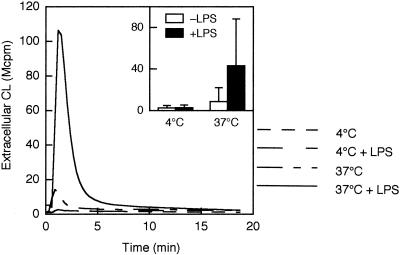
Galectin-3-induced extracellular release of oxygen radicals in LPS-primed and unprimed neutrophils. Cells were preincubated for 30 min at 4 or 37°C in the presence or absence of LPS (10 μg/ml), after which they were stimulated with galectin-3 (40 μg/ml). The extracellular release of superoxide anion was measured by isoluminol-amplified CL in the presence of HRP, and CL responses are given as 106 cpm (Mcpm). Kinetics of a representative experiment as well as the mean peak value (+SD) of three experiments (inset) are shown.
FIG. 3
FIG. 3
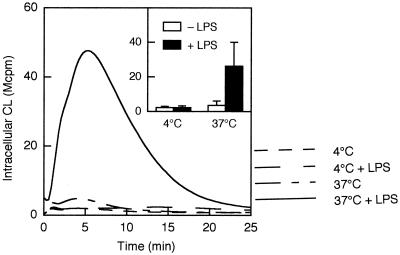
Galectin-3-induced intracellular production of oxygen radicals in LPS-primed and unprimed neutrophils. Cells were preincubated for 30 min at 4 or 37°C in the presence or absence of LPS (10 μg/ml), after which they were stimulated with galectin-3 (20 μg/ml). The intracellular production of superoxide anion was measured by luminol-amplified CL in the presence of SOD and catalase, and CL responses are given as 106 cpm (Mcpm). Kinetics of a representative experiment as well as the mean peak value (+SD) of three experiments (inset) are shown.
FIG. 4
FIG. 4
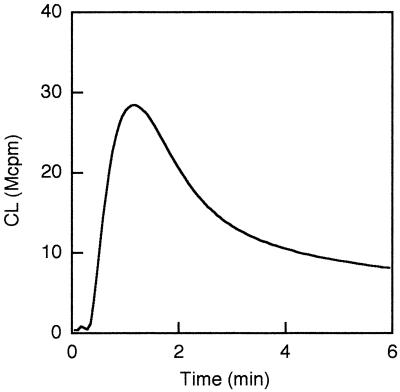
Galectin-3-induced production of oxygen radicals in neutrophil cytoplasts. Cytoplasts resuspended to a concentration of 106/ml were stimulated with galectin-3 (20 μg/ml). The extracellular release of superoxide anion was measured by isoluminol-amplified CL in the presence of HRP, and the CL response is given as 106 cpm (Mcpm). Kinetics of a representative experiment are shown. The mean peak value (±SD) of three experiments was 20.4 ± 7.2 Mcpm.
FIG. 5
FIG. 5
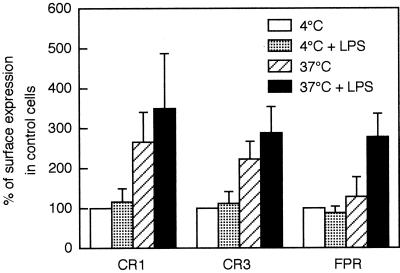
Cell surface exposure of CRs and FPR in LPS-primed and unprimed neutrophils. Neutrophils were preincubated for 30 min in the presence or absence of LPS (10 μg/ml) at 4 or 37°C. Cell surface exposure of CR1 and CR3 as measured by fluorescence-activated cell sorting analysis and cell surface exposure of FPR as measured by binding of radiolabeled fMLF are shown. The data for each cell population, expressed as percentage of the value obtained with control cells (4°C; open bars), are given as mean + SD, n = 6 (CR1 and CR3) or n = 3 (FPR). The control value (100%) for the specific (total minus nonspecific) fMLF binding to FPR was 13.2 fmol/106 cells. Nonspecific binding, measured in the presence of excess unlabeled fMLF, was 10 fmol/106 under all conditions tested. CR1 is a marker for the plasma membrane and secretory vesicles; CR3 and FPR are present in the secretory vesicles as well as in the gelatinase and specific granules.
FIG. 6
FIG. 6
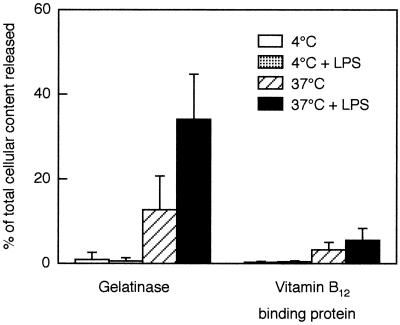
Extracellular release of gelatinase and vitamin B12-binding protein from LPS-primed and unprimed neutrophils. Neutrophils were preincubated for 30 min in presence or absence of LPS (10 μg/ml) at 4 or 37°C. Bars represent release into the medium of gelatinase (marker for the gelatinase and specific granules) and vitamin B12-binding protein (marker for the specific granules), as a percentage (mean + SD, n = 5) of the total amount in control cells.

References

    1. Andersson T, Dahlgren C, Lew P D, Stendahl O. Cell surface expression of fMet-Leu-Phe receptors on human neutrophils. Correlation to changes in the cytosolic free Ca2+ level and action of phorbol myristate acetate. J Clin Investig. 1987;79:1226–1233. - PMC - PubMed
    1. Askew D, Yurochko A D, Burger C J, Elgert K D. Normal and tumor-bearing host macrophage responses: variability in accessory function, surface markers, and cell-cycle kinetics. Immunol Lett. 1990;24:21–29. - PubMed
    1. Babior B M. NADPH oxidase: an update. Blood. 1999;93:1464–1476. - PubMed
    1. Beauchemin N, Draber P, Dveksler G, Gold P, Gray-Owen S, Grunert F, Hammarström S, Holmes K V, Karlsson A, Kuroki M, Lin S H, Lucka L, Najjar S M, Neumaier M, Öbring B, Shively J E, Skubitz K M, Stanners C P, Thomas P, Thompson J A, Virji M, vonKleist S, Wagener C, Watt S, Zimmermann W. Redefined nomenclature for members of the carcinoembryonic antigen family. Exp Cell Res. 1999;252:243–249. - PubMed
    1. Bennett T A, Lynam E B, Sklar L A, Rogelj S. Hydroxamate-based metalloprotease inhibitor blocks shedding of L-selectin adhesion molecule from leukocytes: functional consequences for neutrophil aggregation. J Immunol. 1996;156:3093–3097. - PubMed

Publication types

MeSH terms

LinkOut - more resources