. 2001 Feb;69(2):906-11.
doi: 10.1128/IAI.69.2.906-911.2001.

Migration-inhibitory factor gene-deficient mice are susceptible to cutaneous Leishmania major infection

Affiliations

Migration-inhibitory factor gene-deficient mice are susceptible to cutaneous Leishmania major infection

A R Satoskar et al. Infect Immun. 2001 Feb.

Abstract

To determine the role of endogenous migration-inhibitory factor (MIF) in the development of protective immunity against cutaneous leishmaniasis, we analyzed the course of cutaneous Leishmania major infection in MIF gene-deficient mice (MIF(-/-)) and wild-type (MIF(+/+)) mice. Following cutaneous L. major infection, MIF(-/-) mice were susceptible to disease and developed significantly larger lesions and greater parasite burdens than MIF(+/+) mice. Interestingly, antigen-stimulated lymph node cells from MIF(-/-) mice produced more interleukin-4 (IL-4) and gamma interferon (IFN-gamma) than those from MIF(+/+) mice, although the differences were statistically not significant. IFN-gamma-activated resting peritoneal macrophages from MIF(-/-) mice showed impaired macrophage leishmanicidal activity and produced significantly lower levels of nitric oxide and superoxide in vitro. The macrophages from MIF(-/-) mice, however, produced much more IL-6 than macrophages from wild-type mice. These findings demonstrate that endogenous MIF plays an important role in the development of protective immunity against L. major in vivo. Furthermore, they indicate that the susceptibility of MIF(-/-) mice to L. major infection is due to impaired macrophage leishmanicidal activity rather than dysregulation of Th1 and Th2 responses.


Figures
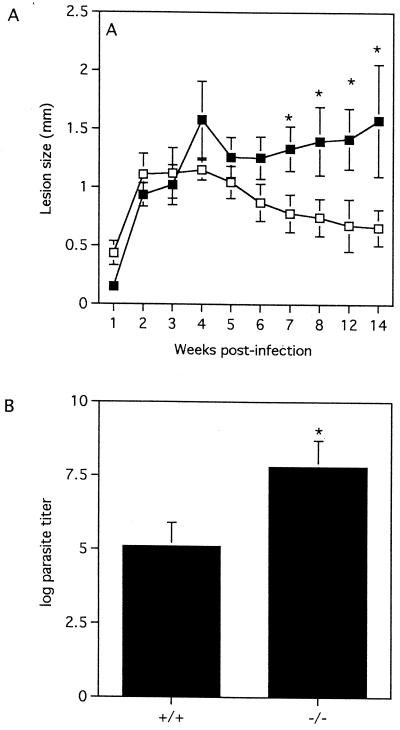
FIG. 1
FIG. 1
MIF−/− mice are relatively more susceptible to cutaneous L. major infection than MIF+/+ mice and develop large lesions. (A) Course of cutaneous L. major infection in MIF−/− (solid squares) and MIF+/+ (open squares) mice following infection with 2 × 10⁶ stationary-phase promastigotes. Disease progression was monitored by measuring the increase in thickness of the infected footpad and comparing this to the thickness of the contralateral uninfected footpad. (B) Footpad parasite burdens in MIF−/− and MIF+/+ mice were determined at week 12 postinfection by limiting-dilution analysis. Data are expressed as the mean titer ± the standard error (SE). Similar results were observed in three and two independent experiments (A and B, respectively).
FIG. 2
FIG. 2
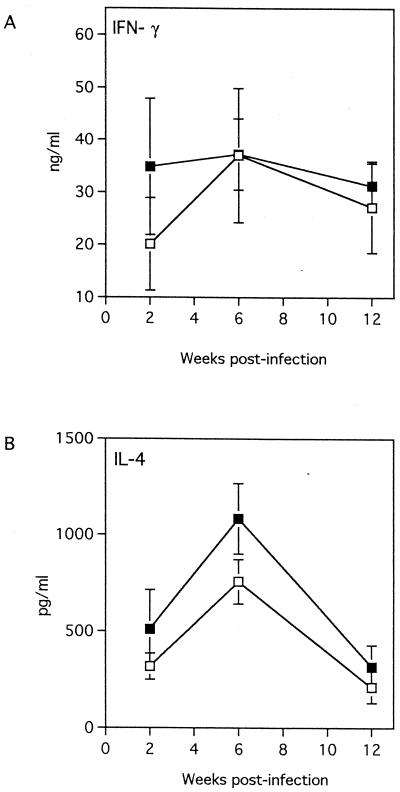
Kinetics of in vitro cytokine production by LmAg-stimulated lymph node cells from MIF−/− (solid squares) and MIF+/+ (open squares) mice. (A) IFN-γ and (B) IL-4 production by draining lymph node cells following in vitro stimulation with LmAg (20 μg/ml) was measured at weeks 2, 6, and 12 postinfection by ELISA. The graph shows the mean (n = 6 to 9 animals) of two separate experiment. Data are expressed as the mean ± SE.
FIG. 3
FIG. 3
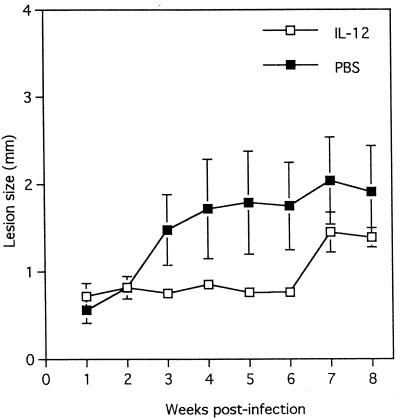
Effect of recombinant IL-12 treatment on course of L. major infection in MIF−/− mice. Disease progression was monitored by measuring the increase in the thickness of infected footpad and comparing this to the thickness of the contralateral uninfected footpad. Data are expressed as mean increase in footpad thickness ± SE. Four mice were used in each group.
FIG. 4
FIG. 4
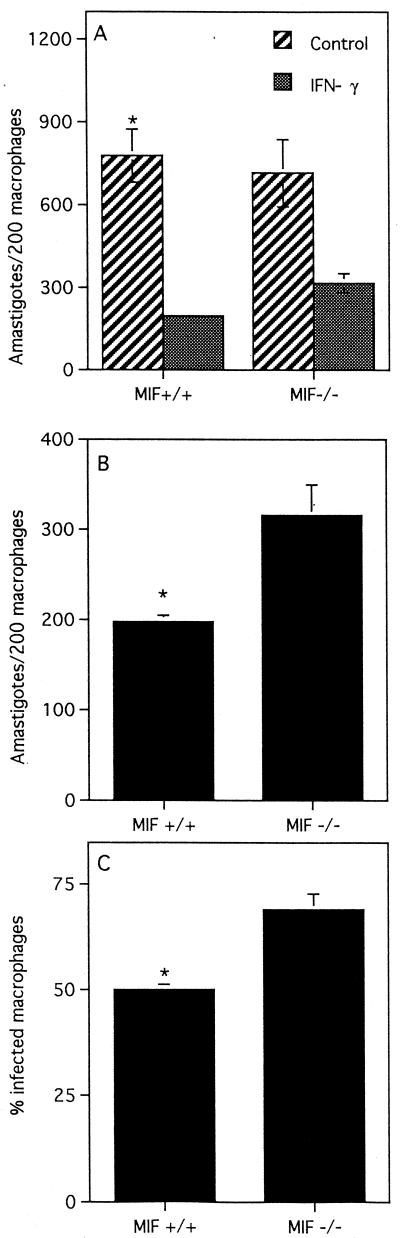
Resting peritoneal macrophages from MIF−/− mice display impairment of IFN-γ-induced leishmanicidal activity. Macrophages were infected with L. major stationary-phase promastigotes as described in Materials and Methods and stimulated with 200 U of IFN-γ per ml for 72 h. The number of amastigotes per 200 infected macrophages (A and B) and the percentage of infected macrophages (C) were determined microscopically by Giemsa staining. This experiment is representative of two performed. Four to five mice were used in each group, and cells were plated in triplicate.
FIG. 5
FIG. 5
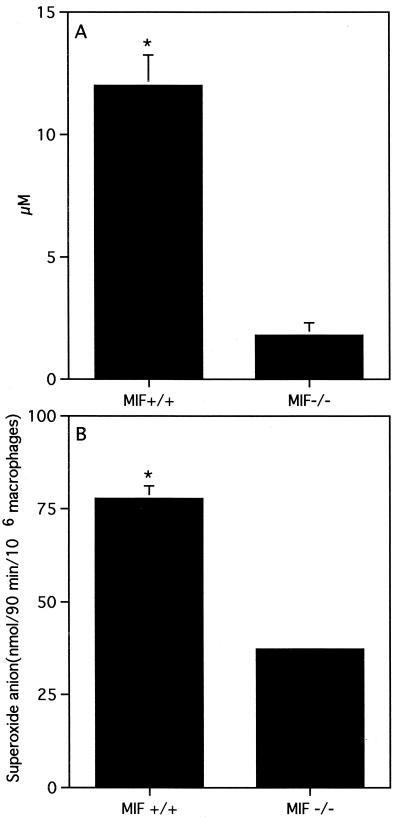
Production of nitric oxide (NO) and superoxide (O2) is impaired in macrophages from MIF−/− mice. (A) Nitric oxide production and (B) superoxide (O2) production were measured as described in Materials and Methods. Similar results were observed in two independent experiments. Data are expressed as mean ± SE.
FIG. 6
FIG. 6
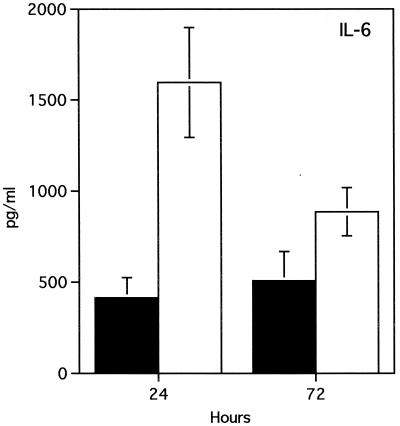
Macrophages from MIF−/− mice (open squares) produce significantly more IL-6 than those from MIF+/+ mice (squares). Resting peritoneal macrophages were infected with L. major promastigotes in vitro and stimulated with IFN-γ (200 U/ml). IL-6 production was measured at 12, 24, and 48 h postinfection by ELISA. Data are expressed as the mean of triplicates ± SE. Similar results were observed in three independent experiments.

References

    1. Alexander J, Satoskar A R, Russell D G. Leishmania species: models of intracellular parasitism. J Cell Sci. 1999;112:2993–3002. - PubMed
    1. Bacher M, Metz C, Calandra T, Mayer K, Chesney J, Lhoff M, Gemsa D, Donnelly T, Bucala R. An essential role for MIF in T cell activation. Proc Natl Acad Sci USA. 1996;93:7849–7854. - PMC - PubMed
    1. Bernhagen J, Calandra T, Mitchell R A, Martin S B, Tracey K J, Voelter W, Manouge K R, Cerami A, Bucala R. MIF is a pituitary-derived cytokine that potentiates lethal endotoxemia. Nature. 1993;365:756–759. - PubMed
    1. Bozza M, Satoskar A R, Lin G, Lu B, Humbles A A, Gerard C, David J R. Targeted disruption of migration inhibitory factor gene reveals its critical role in sepsis. J Exp Med. 1999;189:341–346. - PMC - PubMed
    1. Calandra T, Bernhagen J, Mitchell R A, Bucala R. The macrophage is an important and previously unrecognized source of macrophage migration inhibitory factor. J Exp Med. 1994;179:1895–1902. - PMC - PubMed

Publication types

MeSH terms

LinkOut - more resources