. 2001 Feb;69(2):968-76.
doi: 10.1128/IAI.69.2.968-976.2001.

Infectivity of Chlamydia trachomatis serovar LGV but not E is dependent on host cell heparan sulfate

Affiliations

Infectivity of Chlamydia trachomatis serovar LGV but not E is dependent on host cell heparan sulfate

M Taraktchoglou et al. Infect Immun. 2001 Feb.

Abstract

The ability of heparan sulfate, heparin, and other glycosaminoglycans to inhibit the infectivity of Chlamydia trachomatis serovars E and LGV was examined using a simple competitive inhibition assay with three cell types from the human female reproductive tract, including primary human endosalpingeal cells. With the majority of the glycosaminoglycans tested, LGV was more significantly inhibited than serovar E. We have compared chlamydial infectivity between a wild-type Chinese hamster ovary cell line and two glycosaminoglycan-deficient cell lines. LGV was shown to be unable to infect heparan sulfate-deficient and GAG-deficient Chinese hamster ovary cell lines, whereas the E serovar infected these cells as efficiently as the control (nondeficient) cells. These two sets of experiments confirmed that serovar LGV is more dependent on a heparan sulfate-related mechanism of infectivity than is serovar E. This is further supported by the fact that attempts to purify a heparan sulfate-like molecule from either serovar cultured in glycosaminoglycan-deficient cell lines were nonproductive. Previous reports have suggested that chlamydia are able to produce a heparan sulfate-like molecule that is important for attachment and infectivity. We have attempted to detect possible binding of a specific heparan sulfate antibody to C. trachomatis by flow cytometry. Results showed no binding of the heparan sulfate antibody to C. trachomatis serovar LGV or E. Our results strongly indicate that chlamydiae do not produce a heparan sulfate-like molecule but rather use host cell heparan sulfate in order to infect cells.


Figures
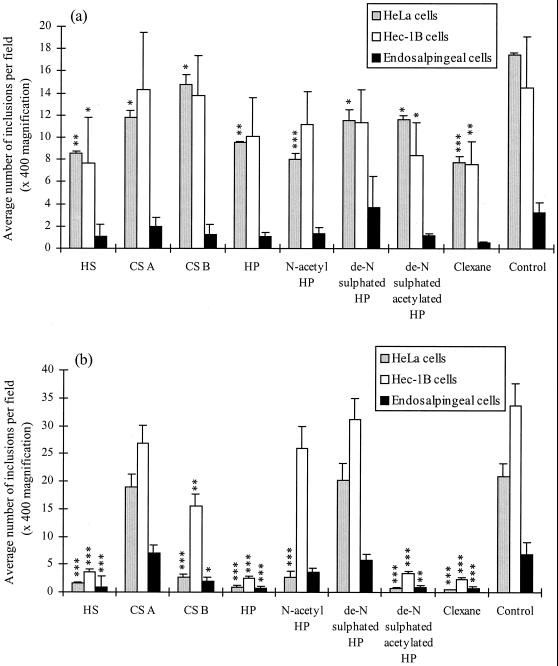
FIG. 1
FIG. 1
Infectivity inhibition results with serovar E (a) and serovar LGV (b) at 37°C Comparison of C. trachomatis infectivity levels incubated on HeLa, Hec-1B, and endosalpingeal cell monolayers with addition of different GAGs: HP and chemically modified HPs (all used at 0.5 mg ml−1). This figure represents the results of six different experiments. Error bars: standard error. Results were statistically analyzed using a one-way-paired analysis of variance test, and a Tukey-Kramer test was performed if there was a significant difference between the columns. ∗, P < 0.05; ∗∗, P < 0.01; ∗∗∗, P < 0.001.
FIG. 2
FIG. 2
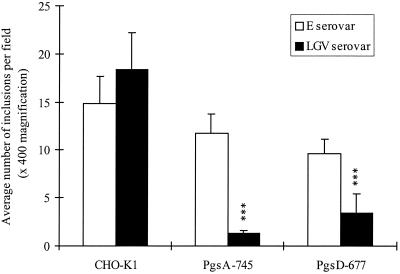
Comparison of serovar E and LGV infectivity of CHO-K1, pgsA-745 and pgsD-677 cells at 37°C. pgsA-745 and pgsD-677 cells are defective CHO-K1 cell lines. pgsA-745 cells do not produce any GAGs, and pgsD-677 are not able to produce any HS (they do produce CS). This figure represents the results of six different experiments. Error bars: standard error. Results were statistically analyzed using a one-way-paired analysis of variance test, and a Tukey-Kramer test was performed if there was a significant difference between the columns. ∗, P < 0.05; ∗∗, P < 0.01; ∗∗∗, P <.001.
FIG. 3
FIG. 3
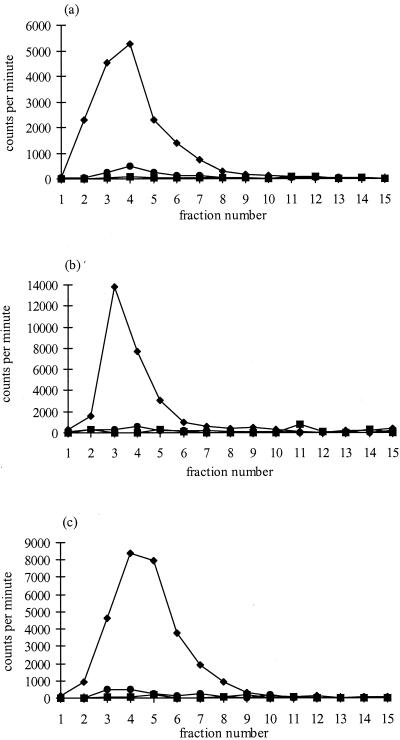
Elution profiles of radiolabeled GAGs prepared from control non infected cells (a), LGV-infected cells (b), and E serovar infected cells (c). ⧫, CHO-K1; ■, pgsA-745; ●, pgsD-677. Fractions 1 to 15 were eluted using 1.0 M NaCl, and a further 15 fractions (not shown) were eluted using 1.5 M NaCl (no radiolabeled material was eluted in these further 15 fractions). The radioactivity in each fraction was determined by liquid scintillation counting (1% volume of each 0.5-ml fraction collected).
FIG. 4
FIG. 4
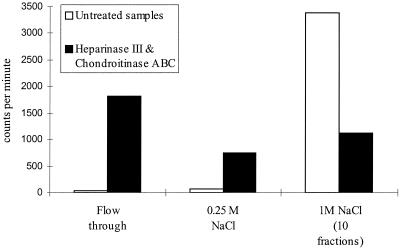
Scintillation counting of heparitinase- and chondroitinase ABC-digested samples compared with that of untreated controls. GAGs from noninfected CHO-K1 cells (fractions 2 to 9) were pooled (Fig. 3a), desalted, and then treated with 2.5 mU of heparitinase and 25 mU of chondroitinase ABC. Total counts per minute of the column flowthrough, 0.25 M NaCl, and first 10 fractions of 1 M NaCl are illustrated in this figure. In the untreated control GAGs bound to the DEAE-Sepharose column and were eluted in the 1 M NaCl fractions. In the digested samples most of the counts were collected in the flowthrough and 0.25 M NaCl, since degraded GAGs did not bind to the column. Material remaining bound after the enzyme treatments probably represents sulfated HS oligosaccharides which are resistant to heparitinase degradation. The radioactivity in a 1% volume of each sample was recorded by scintillation counting.
FIG. 5
FIG. 5
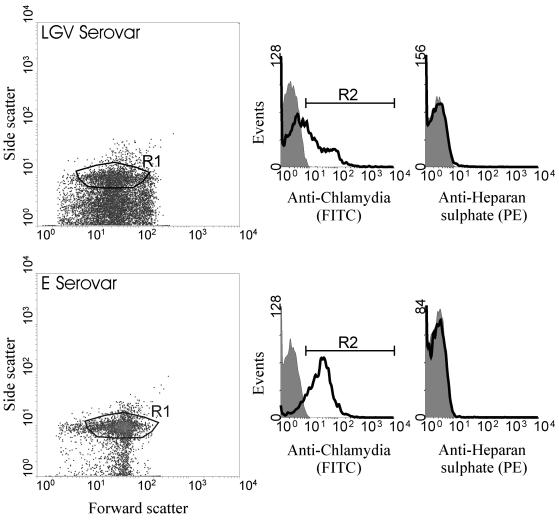
Representative flow cytometric analysis of serovar LGV (top panel) and serovar E (bottom panel) EBs stained with a chlamydial antibody (FITC conjugated) and/or an (HS-specific antibody followed by a secondary antibody. The left-hand panels illustrate typical density blots of forward versus side scatter, with region 1 (R1) representing the population of particles analyzed in the corresponding histograms. The middle panels illustrate chlamydial staining with an antichlamydia FITC-conjugated antibody (solid line) and unstained controls (shaded area). Only particles included in region R2 (positively stained with antichlamydia antibody) were analyzed for positive staining with an anti-HS antibody. The righthand panels illustrate anti-HS (PE) staining (solid line) and unstained controls (shaded area).

References

    1. Bernfield M, Gotte M, Park P P, Reizes O, Fitzgerald M L, Lincenum J, Zako M. Functions of cell surface heparan sulfate proteoglycans. Annu Rev Biochem. 1999;68:729–777. - PubMed
    1. Brieger D, Dawes J. Production method affects the pharmacokinetic and ex vivo biological properties of low molecular weight heparins. Thromb Haemost. 1997;77:317–322. - PubMed
    1. Cates W, Wasserheit J N. Genital chlamydial infections: epidemiology and reproductive sequelae. Am J Obstet Gynecol. 1991;164:1771–1781. - PubMed
    1. Cesar B, Gutierrez-Martin C B, Ojcius D M, Hsia R, Hellio R, Bavoil P M, Dautry-Varsat A. Heparin-mediated inhibition of Chlamydia psittaci to HeLa cells. Microb Pathog. 1997;22:47–57. - PubMed
    1. Chen J C R, Stephens R S. Trachoma and LGV biovars of Chlamydia trachomatis share the same glycosaminoglycan-dependent mechanism for infection of eukaryotic cells. Mol Microbiol. 1994;11:501–507. - PubMed

Publication types

LinkOut - more resources