. 2001 Mar;183(5):1813-8.
doi: 10.1128/JB.183.5.1813-1818.2001.

TFE, an archaeal transcription factor in Methanobacterium thermoautotrophicum related to eucaryal transcription factor TFIIEalpha

Affiliations

TFE, an archaeal transcription factor in Methanobacterium thermoautotrophicum related to eucaryal transcription factor TFIIEalpha

B L Hanzelka et al. J Bacteriol. 2001 Mar.

Abstract

In the archaeon Methanobacterium thermoautotrophicum, MTH1669 encodes a protein with a sequence related to the N-terminal sequences of the alpha-subunits of eucaryal general transcription factor TFIIE. The recombinant MTH1669 gene product has been purified and shown to stimulate transcription in vitro from M. thermoautotrophicum promoters that were almost inactive or much less active in reaction mixtures that contained only M. thermoautotrophicum RNA polymerase, TATA-binding protein and transcription factor B. As all complete archaeal genome sequences contain an MTH1669 homolog, the protein encoded by this gene is apparently the first characterized example of a transcription activator, here designated TFE, that may be universally present in the Archaea.


Figures
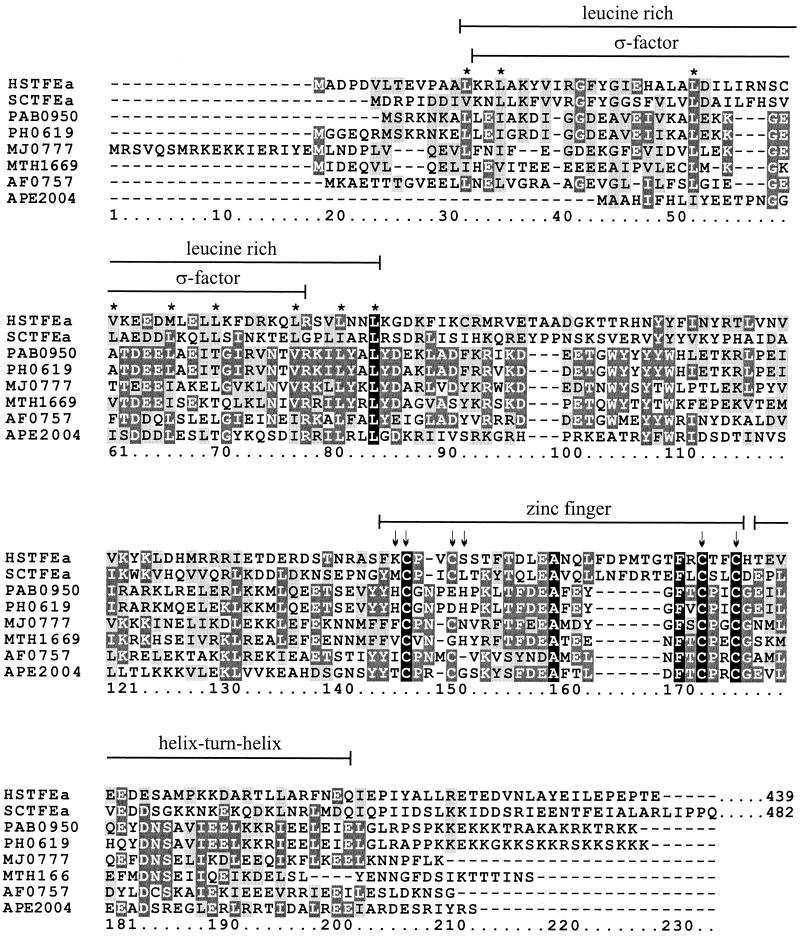
FIG. 1
FIG. 1
Alignment of archaeal sequences with the N-terminal sequences of the α-subunits of yeast and human TFIIE. The M. thermoautotrophicum ΔH (MTH1669), Pyrococcus horikoshii (PH0619), Pyrococcus abysii (PAB0950), Methanococcus jannaschii (MJ0777), Archaeoglobus fulgidus (AF0757), and Aeropyrum pernix (APE2004) archaeal sequences are identified by their genome reading frame reference numbers (2, 15), and the yeast and human sequences are identified by SCTFEa (GenBank accession no. 607957) and HSTFEa (GenBank accession no. 5031726), respectively. Only the N-terminal 210 residues of the yeast (482 residues in total) and human (439 residues in total) proteins are shown. The alignment was generated by PILEUP (Genetic Computer Group, Inc.). Residues present in all eight sequences are identified by a black background, identical residues are identified by a dark gray background, and similar residues are identified by a light gray background. Brackets above the sequences indicate the leucine-rich region with similarity to bacterial ς factors (25), the zinc finger motif (18), and the helix-turn-helix region in human TFIIE. Conserved hydrophobic positions within the leucine-rich region are identified by asterisks (∗), and arrows (↓) identify cysteine and histidine residues that could ligate the zinc atom in the proposed zinc finger domains.
FIG. 2
FIG. 2
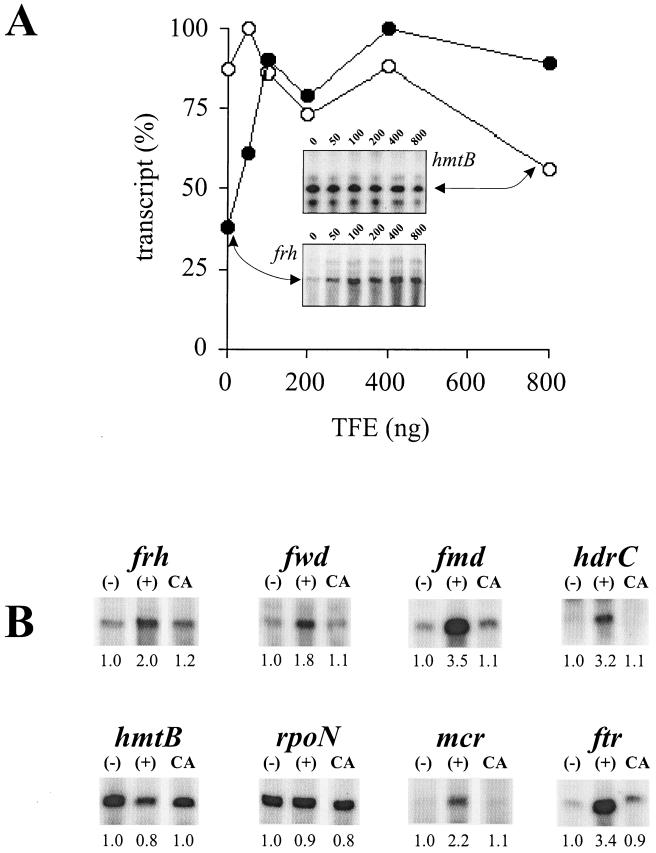
Effects of TFE and TFE(C155A) addition on in vitro transcription. (A). Amounts of frh and hmtB transcripts synthesized after 30 min of incubation at 58°C in the presence of increasing amounts of TFE (listed in nanograms above the corresponding lanes in the gels shown), determined by 32P-decay, plotted as percentages of the maximum amount of that transcript synthesized. (B) Run off transcripts synthesized from the promoter listed above each gel (28, 29) in reaction mixtures with no addition (−) or supplemented with 200 ng of TFE (+) or with 200 ng of TFE(C155A) (CA). The amount of each transcript synthesized was determined by 32P-decay measurements, and the length of each transcript (130 to 260 nucleotides) was confirmed, based on the location of the corresponding TATA box, by adjacent coelectrophoresis of 32P-labeled size standards (Boehringer-Mannheim, Indianapolis, Id.). Below the lanes are mean values, from three to seven independent experiments, of the amount of transcript synthesized in the presence of TFE (+) or TFE(C155A) (CA) relative to the amount synthesized with no addition (−).
FIG. 3
FIG. 3
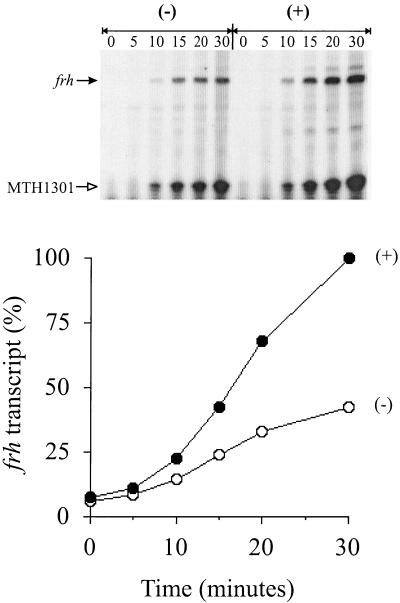
Kinetics of in vitro transcription in the presence and absence of TFE. The amounts of frh transcript present after increasing times of in vitro transcription with (+) or without (−) 200 ng of TFE were determined, and the mean values from two independent experiments are shown in the graph as percentages of the amount synthesized after 30 min in the presence of TFE. The arrows to the left of the gel identify the frh transcript and a transcript that is transcribed from the opposite strand from the promoter of the adjacent MTH1301 gene (35). MTH1301 encodes a protein of unknown function, but as illustrated, transcription from the MTH1301 promoter was stimulated ∼2.5-fold by TFE addition.

References

    1. Alex L, Reeve J N, Orme-Johnson W H, Walsh C T. Cloning, sequence determination and expression of the genes encoding the subunits of the Ni-containing 8-hydroxy-5-deazaflavin reducing hydrogenase from Methanobacterium thermoautotrophicum ΔH. Biochemistry. 1990;29:7237–7244. - PubMed
    1. Aravind L, Koonin E V. DNA-binding proteins and evolution of transcription regulation in the archaea. Nucleic Acids Res. 1999;27:4658–4670. - PMC - PubMed
    1. Bell S D, Cairns S S, Robson R L, Jackson S P. Transcription regulation of an archaeal operon in vivo and in vitro. Mol Cell. 1999;4:971–982. - PubMed
    1. Bell S D, Jackson S P. Mechanism of autoregulation by an archaeal transcriptional repressor. J Biol Chem. 2000;275:31624–31629. - PubMed
    1. Bell S D, Jaxel C, Nadal M, Kosa P F, Jackson S P. Temperature, template topology, and factor requirements of archaeal transcription. Proc Natl Acad Sci USA. 1998;95:15218–15222. - PMC - PubMed

Publication types

MeSH terms

LinkOut - more resources