


Review
doi: 10.1172/JCI11916.
NF-kappaB in neuronal plasticity and neurodegenerative disorders
Affiliations
- PMID: 11160145
- PMCID: PMC199201
- DOI: 10.1172/JCI11916
Item in Clipboard
Review
NF-kappaB in neuronal plasticity and neurodegenerative disorders
J Clin Invest.
2001 Feb.
No abstract available
Figures
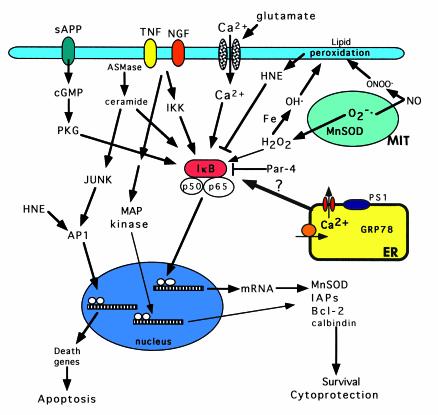
Signaling pathways that regulate NF-κB activity in neurons, and their possible involvement in the pathogenesis of neurodegenerative disorders. NF-κB in its inactive form is present in the cytosol as a three-subunit complex, with the prototypical components being p65 and p50 (transcription factor dimer) and IκBα (inhibitory subunit). NF-κB is activated by signals that activate IκB kinase (IKK), resulting in phosphorylation of IκBα; this targets IκBα for degradation in the proteosome and frees the p65-p50 dimer, which then translocates to the nucleus and binds to consensus κB sequences in the enhancer region of κB-responsive genes. Diverse signals can induce NF-κB activation, including TNF-α, sAPPα, NGF, and glutamate; increases in levels of intracellular Ca2+ and reactive oxygen species such as H2O2 can be potent activators of NF-κB. NF-κB induces the expression of several different genes that promote neuron survival, including those encoding manganese superoxide dismutase (Mn-SOD), inhibitor-of-apoptosis proteins (IAPs), Bcl-2, and calbindin. Several signals that inhibit NF-κB activity are generated in neurons undergoing apoptosis; examples include prostate apoptosis response-4 (Par-4) and the lipid peroxidation product 4-hydroxynonenal (HNE). NF-κB is modulated by signals emanating from the endoplasmic reticulum (ER) and mitochondria (MIT). AP1, activator protein-1; GRP78, glucose-regulated protein-78; JUNK, Jun NH2-terminal kinase; PKG, cGMP-dependent protein kinase.
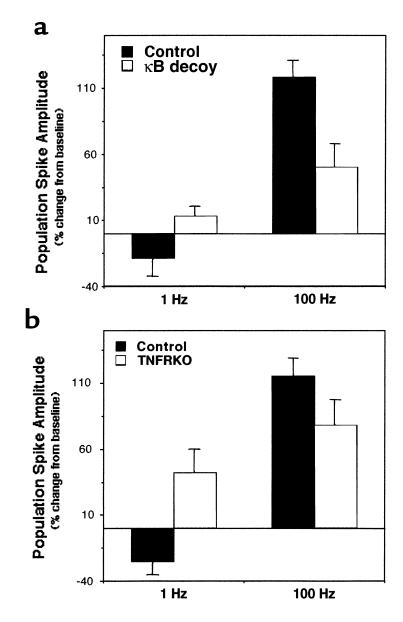
NF-κB in synaptic plasticity. (a) Population spike amplitudes recorded from hippocampal slices from adult mice, pretreated with either scrambled control DNA or κB decoy DNA and stimulated at either 1 or 100 Hz. Note that κB decoy DNA prevents LTD of synaptic transmission induced by stimulation at 1 Hz and attenuated long-term enhancement of synaptic transmission induced by stimulation at 100 Hz. (b) Population spike responses recorded from hippocampal slices from wild-type mice (Control) and mice lacking TNF-α receptors (TNFRKO) after stimulation at either 1 or 100 Hz. Note that LTD of synaptic transmission is not induced by stimulation at 1 Hz in slices from TNFRKO mice, and that long-term enhancement of synaptic transmission is attenuated in slices from TNFRKO mice. Modified from ref..
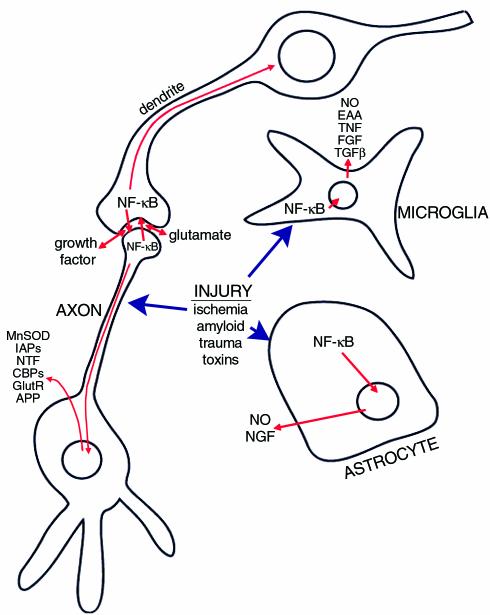
Complex roles for NF-κB in integrating signaling between and within neurons and glial cells. Following brain injury, NF-κB is activated in neurons and glial cells (astrocytes and microglia). Activation of NF-κB in neurons induces production of antiapoptotic gene products and proteins involved in modulating synaptic plasticity. Activation of NF-κB in glial cells results in production of proinflammatory cytokines, and potentially neurotoxic reactive oxygen species and excitotoxins. APP, amyloid precursor protein; CBPs, calcium-binding proteins; EAA, excitatory amino acid; GlutR, glutamate receptors; IAP, inhibitor-of-apoptosis proteins; NO, nitric oxide; NTF, neurotrophic factor.
References
-
- Baeuerle P, Baltimore D. NF-κB: ten years after. Cell. 1996; 87:13–20. - PubMed
-
- O’Neill LA, Kaltschmidt C. NF-kappa B: a crucial transcription factor for glial and neuronal cell function. Trends Neurosci. 1997; 20:252–258. - PubMed
-
- Moerman AM, Mao X, Lucas MM, Barger SW. Characterization of a neuronal κB-binding factor distinct from NF-κB. Brain Res Mol Brain Res. 1999; 67:303–315. - PubMed
-
- Bruce AJ, et al. Altered neuronal and microglial responses to brain injury in mice lacking TNF receptors. Nat Med. 1996; 2:788–794. - PubMed
-
- Carter BD, et al. Selective activation of NF-κB by nerve growth factor through the neurotrophin receptor p75. Science. 1996; 272:542–545. - PubMed
Publication types
MeSH terms
Substances
LinkOut - more resources
Full Text Sources
Other Literature Sources
Medical
