


Age-dependent changes in brain, CSF, and plasma amyloid (beta) protein in the Tg2576 transgenic mouse model of Alzheimer's disease
- PMID: 11160418
- PMCID: PMC6763819
- DOI: 10.1523/JNEUROSCI.21-02-00372.2001
Age-dependent changes in brain, CSF, and plasma amyloid (beta) protein in the Tg2576 transgenic mouse model of Alzheimer's disease
Abstract
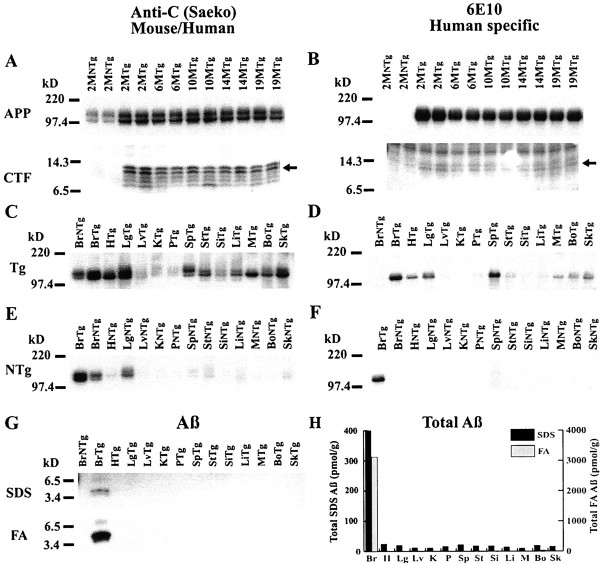
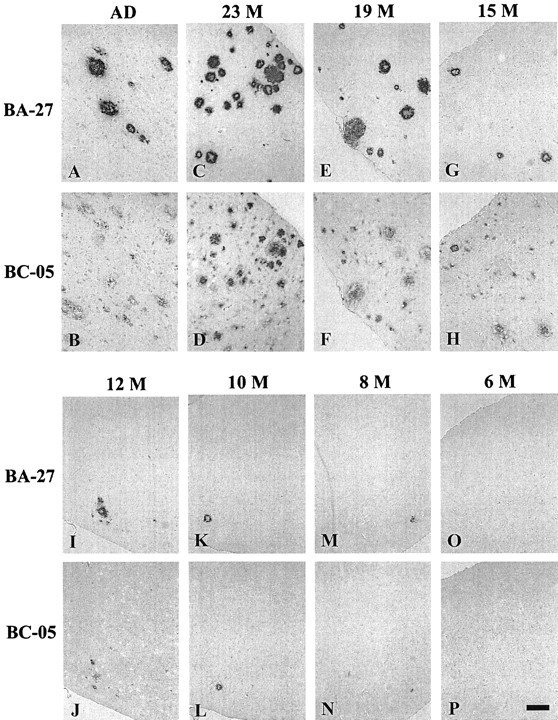
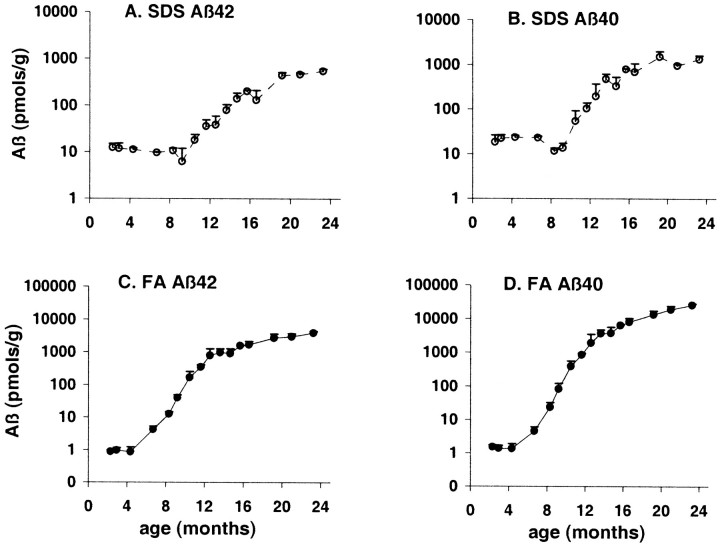
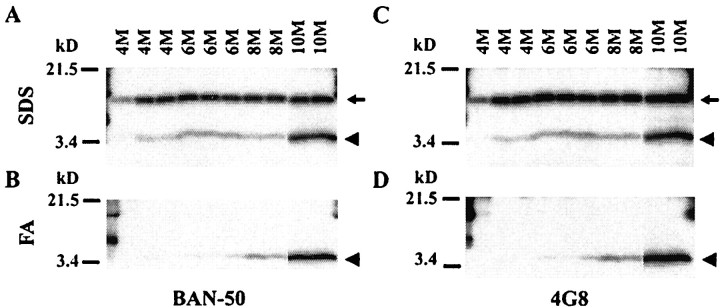
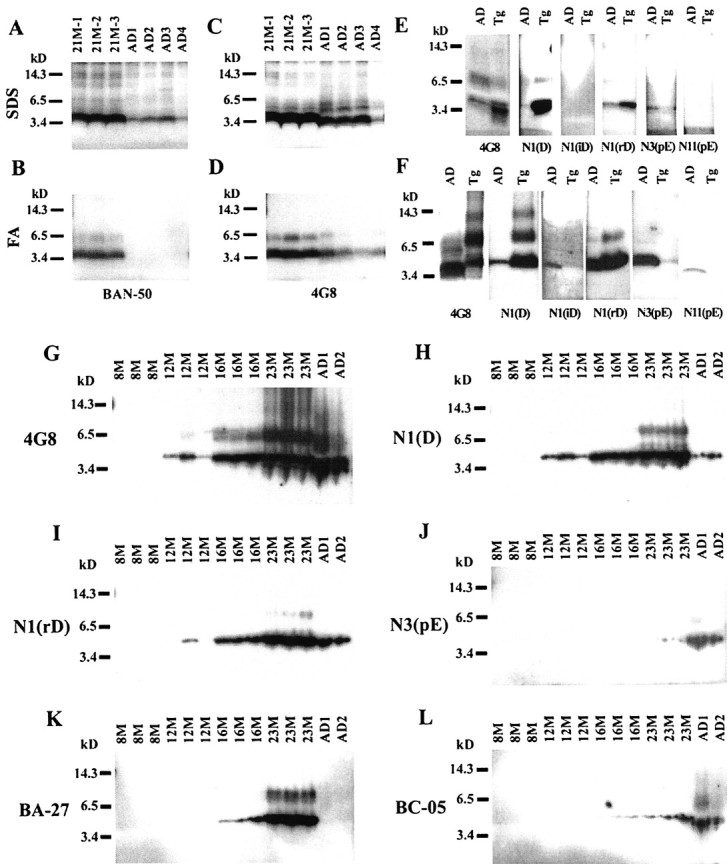
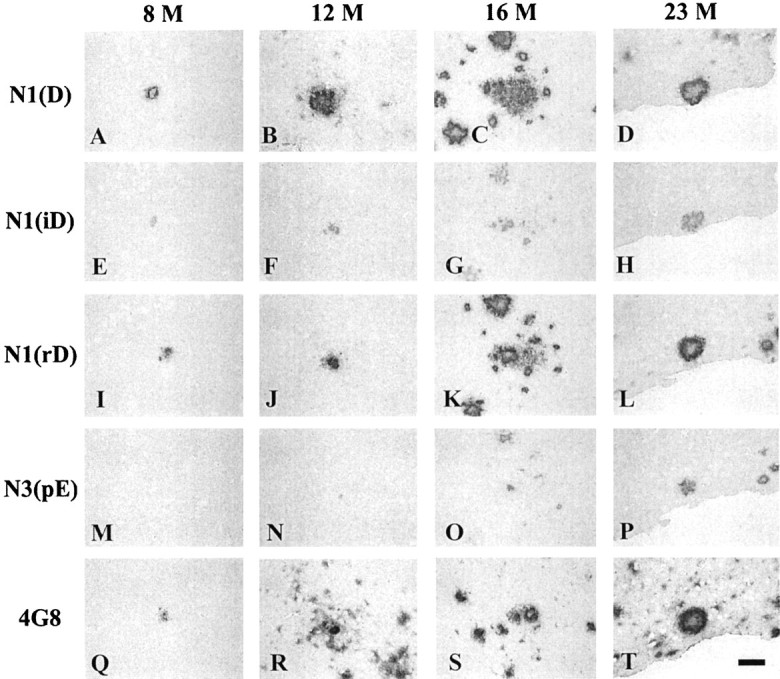
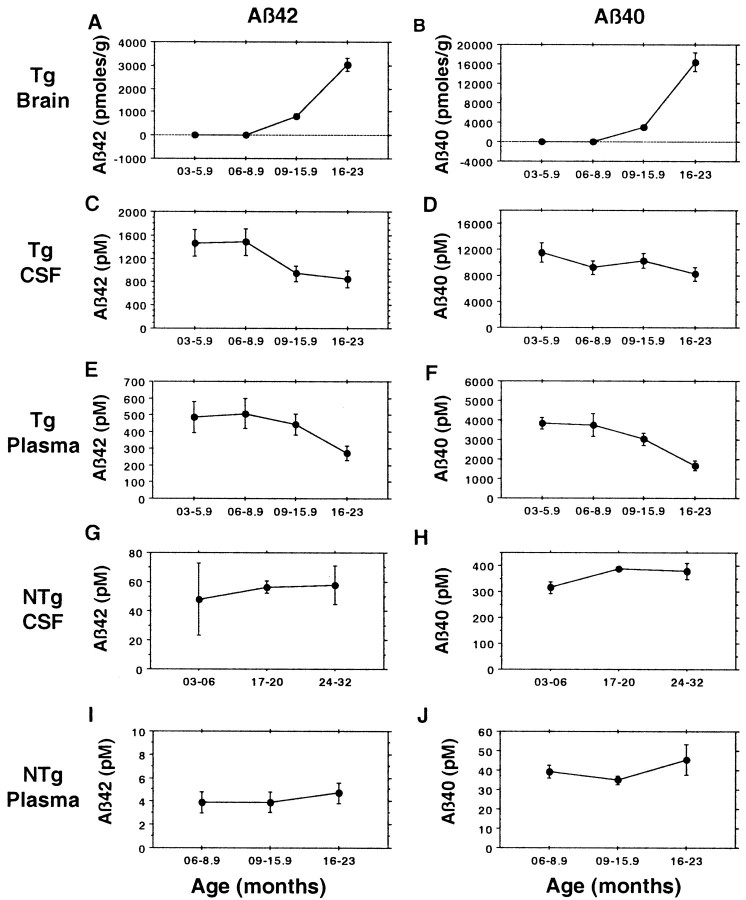
The accumulation of amyloid beta protein (Abeta) in the Tg2576 mouse model of Alzheimer's disease (AD) was evaluated by ELISA, immunoblotting, and immunocytochemistry. Changes in Abeta begin at 6-7 months as SDS-insoluble forms of Abeta42 and Abeta40 that require formic acid for solubilization appear. From 6 to 10 months, these insoluble forms increase exponentially. As insoluble Abeta appears, SDS-soluble Abeta decreases slightly, suggesting that it may be converting to an insoluble form. Our data indicate that it is full-length unmodified Abeta that accumulates initially in Tg2576 brain. SDS-resistant Abeta oligomers and most Abeta species that are N-terminally truncated or modified develop only in older Tg2576 mice, in which they are present at levels far lower than in human AD brain. Between 6 and 10 months, when SDS-insoluble Abeta42 and Abeta40 are easily detected in every animal, histopathology is minimal because only isolated Abeta cores can be identified. By 12 months, diffuse plaques are evident. From 12 to 23 months, diffuse plaques, neuritic plaques with amyloid cores, and biochemically extracted Abeta42 and Abeta40 increase to levels like those observed in AD brains. Coincident with the marked deposition of Abeta in brain, there is a decrease in CSF Abeta and a substantial, highly significant decrease in plasma Abeta. If a similar decline occurs in human plasma, it is possible that measurement of plasma Abeta may be useful as a premorbid biomarker for AD.
Figures
References
-
- Andreasen N, Hesse C, Davidsson P, Minthon L, Wallin A, Winblad B, Vanderstichele H, Vanmechelen E, Blennow K. Cerebrospinal fluid β-amyloid(1–42) in Alzheimer disease: differences between early- and late-onset Alzheimer disease and stability during the course of disease. Arch Neurol. 1999;56:673–680. - PubMed
-
- Borchelt DR, Thinakaran G, Eckman CB, Lee MK, Davenport F, Ratovitsky T, Prada CM, Kim G, Seekins S, Yager D, Slunt HH, Wang R, Seeger M, Levey AI, Gandy SE, Copeland NG, Jenkins NA, Price DL, Younkin SG, Sisodia SS. Familial Alzheimer's disease-linked presenilin 1 variants elevate Aβ1–42/1–40 ratio in vitro and in vivo. Neuron. 1996;17:1005–1013. - PubMed
-
- Cai XD, Golde TE, Younkin SG. Release of excess amyloid β protein from a mutant amyloid β protein precursor. Science. 1993;259:514–517. - PubMed
-
- Carp RI, Davidson AL, Merz PA. A method for obtaining cerebrospinal fluid from mice. Res Vet Sci. 1971;12:499. - PubMed
-
- Chapman PF, White GL, Jones MW, Cooper-Blacketer D, Marshall VJ, Irizarry M, Younkin L, Good MA, Bliss TVP, Hyman BT, Younkin SG, Hsiao KK. Impaired synaptic plasticity and learning in aged amyloid precursor protein transgenic mice. Nat Neurosci. 1999;2:271–276. - PubMed
Publication types
MeSH terms
Substances
Grants and funding
LinkOut - more resources
Full Text Sources
Other Literature Sources
Medical
Molecular Biology Databases
