. 2001 Feb 1;29(3):662-7.
doi: 10.1093/nar/29.3.662.

RAD51 supports spontaneous non-homologous recombination in mammalian cells, but not the corresponding process induced by topoisomerase inhibitors

Affiliations

RAD51 supports spontaneous non-homologous recombination in mammalian cells, but not the corresponding process induced by topoisomerase inhibitors

C Arnaudeau et al. Nucleic Acids Res. .

Abstract

The RAD51 protein has been shown to participate in homologous recombination by promoting ATP-dependent homologous pairing and strand transfer reactions. In the present study, we have investigated the possible involvement of RAD51 in non-homologous recombination. We demonstrate that overexpression of CgRAD51 enhances the frequency of spontaneous non-homologous recombination in the hprt gene of Chinese hamster cells. However, the rate of non-homologous recombination induced by the topoisomerase inhibitors campothecin and etoposide was not altered by overexpression of RAD51. These results indicate that the RAD51 protein may perform a function in connection with spontaneous non-homologous recombination that is not essential to or not rate-limiting for non-homologous recombination induced by camptothecin or etoposide. We discuss the possibility that the role played by RAD51 in non-homologous recombination observed here may not be linked to non-homologous end-joining.


Figures
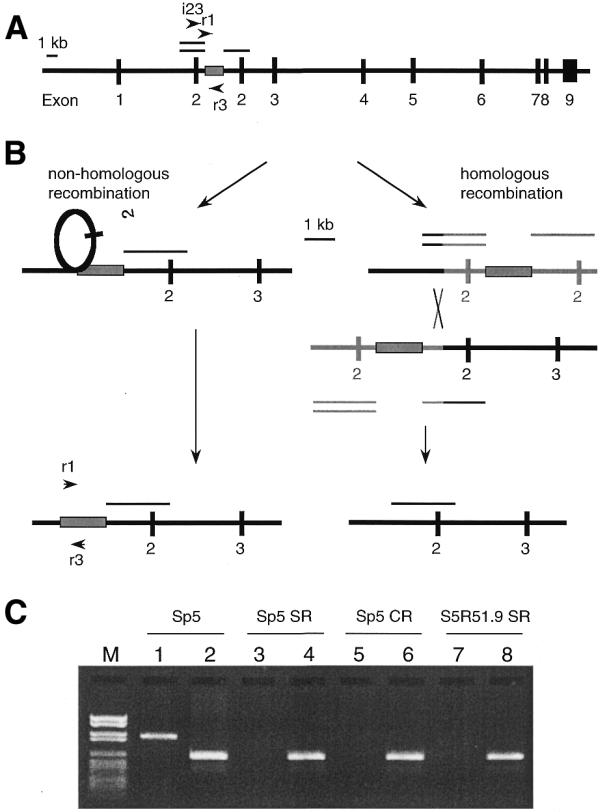
Figure 1
Figure 1
Molecular mechanisms for reversion of the hprt gene in Sp5 cells to wild-type. (A) Duplication of exon 2 in the hprt gene of the Sp5 cell line results in a non-functional gene, which can be selected for on the basis of its [HPRT] phenotype. The single line designates the parental region, while the double lines indicate the duplicated copy of exon 2 together with flanking intron regions (24,25). The box represents the sequence between the duplicated regions. Arrowheads indicate the primers employed. (B) Recombination pathways for reversion to a [HPRT]+ phenotype: if the reversion from a [HPRT] to a [HPRT]+ phenotype involves non-homologous recombination, the region represented by the box will be retained in the revertants. If homologous recombination is involved in this reversion event, this region will invariably be lost. (C) Lanes 1, 3, 5 and 7 contain the PCR products obtained employing the primers i23 and r3 together with DNA from Sp5 cells or from spontaneous (Sp5 SR), CPT-induced (Sp5 CR) Sp5 revertants or from spontaneous S5R51.9 revertants (S5R51.9 SR), respectively. This gel demonstrates that the duplicated exon 2 has been lost in all of these revertants. Lanes 2, 4, 6 and 8 contain the PCR products obtained employing the primers r1 and r3 together with DNA from Sp5 cells or from Sp5 SR, Sp5 CR or S5R51.9 SR, respectively, and demonstrate that the DNA region (boxed) is present in all of these revertants, i.e., that non-homologous recombination was involved in restoring the functional hprt gene. Identical results were obtained for all of the 32 revertants analysed. Marker VI (Boehringer Mannheim) was used as a size indicator. Thus, these data demonstrate that, in all revertants, the original duplication of exon 2 is lost, whereas the DNA region originally located between the duplicated regions (indicated by the box) is retained.
Figure 2
Figure 2
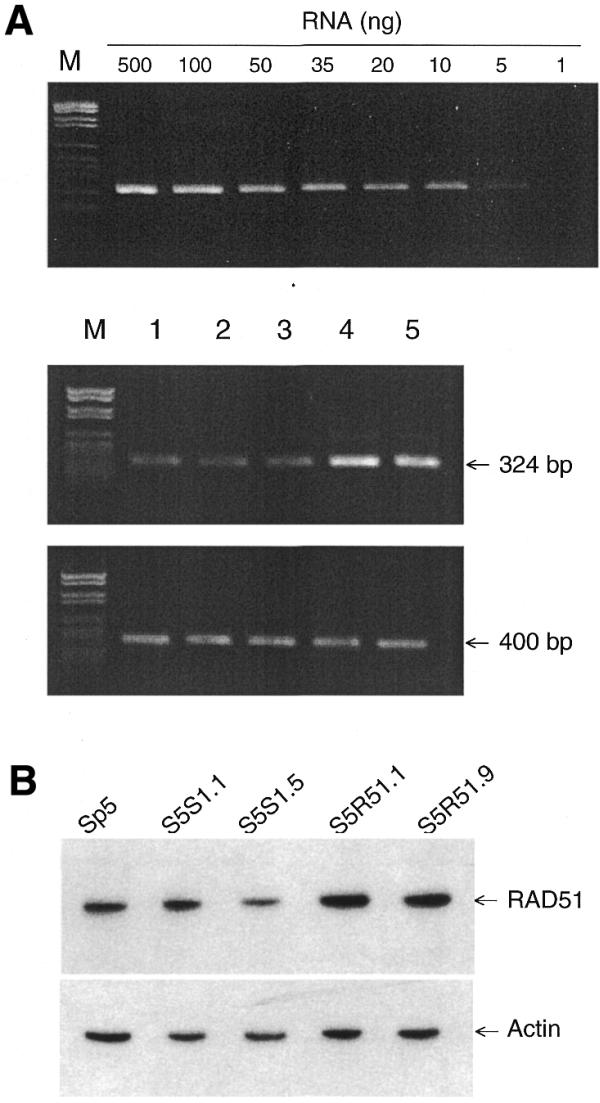
Overexpression of RAD51 in cell lines stably transfected with pZeoRAD51. Sp5 cells were stably transfected and plasmid integration into the genomic DNA verified employing methods described earlier (4). (A) A series of dilutions of total RNA were amplified by RT–PCR using the primers R51f1–R51r1 to ensure that the RT–PCR was quantitative. Overexpression of RAD51 was examined by RT–PCR using 5 ng of the total RNA isolated from Sp5, S5S1.1, S5S1.5, S5R51.1 and S5R51.9 cells (lanes 1–5, respectively), with the level of β-actin mRNA serving as a control, under conditions described previously (4). Marker VI (Boehringer Mannheim) was used as a size indicator. (B) Levels of RAD51 and actin proteins were quantitated by western blotting of extracts from Sp5, S5S1.1, S5S1.5, S5R51.1 and S5R51.9 cells. The overexpression level of CgRAD51 was determined as the ratio between CgRAD51 and actin in each cell line.
Figure 3
Figure 3
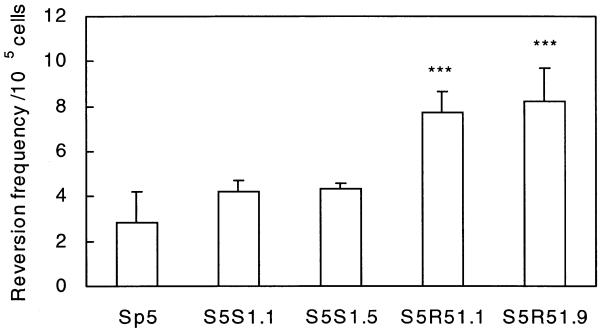
Increased frequency of spontaneous non-homologous recombination in cell lines overexpressing RAD51. The frequency of spontaneous non-homologous recombination in these cell lines was measured as the reversion to the [HPRT]+ phenotype. The S5R51.1 and S5R51.9 cell lines, which overexpress RAD51, demonstrated a statistically significant increase in the frequency of spontaneous non-homologous recombination compared to the control cell lines (***, P < 0.001 in both cases). The error bars indicate the standard deviations of values from four independent experiments.
Figure 4
Figure 4
Lack of influence of overexpression of RAD51 on the frequency of induced non-homologous recombination. The level of non-homologous recombination in cells treated over 24 h with (A) CPT or (B) etoposide. The reversion frequencies reflect the frequencies of recombinational events. The error bars indicate the standard errors of values from two independent experiments.

References

    1. Baumann P., Benson,F.E. and West,S.C. (1996) Human RAD51 protein promotes ATP-dependent homologous pairing and strand transfer reactions in vitro. Cell, 87, 757–766. - PubMed
    1. Xia S.J., Shammas,M.A. and Reis,R.J. (1997) Elevated recombination in immortal human cells is mediated by HsRAD51 recombinase. Mol. Cell. Biol., 17, 7151–7158. - PMC - PubMed
    1. Vispe S., Cazaux,C., Lesca,C. and Defais,M. (1998) Overexpression of Rad51 protein stimulates homologous recombination and increases resistance of mammalian cells to ionizing radiation. Nucleic Acids Res., 26, 2859–2864. - PMC - PubMed
    1. Arnaudeau C., Helleday,T. and Jenssen,D. (1999) The RAD51 protein supports homologous recombination by an exchange mechanism in mammalian cells. J. Mol. Biol., 289, 1231–1238. - PubMed
    1. Shinohara A., Ogawa,H., Matsuda,Y., Ushio,N., Ikeo,K. and Ogawa,T. (1993) Cloning of human, mouse and fission yeast recombination genes homologous to RAD51 and recA. Nature Genet., 4, 239–243. - PubMed

Publication types

MeSH terms