


Inhibition of poly(ADP-ribose) polymerase activity is insufficient to induce tetraploidy
- PMID: 11160908
- PMCID: PMC30380
- DOI: 10.1093/nar/29.3.841
Inhibition of poly(ADP-ribose) polymerase activity is insufficient to induce tetraploidy
Abstract
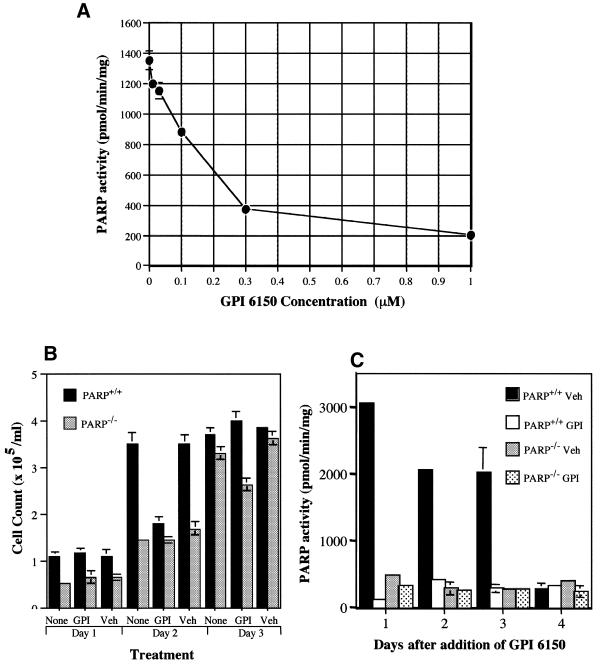
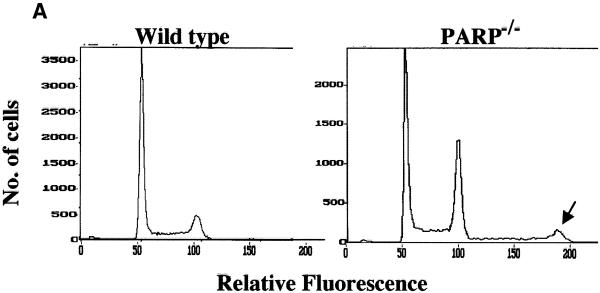
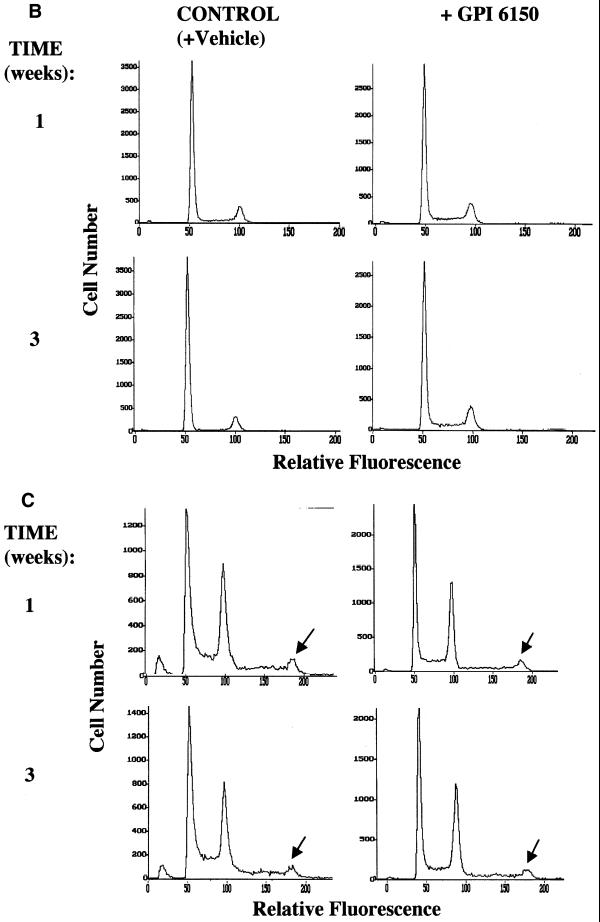
Poly(ADP-ribose) polymerase (PARP) knockout mice are resistant to murine models of human diseases such as cerebral and myocardial ischemia, traumatic brain injury, diabetes, Parkinsonism, endotoxic shock and arthritis, implicating PARP in the pathogenesis of these diseases. Potent selective PARP inhibitors are therefore being evaluated as novel therapeutic agents in the treatment of these diseases. Inhibition or depletion of PARP, however, increases genomic instability in cells exposed to genotoxic agents. We recently demonstrated the presence of a genomically unstable tetraploid population in PARP(-/-) fibroblasts and its loss after stable transfection with PARP cDNA. To elucidate whether the genomic instability is attributable to PARP deficiency or lack of PARP activity, we investigated the effects of PARP inhibition on development of tetraploidy. Immortalized wild-type and PARP(-/-) fibroblasts were exposed for 3 weeks to 20 microM GPI 6150 (1,11b-dihydro-[2H:]benzopyrano[4,3,2-de]isoquinolin-3-one), a novel small molecule specific competitive inhibitor of PARP (K(i) = 60 nM) and one of the most potent PARP inhibitors to date (IC(50) = 0.15 microM). Although GPI 6150 initially decreased cell growth in wild-type cells, there was no effect on cell growth or viability after 24 h. GPI 6150 inhibited endogenous PARP activity in wild-type cells by approximately 91%, to about the residual levels in PARP(-/-) cells. Flow cytometric analysis of unsynchronized wild-type cells exposed for 3 weeks to GPI 6150 did not induce the development of tetraploidy, suggesting that, aside from its catalytic function, PARP may play other essential roles in the maintenance of genomic stability.
Figures


References
-
- Wang Z.Q., Auer,B., Stingl,L., Berghammer,H., Haidacher,D., Schweiger,M. and Wagner,E.F. (1995) Mice lacking ADPRT and poly(ADP-ribosyl)ation develop normally but are susceptible to skin disease. Genes Dev., 9, 509–520. - PubMed
-
- de Murcia J., Niedergang,C., Trucco,C., Ricoul,M., Dutrillaux,B., Mark,M., Oliver,J., Masson,M., Dierich,A., LeMeur,M., Waltzinger,C., Chambon,P. and de Murcia,G. (1997) Requirement of poly(ADP-ribose) polymerase in recovery from DNA damage in mice and men. Proc. Natl Acad. Sci. USA, 94, 7303–7307. - PMC - PubMed
-
- Eliasson M., Sampei,K., Mandir,A., Hurn,P., Traystman,R., Bao,J., Pieper,A., Wang,Z.Q., Dawson,T., Snyder,S. and Dawson,V. (1997) Poly(ADP-ribose) polymerase gene disruption renders mice resistant to cerebral ischemia. Nature Med., 3, 1089–1095. - PubMed
-
- Endres M., Wang,Z.Q., Namura,S., Waeber,C. and Moskowitz,M. (1997) Ischemic brain injury is mediated by the activation of poly(ADP-ribose) polymerase. J. Cereb. Blood Flow Metab., 17, 1143–1151. - PubMed
-
- Whalen M., Clark,R., Dixon,C., Robichaud,P., Marion,D., Vagni,V., Graham,S., Virag,L., Hasko,G., Stachlewitz,R., Szabo,C. and Kochanek,P. (1999) Reduction of cognitive and motor deficits after traumatic brain injury in mice deficient in poly(ADP-ribose) polymerase. J. Cereb. Blood Flow Metab., 19, 835–842. - PubMed
Publication types
MeSH terms
Substances
Grants and funding
LinkOut - more resources
Full Text Sources
Other Literature Sources
Molecular Biology Databases
