


doi: 10.1093/nar/29.4.e24.
A novel multiple affinity purification tag and its use in identification of proteins associated with a cyclin-CDK complex
Affiliations
- PMID: 11160944
- PMCID: PMC29631
- DOI: 10.1093/nar/29.4.e24
Item in Clipboard
A novel multiple affinity purification tag and its use in identification of proteins associated with a cyclin-CDK complex
Nucleic Acids Res.
.
Abstract
A novel multiple affinity purification (MAFT) or tandem affinity purification (TAP) tag has been constructed. It consists of the calmodulin binding peptide, six histidine residues, and three copies of the hemagglutinin epitope. This 'CHH' MAFT tag allows two or three consecutive purification steps, giving high purity. Active Clb2-Cdc28 kinase complex was purified from yeast cells after inserting the CHH tag into Clb2. Associated proteins were identified using mass spectrometry. These included the known associated proteins Cdc28, Sic1 and Cks1. Several other proteins were found including the 70 kDa chaperone, Ssa1.
Figures
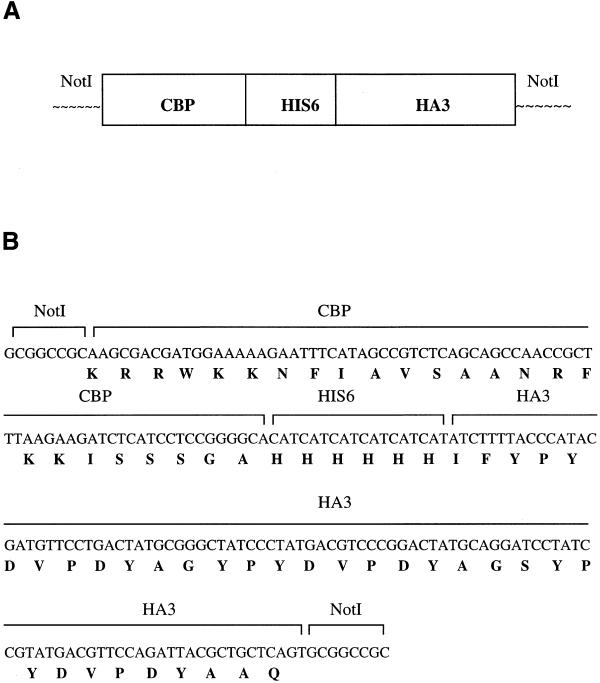
The structure (A)
and sequence (B) of TAP tag (CHH) consisting of
calmodulin binding peptide (CBP), six histidine residues (HIS6),
and three copies of the hemagglutinin epitope (HA3), flanked by NotI sites.
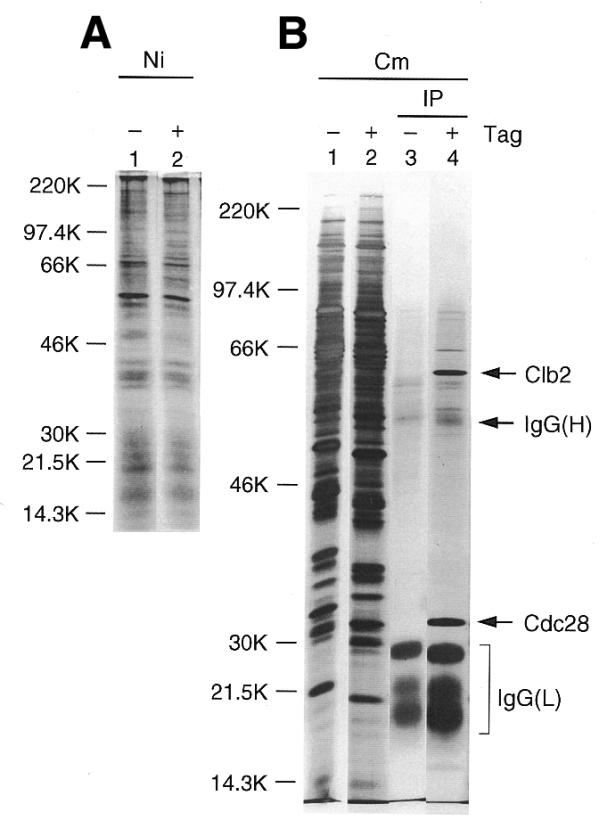
TAP of Clb2–Cdc28
complex. Untagged Clb2 (odd-numbered lanes) and Clb2-CHH (even-numbered
lanes) were expressed under the control of the GAL promoter
in strains YSH16 and YSH19. (A) Untagged (lane
1) or tagged (lane 2) cell extracts were purified on a nickel (Ni)
affinity resin, and visualized after 10% SDS–PAGE
and silver staining. (B) Untagged (lane 1) or tagged
(lane 2) cell extracts were purified on a calmodulin (Cm) affinity
resin. Pooled eluted fractions from the calmodulin affinity resin
were further purified by immunoprecipitation (IP) with 12CA5 monoclonal
antibody on protein A beads (lane 3, untagged control; lane 4, Clb2-CHH).
Proteins were separated using 10% SDS–PAGE and
visualized by silver staining. Most of the material visible in lane
3 is heavy (H) or light (L) chain IgG.
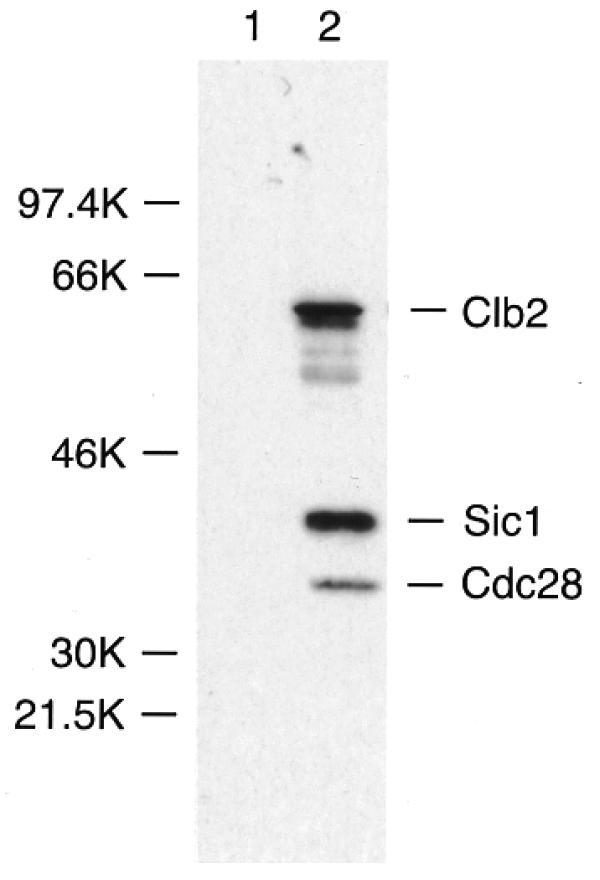
Western analysis of proteins
associated with Clb2–Cdc28 complex. Cell extracts prepared
from untagged Clb2 (lane 1) and Clb2-CHH (lane 2) were subjected
to sequential purifications on calmodulin affinity resin followed
by immunoprecipitation with 12CA5 monoclonal antibody on protein
A beads. Immunoprecipitates were applied to 10% SDS–PAGE
gels and immunoblotted with antibodies against HA (monoclonal 12CA5),
Sic1 (rabbit polyclonal) and Cdc28 (rabbit polyclonal).
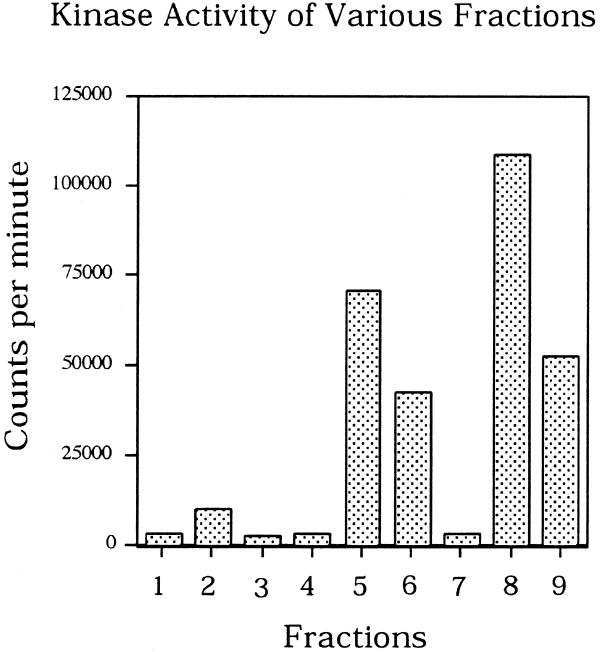
Kinase activity of various
fractions. Untagged (fractions 1–3) or CHH-tagged Clb2
(fractions 4–9) was purified by binding to calmodulin or
nickel resin, eluted, then immunoprecipitated with 12CA5. Equal
proportions of various fractions were assayed for protein kinase
activity using [γ-32P]ATP,
peptide substrates and a filter binding assay (Materials and Methods).
Fraction 1, untagged Clb2, flow-through from calmodulin resin. Fraction
2, untagged Clb2, eluate from calmodulin resin. Fraction 3, untagged
Clb2, immunoprecipitate (IP) of eluate. Fraction 4, Clb2-CHH, flow-through
from calmodulin resin. Fraction 5, Clb2-CHH, eluate from calmodulin
resin. Fraction 6, Clb2-CHH, IP of eluate from calmodulin resin.
Fraction 7, Clb2-CHH, flow-through from nickel resin. Fraction 8,
Clb2-CHH, eluate from nickel resin. Fraction 9, IP of eluate from
nickel resin. The data are means of triplicate determinations. Standard
deviation in each case was <15% of the mean.
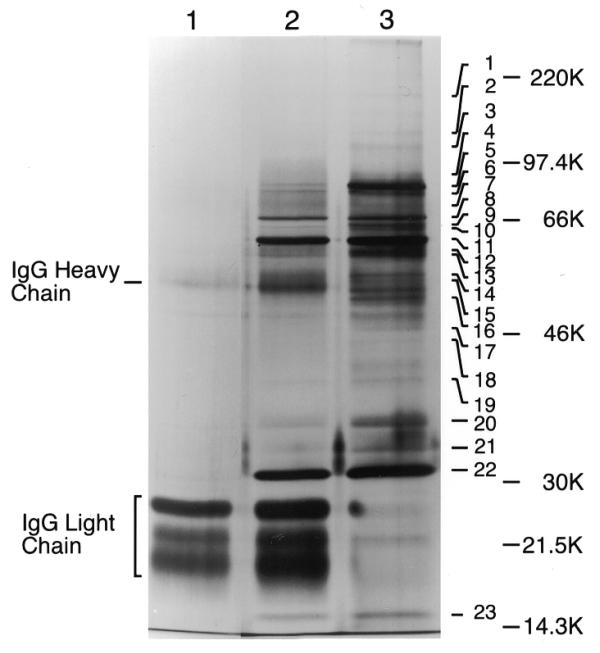
Resolution of TAP Clb2–Cdc28
complex on silver-stained gel. Extracts from 12 l cultures of yeast
strains YSH16, YSH19 and YSH24 carrying untagged Clb2 and Cdc28
(lane 1), Clb2-CHH and Cdc28 (lane 2), or Clb2-CHH, Cdc28 and Cdc28K40R
(lane 3), respectively, were purified on calmodulin affinity resin and
then immunoprecipitated with 12CA5 monoclonal antibody. Purified
proteins were resolved using 10% SDS–PAGE and
proteins were visualized by silver staining. Silver-stained protein
band nos 1–23 (lane 3) were excised, digested with trypsin
and fragments were used for the identification of proteins by mass
spectrometry.
References
-
- Sugano S., Kim,D.W., Yu,Y.S., Mizushima-Sugano,J., Yoshitomo,K., Watanabe,S., Suzuki,F. and Yamaguchi,N. (1992) Use of an epitope-tagged cDNA library to isolate cDNAs encoding proteins with nuclear localization potential. Gene, 120, 227–233. - PubMed
-
- Reisdorf P., Maarse,A.C. and Daignan-Fornier,B. (1993) Epitope-tagging vectors designed for yeast. Curr. Genet., 23, 181–183. - PubMed
Publication types
MeSH terms
Substances
Grants and funding
LinkOut - more resources
Full Text Sources
Other Literature Sources
Molecular Biology Databases
Miscellaneous
