Comparative Study
. 2001 Feb;125(2):595-603.
doi: 10.1104/pp.125.2.595.

Involvement of a nuclear-encoded basic helix-loop-helix protein in transcription of the light-responsive promoter of psbD

Affiliations
Comparative Study

Involvement of a nuclear-encoded basic helix-loop-helix protein in transcription of the light-responsive promoter of psbD

K Baba et al. Plant Physiol. 2001 Feb.

Abstract

In the chloroplast psbD light-responsive promoter (LRP), a highly conserved sequence exists upstream from the bacterial -10/-35 elements. Multiple sequence-specific DNA binding proteins are predicted to bind to the conserved sequence as transcription factors. Using yeast one-hybrid screening of an Arabidopsis cDNA library, a possible DNA binding protein of the psbD LRP upstream sequence was identified. The protein, designated PTF1, is a novel protein of 355 amino acids (estimated molecular weight of 39.6) that contains a basic helix-loop-helix DNA binding motif in the predicted N-terminal region of the mature protein. Transient expression assay of PTF1-GFP fusion protein showed that PTF1 was localized in chloroplasts. Using the modified DNA sequence in the one-hybrid system, the ACC repeat was shown to be essential for PTF1 binding. The rate of psbD LRP mRNA accumulation was reduced in a T-DNA-inserted Arabidopsis ptf1 mutant. Compared with wild-type plants, the mutant had pale green cotyledons and its growth was inhibited under short-day conditions. These results suggest that PTF1 is a trans-acting factor of the psbD LRP.


Figures
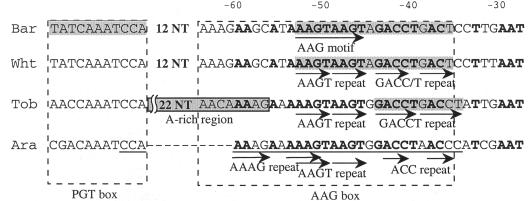
Figure 1
Figure 1
Characteristics of the psbD LRP upstream sequences of four higher plants. Sequences from barley (Bar), wheat (Wht), tobacco (Tob), and Arabidopsis (Ara) are shown. The numbers on top represent the distance from the psbD LRP transcription start site. The nucleotides that are conserved among the four species are indicated with bold letters. The protein binding sequences are shadowed. The sequence that was used as the target sequence in the one-hybrid system is underlined.
Figure 2
Figure 2
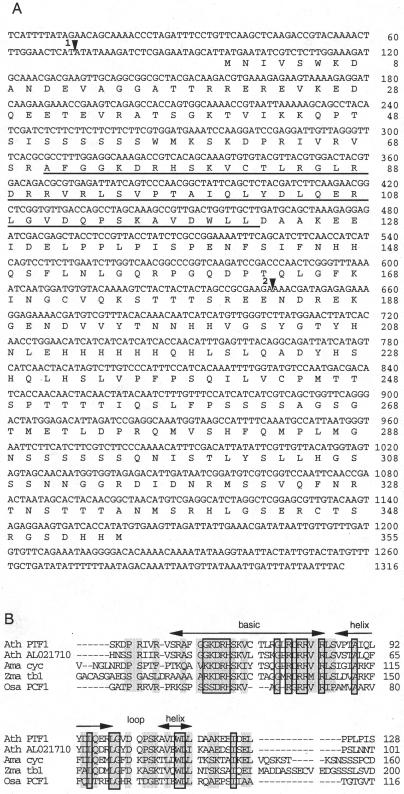
Sequence analysis of Arabidopsis PTF1 cDNA. A, Nucleotide sequence and deduced amino acid sequence of Arabidopsis PTF1 cDNA. The conserved bHLH region is underlined. Arrowhead 1, The position of the intron in 5′-untranslated region found by comparison with the genomic sequence; arrowhead 2, the T-DNA-insertion position of the ptf1 mutant. The GenBank accession number is AB014465. B, Sequence alignment of the conserved regions of PTF1 and four other proteins: Ath AL021710, Arabidopsis teosinte branched1-like protein; Ama cyc, Antirrhinum majus cycloidea protein; Zma tb1, Zea mays branched1 protein; and Osa PCF1, Oryza sativa PCF1. Residues conserved in all five proteins and in more than three proteins are boxed and shadowed, respectively.
Figure 3
Figure 3
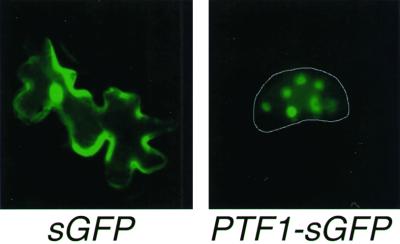
Chloroplast localization of the PTF1-sGFP (S65T) fusion protein in tobacco leaf epidermal cells. Detached tobacco leaves were bombarded with constructs carrying 35S-sGFP(S65T) (left) or 35S-PTF1-sGFP(S65T) (right). The epidermal cells were observed by fluorescence microscopy after a 24-h incubation.
Figure 4
Figure 4
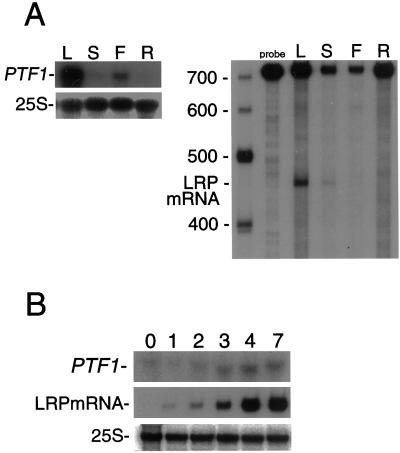
Tissue-specific and light-dependent expression of PTF1 and psbD LRP mRNA. A, Accumulation of PTF1 and 25S rRNA detected by RNA gel-blot analysis (left) and psbD LRP mRNA detected by S1 protection assay (right) in different tissues. L, leaves; S, stems; F, flowers; R, roots. B, Accumulation of PTF1 and 25S rRNA (RNA gel-blot analysis) and psbD LRP mRNA (S1 protection assay) in seedlings grown in the dark for 3 d (0) and further illuminated for the indicated number of days (1–7).
Figure 5
Figure 5
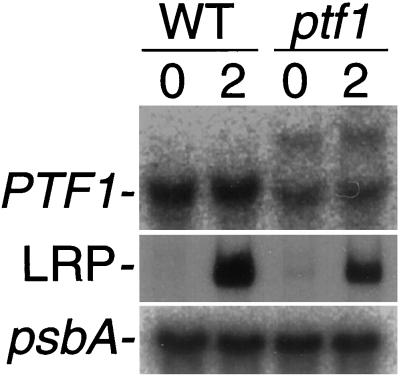
Light response of PTF1 and psbD LRP mRNA in dark-adapted mature plants. Wild-type (WT) and ptf1 mutant (ptf1) Arabidopsis plants were grown for 14 d under continuous light and harvested after 2 d of dark adaptation (0) or following illumination for 2 h (2). PTF1 and psbA mRNAs were detected by RNA gel-blot analysis, and psbD LRP mRNA was detected by S1 protection assay.
Figure 6
Figure 6
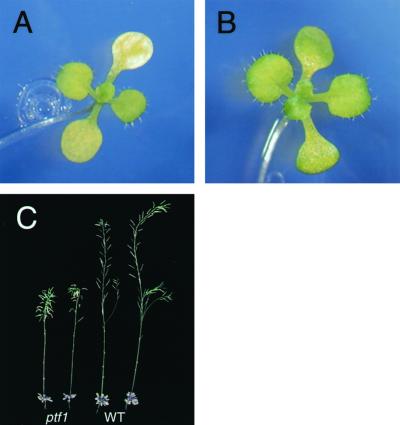
Phenotype of the ptf1 mutant grown under short-day condition. A, Twenty-one-day-old wild-type plant. B, Twenty-one-day-old ptf1 mutant with pale green cotyledons. C, Seventy-five-day-old mature wild-type and ptf1 mutant plants.

References

    1. Allison LA, Maliga P. Light-responsive and transcription-enhancing elements regulate the plastid psbD core promoter. EMBO J. 1995;14:3721–3730. - PMC - PubMed
    1. Baginsky S, Tiller K, Link G. Transcription factor phosphorylation by a protein kinase associated with chloroplast RNA polymerase from mustard (Sinapis alba) Plant Mol Biol. 1997;34:181–189. - PubMed
    1. Chiu W, Niwa Y, Zeng W, Hirano T, Kobayashi H, Sheen J. Engineered GFP as a vital reporter in plants. Curr Biol. 1996;6:325–330. - PubMed
    1. Christopher DA, Kim M, Mullet JE. A novel light-regulated promoter is conserved in cereal and dicot chloroplasts. Plant Cell. 1992;4:785–798. - PMC - PubMed
    1. Christopher DA, Mullet JE. Separate photosensory pathways co-regulate blue light/ultraviolet-A-activated psbD-psbC transcription and light-induced D2 and CP43 degradation in barley (Hordeum vulgare) chloroplasts. Plant Physiol. 1994;104:1119–1129. - PMC - PubMed

Publication types

MeSH terms