. 2001 Feb;125(2):779-86.
doi: 10.1104/pp.125.2.779.

Cavitation fatigue. Embolism and refilling cycles can weaken the cavitation resistance of xylem

Affiliations

Cavitation fatigue. Embolism and refilling cycles can weaken the cavitation resistance of xylem

U G Hacke et al. Plant Physiol. 2001 Feb.

Abstract

Although cavitation and refilling cycles could be common in plants, it is unknown whether these cycles weaken the cavitation resistance of xylem. Stem or petiole segments were tested for cavitation resistance before and after a controlled cavitation-refilling cycle. Cavitation was induced by centrifugation, air drying of shoots, or soil drought. Except for droughted plants, material was not significantly water stressed prior to collection. Cavitation resistance was determined from "vulnerability curves" showing the percentage loss of conductivity versus xylem pressure. Two responses were observed. "Resilient" xylem (Acer negundo and Alnus incana stems) showed no change in cavitation resistance after a cavitation-refilling cycle. In contrast, "weakened" xylem (Populus angustifolia, P. tremuloides, Helianthus annuus stems, and Aesculus hippocastanum petioles) showed considerable reduction in cavitation resistance. Weakening was observed whether cavitation was induced by centrifugation, air dehydration, or soil drought. Observations from H. annuus showed that weakening was proportional to the embolism induced by stress. Air injection experiments indicated that the weakened response was a result of an increase in the leakiness of the vascular system to air seeding. The increased air permeability in weakened xylem could result from rupture or loosening of the cellulosic mesh of interconduit pit membranes during the water stress and cavitation treatment.


Figures
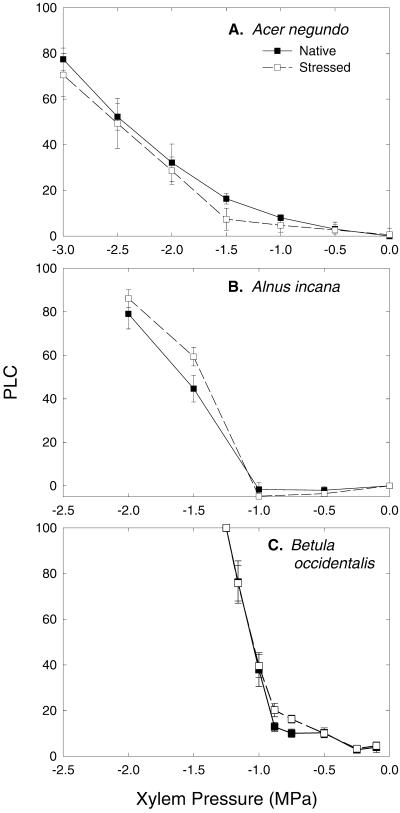
Figure 1
Figure 1
Native (▪) versus stressed (□) vulnerability curves showing the resilient response of stem xylem in Acer negundo, Alnus incana, and B. occidentalis. Curves show the PLC with decreasing xylem pressure. Native and stressed curves were similar (t test, P > 0.05). Means and se, n = 6. B. occidentalis curves are from Alder et al. (1997).
Figure 2
Figure 2
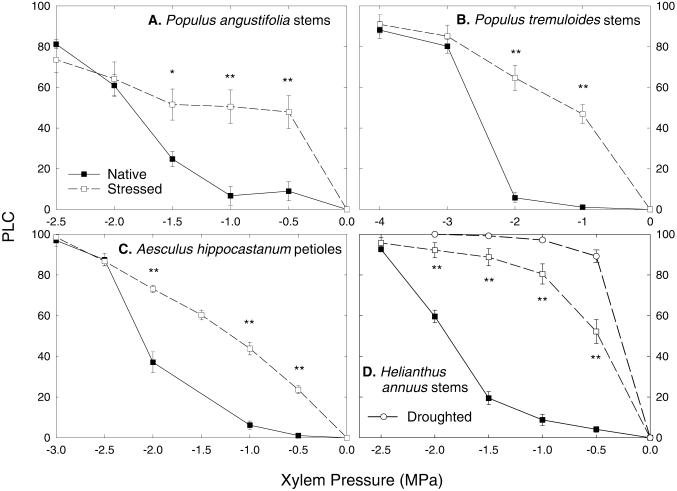
Native (▪) versus stressed (□) vulnerability curves showing the weakened response seen in xylem of P. angustifolia, P. tremuloides, A. hippocastanum, and H. annuus. All data is for stem xylem except for petioles in A. hippocastanum. Means and se, n = 6. Stressed xylem was significantly more vulnerable to embolism than the non-stressed native xylem (t test; * P < 0.05; ** P < 0.01). Stems of H. annuus that were stressed in droughted plants to a native PLC >95% also exhibited a weakening response (D, compare open circles for droughted stems with open squares for centrifuged stems).
Figure 3
Figure 3
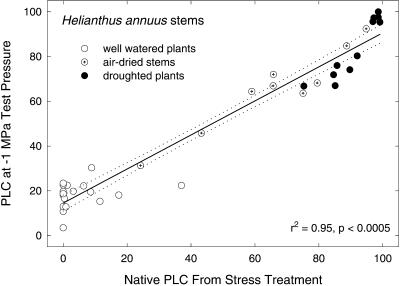
Relationship between Native PLC from a water-stress treatment versus the PLC at test pressure of −1.0 MPa in H. annuus stems. The greater the PLC caused by stress, the more extensive the weakening response as indicated by greater PLC at the test pressure. ○, Stems from well-watered plants where water stress was minimal and native PLC was generally below 20%. A subset of these stems with <5 PLC were used to generate the native and stressed curves in Figure 2D. ●, Stems from droughted plants where water stress caused >70 PLC. A subset of these stems with PLC >95% were used to generate the droughted stem curve in Figure 2D. ⊕, Excised stems that were air dried to varying PLC values as shown. Dotted lines show 95% confidence intervals for the regression.
Figure 4
Figure 4
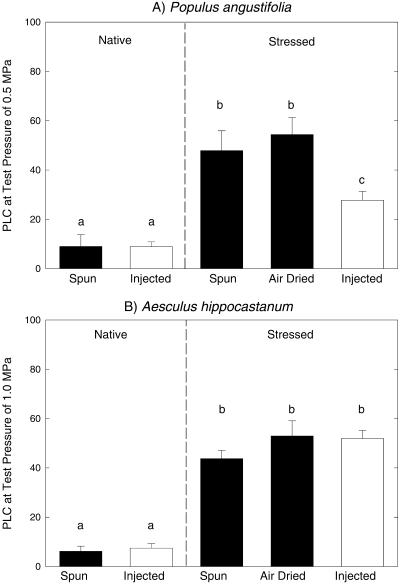
PLC in stem (P. angustifolia, A) and petiole (A. hippocastanum, B) segments at the indicated test pressure (see Fig. 6, procedure 2) for the centrifuge method (black bars) and the air injection method (open bars, injected). Results shown for native segments (left) and separate stressed segments (right). Stressed segments were dehydrated to a stress pressure of −2.5 MPa and refilled. Dehydration was achieved by centrifugation (spun, injected) or air drying (air dried). Treatments with same letters were not different (P > 0.05; lsd test). Means and se, n = 5 to 12.
Figure 5
Figure 5
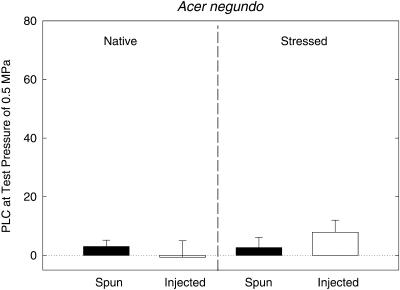
PLC in stem segments of A. negundo at a test pressure of −0.5 MPa for the centrifuge method (solid bars, spun) and the air injection method (open bars, injected). Results shown for native segments (left) and separate stressed segments (right). Stressed segments were dehydrated in the centrifuge to −3 MPa and refilled. Treatments were not different (P > 0.05; lsd test).
Figure 6
Figure 6
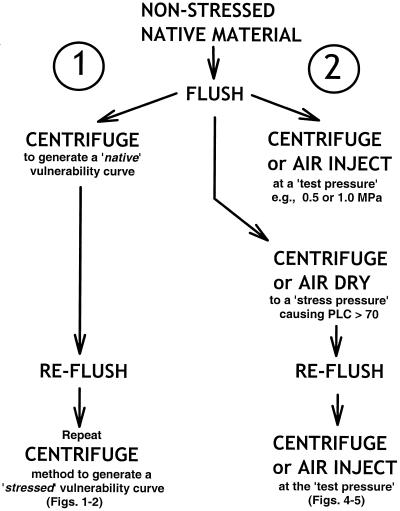
Summary of procedures used to assay the effect of water stress on cavitation resistance. Both began with non-stressed native material that was flushed to remove any native PLC. In procedure 1 (e.g. results in Figs. 1 and 2), the centrifuge method was used to generate a “native” vulnerability curve, material was re-flushed, and then a second “stressed” vulnerability curve was completed. In procedure 2 (e.g. results in Figs. 4 and 5), PLC at a single “test” pressure (usually 0.5 or 1.0 MPa) induced by centrifugation or air injection was measured with or without the stems having prior exposure to a “stress” pressure sufficient to cause >70 PLC. The stress pressure was applied using the centrifuge method or by air drying.

References

    1. Alder NN, Pockman WT, Sperry JS, Nuismer S. Use of centrifugal force in the study of xylem cavitation. J Exp Bot. 1997;48:665–674.
    1. Alder NN, Sperry JS, Pockman WT. Root and stem xylem embolism, stomatal conductance, and leaf turgor in Acer grandidentatum populations along a soil moisture gradient. Oecologia. 1996;105:293–301. - PubMed
    1. Crombie DS, Hipkins MF, Milburn JA. Gas penetration of pit membranes in the xylem of Rhododendron and other species. Planta. 1985;163:27–33. - PubMed
    1. Dawson TE, Ehleringer JR. Gender specific physiology, carbon isotope discrimination, and habitat distribution in boxelder (Acer negundo) Ecology. 1993;74:798–815.
    1. Dina SD. An evaluation of physiological response to water stress as a factor influencing the distribution of six woody species in Red Butte Canyon, Utah. PhD Thesis. Salt Lake City: University of Utah; 1970.

Publication types

LinkOut - more resources