


beta-Arrestin 1 and 2 differentially regulate heptahelical receptor signaling and trafficking
- PMID: 11171997
- PMCID: PMC29303
- DOI: 10.1073/pnas.98.4.1601
beta-Arrestin 1 and 2 differentially regulate heptahelical receptor signaling and trafficking
Abstract
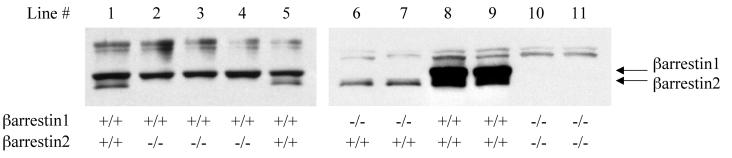
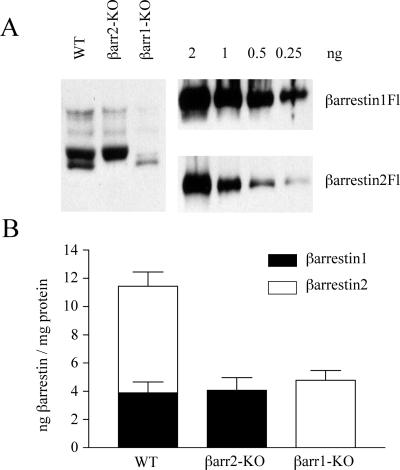
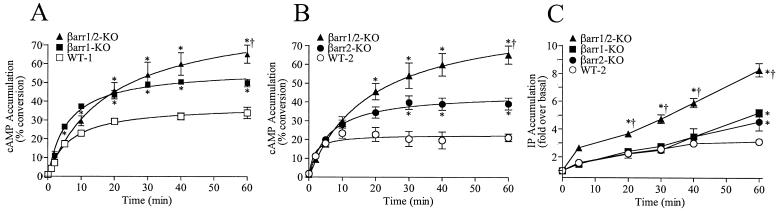
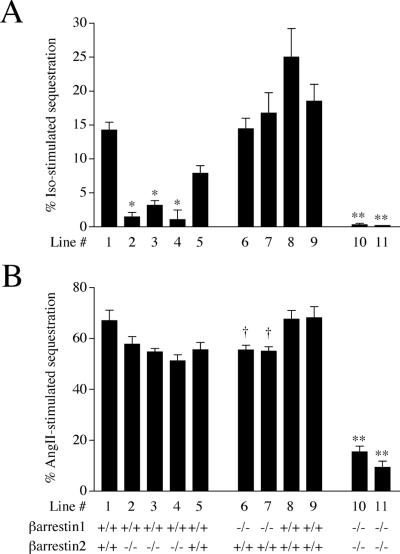
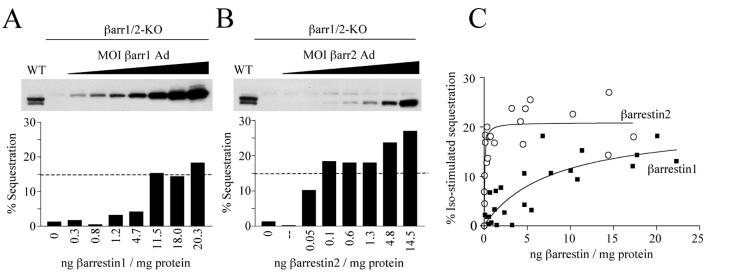
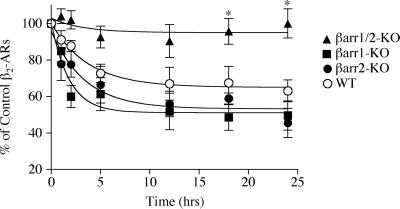
The two widely coexpressed isoforms of beta-arrestin (termed beta arrestin 1 and 2) are highly similar in amino acid sequence. The beta-arrestins bind phosphorylated heptahelical receptors to desensitize and target them to clathrin-coated pits for endocytosis. To better define differences in the roles of beta-arrestin 1 and 2, we prepared mouse embryonic fibroblasts from knockout mice that lack one of the beta-arrestins (beta arr1-KO and beta arr2-KO) or both (beta arr1/2-KO), as well as their wild-type (WT) littermate controls. These cells were analyzed for their ability to support desensitization and sequestration of the beta(2)-adrenergic receptor (beta(2)-AR) and the angiotensin II type 1A receptor (AT(1A)-R). Both beta arr1-KO and beta arr2-KO cells showed similar impairment in agonist-stimulated beta(2)-AR and AT(1A)-R desensitization, when compared with their WT control cells, and the beta arr1/2-KO cells were even further impaired. Sequestration of the beta(2)-AR in the beta arr2-KO cells was compromised significantly (87% reduction), whereas in the beta arr1-KO cells it was not. Agonist-stimulated internalization of the AT(1A)-R was only slightly reduced in the beta arr1-KO but was unaffected in the beta arr2-KO cells. In the beta arr1/2-KO cells, the sequestration of both receptors was dramatically reduced. Comparison of the ability of the two beta-arrestins to sequester the beta(2)-AR revealed beta-arrestin 2 to be 100-fold more potent than beta-arrestin 1. Down-regulation of the beta(2)-AR was also prevented in the beta arr1/2-KO cells, whereas no change was observed in the single knockout cells. These findings suggest that sequestration of various heptahelical receptors is regulated differently by the two beta-arrestins, whereas both isoforms are capable of supporting receptor desensitization and down-regulation.
Figures
References
-
- Pitcher J A, Freedman N J, Lefkowitz R J. Annu Rev Biochem. 1998;67:653–692. - PubMed
-
- Lefkowitz R J. J Biol Chem. 1998;273:18677–18680. - PubMed
-
- Goodman O B, Jr, Krupnick J G, Santini F, Gurevich V V, Penn R B, Gagnon A W, Keen J H, Benovic J L. Nature (London) 1996;383:447–450. - PubMed
-
- McDonald P H, Cote N L, Lin F T, Premont R T, Pitcher J A, Lefkowitz R J. J Biol Chem. 1999;274:10677–10680. - PubMed
Publication types
MeSH terms
Substances
Grants and funding
LinkOut - more resources
Full Text Sources
Molecular Biology Databases
Research Materials
Miscellaneous
