


Replicative DNA polymerases
- PMID: 11178285
- PMCID: PMC150442
- DOI: 10.1186/gb-2001-2-1-reviews3002
Replicative DNA polymerases
Abstract
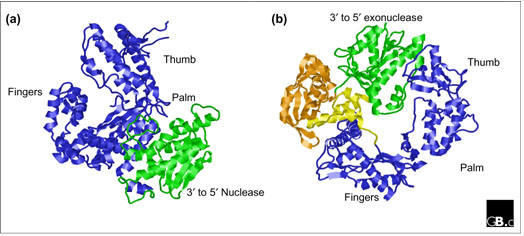
Replicative DNA polymerases are essential for the replication of the genomes of all living organisms. On the basis of sequence similarities they can be classified into three types. Type A polymerases are homologous to bacterial polymerases I, Type B comprises archaebacterial DNA polymerases and eukaryotic DNA polymerase alpha, and the bacterial polymerase III class make up type C. Structures have been solved for several type A and B polymerases, which share a similar architecture. The structure of type C is not yet known. The catalytic mechanism of all three types involves two metal-ion-binding acidic residues in the active site. Replicative polymerases are constitutively expressed, but their activity is regulated through the cell cycle and in response to different growth conditions.
Figures
References
-
- Delarue M, Poch O, Tordo N, Moras D, Argos P. An attempt to unify the structure of polymerases. Prot Engineering. 1990;3:461–467. Pioneer work in the identification of conserved regions in various polymerase types and comparison with the E. coli polymerase I fold. - PubMed
-
- Braithwaite DK, Ito J. Compilation, alignment, and phylogenetic relationships of DNA polymerases. Nucleic Acids Res. 1993;21:787–802. A collection of aligned type A, B and C DNA polymerase sequences. Although somewhat outdated, this article is still a good reference for DNA polymerase families. - PMC - PubMed
-
- Prosite http://www.expasy.ch/prosite/ Database of protein domains.
-
- Steitz TA. DNA polymerases: structural diversity and common mechanisms. J Biol Chem. 1999;274:17395–17398. An excellent review on the structure of DNA polymerases. - PubMed
Publication types
MeSH terms
Substances
LinkOut - more resources
Full Text Sources
Other Literature Sources
