


Origin of the mutations in the parkin gene in Europe: exon rearrangements are independent recurrent events, whereas point mutations may result from Founder effects
- PMID: 11179010
- PMCID: PMC1274475
- DOI: 10.1086/318791
Origin of the mutations in the parkin gene in Europe: exon rearrangements are independent recurrent events, whereas point mutations may result from Founder effects
Abstract
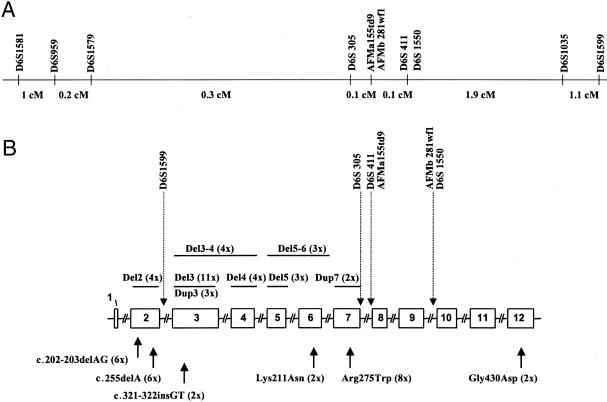
A wide variety of mutations in the parkin gene, including exon deletions and duplications, as well as point mutations, result in autosomal recessive early-onset parkinsonism. Interestingly, several of these anomalies were found repeatedly in unrelated patients and may therefore result from recurrent, de novo mutational events or from founder effects. In the present study, haplotype analysis, using 10 microsatellite markers covering a 4.7-cM region known to contain the parkin gene, was performed in 48 families, mostly from European countries, with early-onset autosomal recessive parkinsonism. The patients carried 14 distinct mutations in the parkin gene, and each mutation was detected in more than one family. Our results support the hypothesis that exon rearrangements occurred independently, whereas some point mutations, found in families from different geographic origins, may have been transmitted by a common founder.
Figures
References
Electronic-Database Information
-
- Centre d’Etude du Polymorphisme Humain, http://www.cephb.fr (for the control DNA sample)
-
- DNA Databank of Japan, http://www.ddbj.nig.ac.jp (for the cDNA sequence of the parkin gene [accession number AB009973])
-
- Genome Database, http://www.gdb.org (for primer sequences)
-
- Online Mendelian Inheritance in Man (OMIM), http://www.ncbi.nlm.nih.gov/Omim (for early-onset parkinsonism [MIM 600116])
-
- Sanger Center, http://www.sanger.ac.uk (for the clone 292F10 and RP1-45F6 sequences [accession numbers 2760544 and 5924005, respectively])
References
-
- Abbas N, Lücking CB, Ricard S, Durr A, Bonifati V, De Michele G, Bouley S, Vaughan JR, Gasser T, Marconi R, Broussolle E, Brefel-Courbon C, Harhangi BS, Oostra BA, Fabrizio E, Bohme GA, Pradier L, Wood NW, Filla A, Meco G, Denefle P, Agid Y, Brice A (1999) A wide variety of mutations in the parkin gene are responsible for autosomal recessive parkinsonism in Europe. French Parkinson's Disease Genetics Study Group and the European Consortium on Genetic Susceptibility in Parkinson's Disease. Hum Mol Genet 8:567–574 - PubMed
-
- Asakawa S, Hattori N, Shintani A, Sasaki T, Kawasaki K, Shimizu A, Kitada T, Matsumine H, Minoshima S, Shimizu Y, Mizuno Y, Shimizu N (2000) Molecular analysis of the deletion breakpoints of parkin gene. Am J Hum Genet Suppl 67:398
-
- Chance PF, Alderson MK, Leppig KA, Lensch MW, Matsunami N, Smith B, Swanson PD, Odelberg SJ, Disteche CM, Bird TD (1993) DNA deletion associated with hereditary neuropathy with liability to pressure palsies. Cell 72:143–151 - PubMed
-
- de Silva HR, Khan NL, Wood NW (2000) The genetics of Parkinson's disease. Curr Opin Genet Dev 10:292–298 - PubMed
-
- Deininger PL, Batzer MA (1999) Alu repeats and human disease. Mol Genet Metab 67:183–193 - PubMed
Publication types
MeSH terms
Substances
LinkOut - more resources
Full Text Sources
Medical
Molecular Biology Databases
