Radiography of the lumbar spine in primary care patients with low back pain: randomised controlled trial
- PMID: 11179160
- PMCID: PMC26570
- DOI: 10.1136/bmj.322.7283.400
Radiography of the lumbar spine in primary care patients with low back pain: randomised controlled trial
Abstract
Objective: To test the hypothesis that radiography of the lumbar spine in patients with low back pain is not associated with improved clinical outcomes or satisfaction with care.
Design: Randomised unblinded controlled trial.
Setting: 73 general practices in Nottingham, north Nottinghamshire, southern Derbyshire, north Lincolnshire, and north Leicestershire. 52 practices recruited participants to the trial.
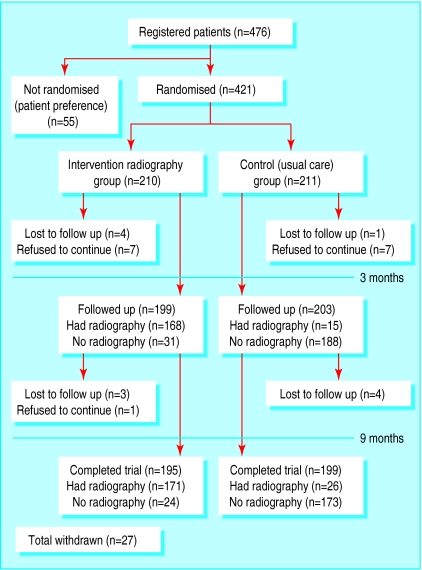
Subjects: 421 patients with low back pain of a median duration of 10 weeks.
Intervention: Radiography of the lumbar spine.
Main outcome measures: Roland adaptation of the sickness impact profile, visual analogue scale for pain, health status, EuroQol, satisfaction with care, use of primary and secondary care services, and reporting of low back pain at three and nine months after randomisation.
Results: The intervention group were more likely to report low back pain at three months (relative risk 1.26, 95% confidence interval 1.00 to 1.60) and had a lower overall health status score and borderline higher Roland and pain scores. A higher proportion of participants consulted their doctor in the three months after radiography (1.62, 1.33 to 1.97). Satisfaction with care was greater in the group receiving radiography at nine but not three months after randomisation. Overall, 80% of participants in both groups at three and nine months would have radiography if the choice was available. An abnormal finding on radiography made no difference to the outcome, as measured by the Roland score.
Conclusions: Radiography of the lumbar spine in primary care patients with low back pain of at least six weeks' duration is not associated with improved patient functioning, severity of pain, or overall health status but is associated with an increase in doctor workload. Guidelines on the management of low back pain in primary care should be consistent about not recommending radiography of the lumbar spine in patients with low back pain in the absence of indicators for serious spinal disease, even if it has persisted for at least six weeks. Patients receiving radiography are more satisfied with the care they received. The challenge for primary care is to increase satisfaction without recourse to radiography.
Comment in
- ACP J Club. 2001 Sep-Oct;135(2):66
References
-
- Royal College of General Practitioners OoPCaS; the Department of Health. Morbidity statistics from general practice. Fourth national study 1991-1992. London: HMSO; 1995.
-
- Wall BF, Rae S, Darby SC, Kendall GM. A reappraisal of the genetic consequences of diagnostic radiology in Great Britain. Br J Radiol. 1981;54:719–730. - PubMed
-
- Kaplan DM, Knapp M, Romm FJ, Velez R. Low back pain and x-ray films of the lumbar spine: a prospective study in primary care. South Med J. 1986;79:811–814. - PubMed
-
- Rockey PH, Tompkins RK, Wood RW, Wolcott BW. The usefulness of x-ray examinations in the evaluation of patients with back pain. J Fam Pract. 1978;7:455–465. - PubMed
Publication types
MeSH terms
LinkOut - more resources
Full Text Sources
Medical