Comparative Study
. 2001 Mar;69(3):1687-96.
doi: 10.1128/IAI.69.3.1687-1696.2001.

exl, an exchangeable genetic island in Neisseria meningitidis

Affiliations
Comparative Study

exl, an exchangeable genetic island in Neisseria meningitidis

C M Kahler et al. Infect Immun. 2001 Mar.

Abstract

The genetic structure and evolution of a novel exchangeable meningococcal genomic island was defined for the important human pathogen Neisseria meningitidis. In 125 meningococcal strains tested, one of three unrelated nucleotide sequences, designated exl (exchangeable locus), was found between a gene required for heme utilization, hemO, and col, encoding a putative Escherichia coli collagenase homologue. The 5' boundary of each exl cassette was the stop codon of hemO, whereas the 3' boundary was delineated by a 33-bp repeat containing neisserial uptake sequences located downstream of col. One of the three alternative exl cassettes contained the meningococcal hemoglobin receptor gene, hmbR (exl3). In other meningococcal strains, hmbR was absent from the genome and was replaced by either a nucleotide sequence containing a novel open reading frame, exl2, or a cassette containing exl3. The proteins encoded by exl2 and exl3 had no significant amino acid homology to HmbR but contained six motifs that are also present in the lipoprotein components of the lactoferrin (LbpB), transferrin (TbpB), and hemoglobin-haptoglobin (HpuA) uptake systems. To determine the evolutionary relationships among meningococci carrying hmbR, exl2, or exl3, isolates representing 92 electrophoretic types were examined. hmbR was found throughout the population structure of N. meningitidis (genetic distance, >0.425), whereas exl2 and exl3 were found in clonal groups at genetic distances of <0.2. The commensal neisserial species were identified as reservoirs for all of the exl cassettes found in meningococci. The structure of these cassettes and their correlation with clonal groups emphasize the extensive gene pool and frequent horizontal DNA transfer events that contribute to the evolution and virulence of N. meningitidis.


Figures
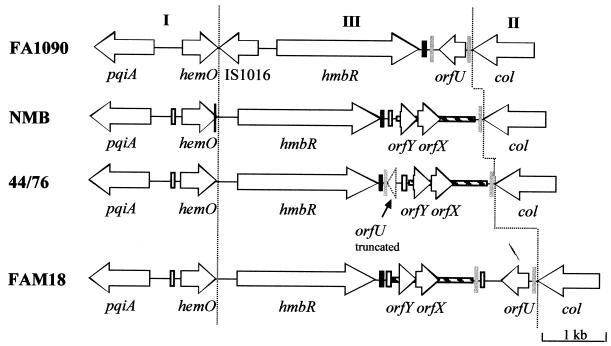
FIG. 1
FIG. 1
Genetic arrangement of the hmbR locus in N. gonorrhoeae strain FA1090 (accession number AF319529) and N. meningitidis strains NMB (accession numbers AF319530 and AF319531), 44/76 (accession number AF319527), and FAM18 (accession number AF319528). Each ORF is represented by an arrow that indicates the direction of transcription. The thin black vertical line indicates the position of a 23-bp sequence which is duplicated in hemO of strain NMB. The thick grey vertical lines indicate the positions of the 33-bp repeats of orfU. Black bars represent a 112-bp conserved nucleotide sequence immediately bordering the 3′ end of hmbR. White bars indicate the locations of neisserial repeat sequences (4). Hatched bars indicate the positions of the 1,280-bp sequence containing orfYX.
FIG. 2
FIG. 2
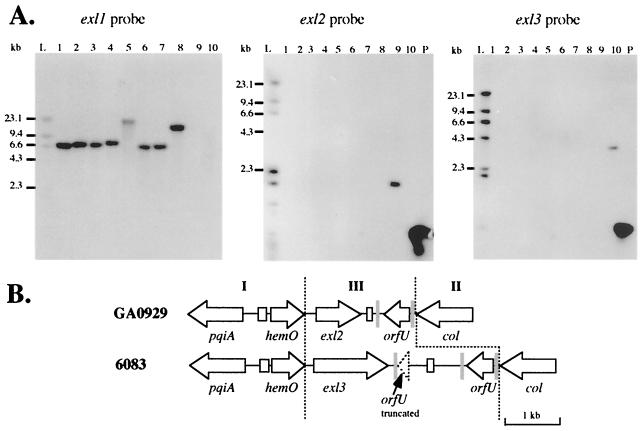
(A) Carriage of exl loci in meningococcal genomes is mutually exclusive. Southern blots of 10 meningococcal strains hybridized with hmbR, exl2, and exl3 probes are shown. Lanes 1 through 10 contain genomic DNAs from strains NMB, 44/76, 6940, M981, FAM18, M1205, M1843, F8229, GA0929, and 6083, respectively. Lane L contains labeled size markers, and lane P contains unlabeled probe DNA as a positive control. (B) Genetic arrangement of the exl cassettes in N. meningitidis strainsGA0929 (accession number AF319532) and 6083 (accession number AF319533). See the legend to Fig. 1 for details.
FIG. 3
FIG. 3
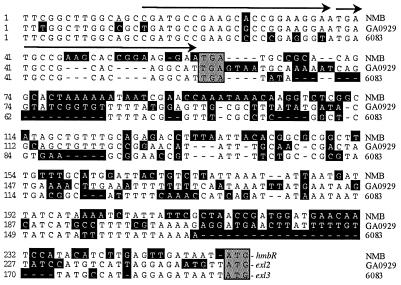
The 5′ boundary of the exl cassettes corresponds to the stop codon of hemO. Shown is the alignment of the exl cassettes from the 3′ end of hemO to the start codon of hmbR from N. meningitidis strain NMB, exl2 from N. meningitidis strain GA0929, and exl3 from N. meningitidis strain 6083. The stop codon of each hemO sequence and the start codon of each exl ORF are marked by grey boxes. Nucleotide residues that do not match the consensus sequence are enclosed in black boxes. Gaps are represented by dashes. The position of the 23-bp sequence in hemO (nucleotides 15 to 37) that is duplicated in strain NMB is indicated by arrows.
FIG. 4
FIG. 4
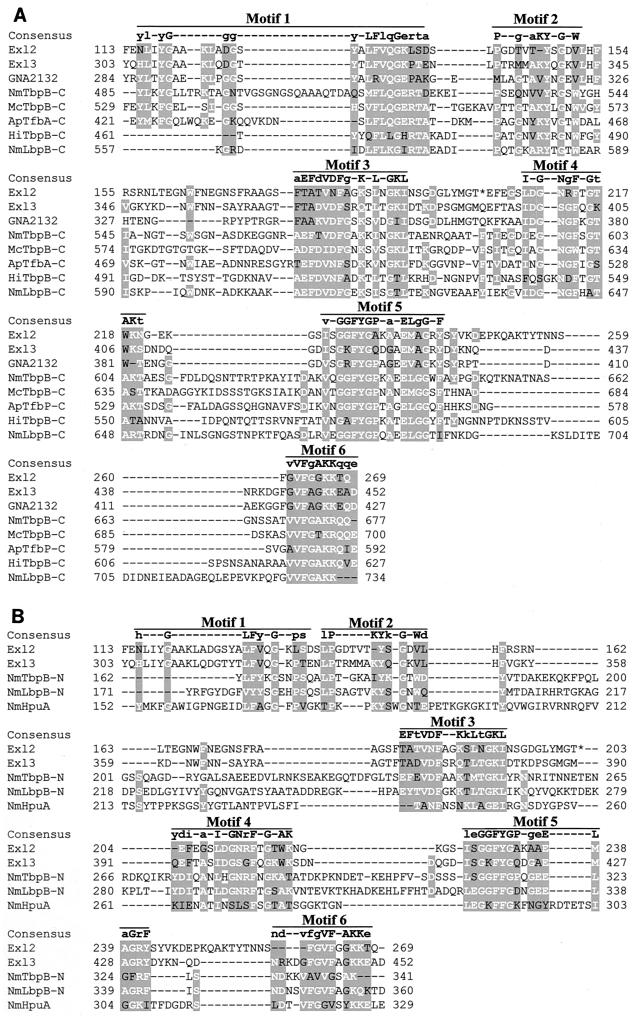
Alignment of Exl2 and Exl3 with iron binding lipoproteins. The carboxy termini of Exl2, Exl3, and GNA2132 are 45% identical. These three proteins have low identity (below 25%) with the transferrin binding proteins (TbpB) of N. meningitidis (NmTbpB), Moraxella catarrhalis (McTbpB), Actinobacillus pleuropneumoniae (ApTfbB), and Haemophilus influenzae (HiTbpB); the meningococcal lactoferrin receptor (NmLbpB); and the Hb-Hp receptor (NmHpuA). Six motifs were identified in the carboxy termini (A) and amino termini (B) of the NmTbpB and NmLbpB proteins. Exl2, Exl3, GNA2132, and NmHpuA contained only one copy of the six motifs. The consensus sequence for each motif is shown above the alignments. Uppercase letters indicate residues that are conserved in the carboxy- and amino-terminal motifs, whereas lowercase letters indicate residues specific for the motif in each domain. The consensus sequence for the amino-terminal motifs (B) was determined using all nine proteins (data not shown).
FIG. 5
FIG. 5
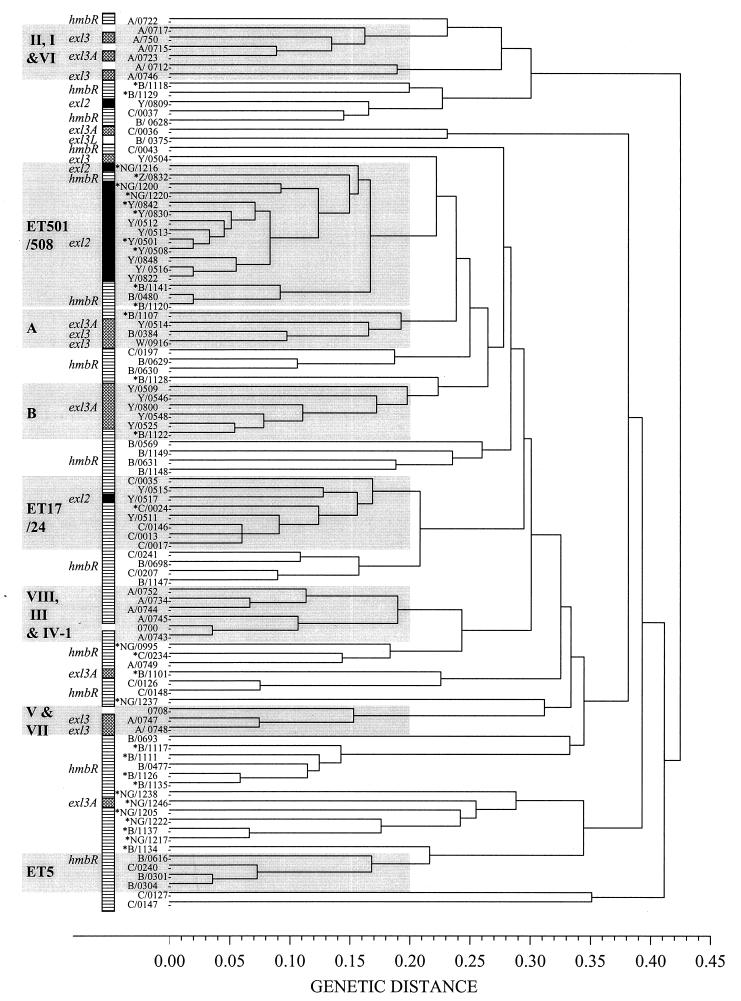
ET dendrogam showing the distribution of different exl cassettes in the meningococcal population represented by 97 ETs. The carriage of hmbR (stippled boxes), exl2 (black boxes), and exl3 or exl3A (hatched boxes) in 92 ET isolates is shown to the left of the dendrogram. The ET designations appear on the y axis in the following manner: serogroup/ET type, where serogroup is represented by the single-letter code (A, B, C, Y, W [W-135], Z, and NG [nongroupable]) and ET type is represented by the four-digit numerical code. All of the representative strains from each ET type are clinical isolates, except for those labeled with an asterisk, indicating isolation from the nasopharynx of an asymptomatic carrier. ET complexes or clonal groups are boxed in grey and are labeled accordingly. The ET clonal groups ET5 and ET17-ET24 and subgroups I, II, III, IV-1, V, VI, VII, and VIII have been described elsewhere (2). The clonal complexes ET501-ET508, A, and B are described in this study.
FIG. 6
FIG. 6
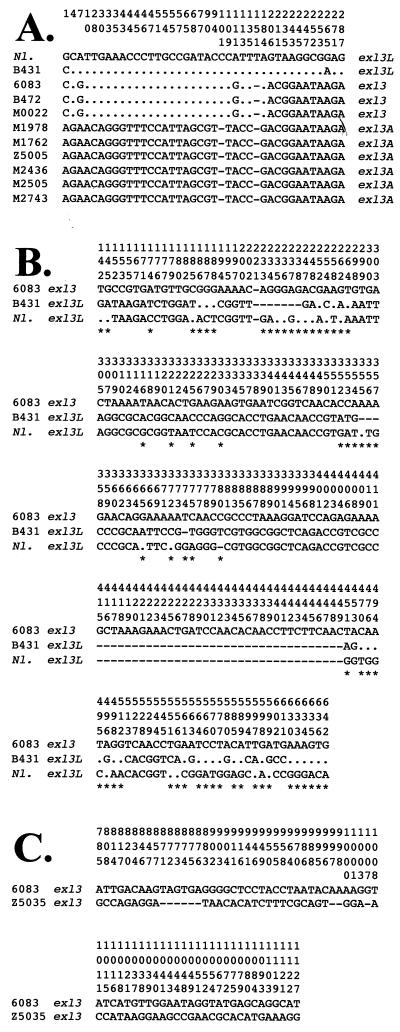
(A) Polymorphisms in the 3′ end of hemO and the intergenic space between this position and the exl3 start codon are characteristic of the exl3 alleles in N. meningitidis. Alignment of the nucleotide sequences from position 663 of hemO (position 1 in this figure) to position 288 of exl3 in 10 meningococcal isolates and N. lactamica is shown. The numbering of the polymorphic sites within the sequences is shown in vertical format above the sequence for N. lactamica exl3L (accession number AF319537). In this scheme, numbers 29 to 31 correspond to the stop codon of hemO and positions 164 to 166 correspond to the exl3 start codon. Nucleotide positions that are identical to those in N. lactamica exl3L are shown as dots, and dashes indicate spaces. Meningococcal isolates (ETs): B431 (375), 6083 (916), B472 (384), M0022 (504), M1978 (525), M1762 (509), Z5005 (723), M2436 (546), M2505 (548), and M2743 (800). (B) Polymorphisms in the first 650 bp of exl3L from N. meningitidis strain B431 (ET375) and N. lactamica exl3L. Identical nucleotides (dots) and spaces (dashes) are marked according to the reference sequence of exl3 from N. meningitidis strain 6083 (ET916). The polymorphic sites are numbered from positions 1 to 3 corresponding to the ATG start codon of exl3. Asterisks mark polymorphisms not shared between the exl3L cassettes in N. meningitidis strain B431 and N. lactamica. (C) Alignment of the complete exl3 genes from N. meningitidis strain 6083 (ET916) and N. meningitidis strain Z5035 (ET747). This alignment revealed polymorphisms in the nucleotide sequence that corresponds to the C-terminal domain of the translated protein. In this numbering scheme, positions 1 to 3 correspond to the ATG start codon of exl3 (see above for details).

References

    1. Altschul S F, Madden T L, Schäffer A A, Zhang J, Zhang Z, Miller W, Lipman D J. Gapped BLAST and PSI-BLAST: a new generation of protein database search programs. Nucleic Acids Res. 1997;25:3389–3402. - PMC - PubMed
    1. Caugant D A. Population genetics and molecular epidemiology of Neisseria meningitidis. APMIS. 1998;106:505–525. - PubMed
    1. Cornelissen C N, Kelley M, Hobbs M M, Anderson J E, Cannon J G, Cohen M S, Sparling P F. The transferrin receptor expressed by gonococcal strain FA1090 is required for the experimental infection of human male volunteers. Mol Microbiol. 1998;27:611–616. - PubMed
    1. Correia F F, Inouye S, Inouye M. A family of small repeated elements with some transposon-like properties in the genome of Neisseria gonorrhoeae. J Biol Chem. 1988;263:12194–12198. - PubMed
    1. Deich R A, Smith H O. Mechanism of homospecific DNA uptake in Haemophilus influenzae transformation. Mol Gen Genet. 1980;177:369–374. - PubMed

Publication types

MeSH terms

Substances

LinkOut - more resources