


The slow component of O(2) uptake is not accompanied by changes in muscle EMG during repeated bouts of heavy exercise in humans
- PMID: 11179407
- PMCID: PMC2278436
- DOI: 10.1111/j.1469-7793.2001.0245j.x
The slow component of O(2) uptake is not accompanied by changes in muscle EMG during repeated bouts of heavy exercise in humans
Abstract
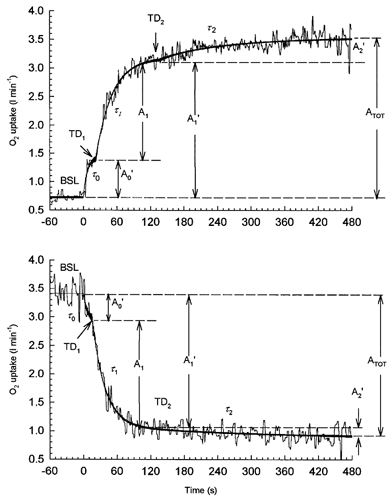
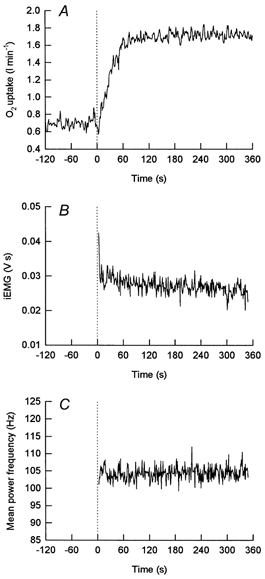
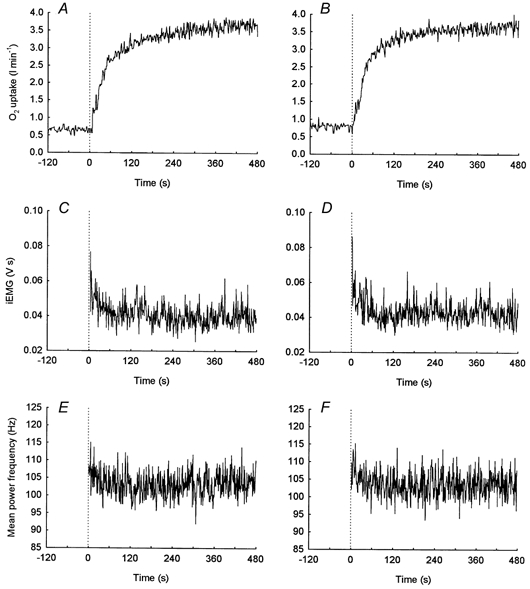
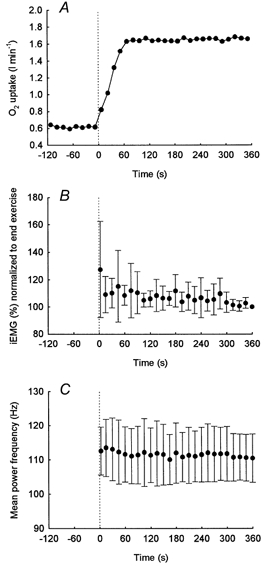
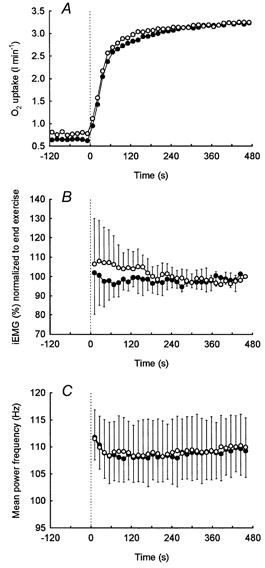
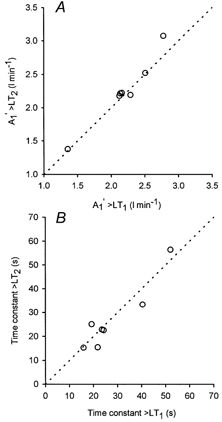
1. We hypothesized that either the recruitment of additional muscle motor units and/or the progressive recruitment of less efficient fast-twitch muscle fibres was the predominant contributor to the additional oxygen uptake (VO2) observed during heavy exercise. Using surface electromyographic (EMG) techniques, we compared the VO2 response with the integrated EMG (iEMG) and mean power frequency (MPF) response of the vastus lateralis with the VO2 response during repeated bouts of moderate (below the lactate threshold, < LT) and heavy (above the lactate threshold, > LT) intensity cycle ergometer exercise. 2. Seven male subjects (age 29 +/- 7 years, mean +/- S.D.) performed three transitions to a work rate (WR) corresponding to 90 % LT and two transitions to a work rate that would elicit a VO2 corresponding to 50 % of the difference between peak VO2 and the LT (i.e. Delta50 %, > LT1 and > LT2). 3. The VO2 slow component was significantly reduced by prior heavy intensity exercise (> LT1, 410 +/- 196 ml min(-1); > LT2, 230 +/- 191 ml min-1). The time constant (tau), amplitude (A) and gain (DeltaVO2/DeltaWR) of the primary VO2 response (phase II) were not affected by prior heavy exercise when a three-component, exponential model was used to describe the V2 response. 4. Integrated EMG and MPF remained relatively constant and at the same level throughout both > LT1 and > LT2 exercise and therefore were not associated with the VO2 slow component. 5. These data are consistent with the view that the increased O2 cost (i.e. VO2 slow component) associated with performing heavy exercise is coupled with a progressive increase in ATP requirements of the already recruited motor units rather than to changes in the recruitment pattern of slow versus fast-twitch motor units. Further, the lack of speeding of the kinetics of the primary VO2 component with prior heavy exercise, thought to represent the initial muscle VO2 response, are inconsistent with O2 delivery being the limiting factor in V > O2 kinetics during heavy exercise.
Figures
References
-
- Aura O, Komi P. Effects of muscle fiber distribution on the mechanical efficiency of human locomotion. International Journal of Sports Medicine. 1987;8(suppl.):30–37. - PubMed
-
- Barclay CJ. Efficiency of fast- and slow-twitch muscles of the mouse performing cyclic contractions. Journal of Experimental Biology. 1994;193:65–78. - PubMed
-
- Barstow TJ, Casaburi R, Wasserman K. O2 uptake kinetics and the O2 deficit as related to exercise intensity and blood lactate. Journal of Applied Physiology. 1993;75:755–762. - PubMed
-
- Barstow TJ, Jones AM, Nguyen PH, Casaburi R. Influence of muscle fiber type and pedal frequency on oxygen uptake kinetics of heavy exercise. Journal of Applied Physiology. 1996;81:1642–1650. - PubMed
Publication types
MeSH terms
Grants and funding
LinkOut - more resources
Full Text Sources
Medical
Miscellaneous
