. 2001 Feb;12(2):323-37.
doi: 10.1091/mbc.12.2.323.

Remodeling of yeast genome expression in response to environmental changes

Affiliations
Free PMC article

Remodeling of yeast genome expression in response to environmental changes

H C Causton et al. Mol Biol Cell. 2001 Feb.
Free PMC article

Abstract

We used genome-wide expression analysis to explore how gene expression in Saccharomyces cerevisiae is remodeled in response to various changes in extracellular environment, including changes in temperature, oxidation, nutrients, pH, and osmolarity. The results demonstrate that more than half of the genome is involved in various responses to environmental change and identify the global set of genes induced and repressed by each condition. These data implicate a substantial number of previously uncharacterized genes in these responses and reveal a signature common to environmental responses that involves approximately 10% of yeast genes. The results of expression analysis with MSN2/MSN4 mutants support the model that the Msn2/Msn4 activators induce the common response to environmental change. These results provide a global description of the transcriptional response to environmental change and extend our understanding of the role of activators in effecting this response.


Figures
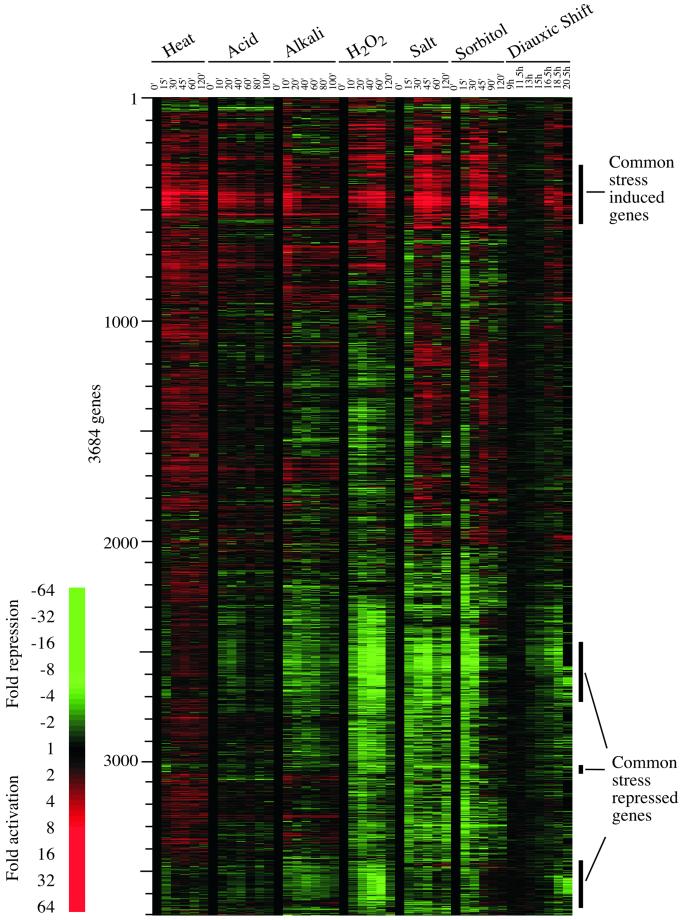
Figure 1
Figure 1
Time-course expression profiles for cells exposed to changes in environment. The expression profiles of 3684 genes whose transcript levels changed by threefold in at least one of the time courses are represented. See MATERIALS AND METHODS for further details of data analysis. Each horizontal strip represents a single gene. The fold change is represented by a color (see color bar). The genes that are induced or repressed in most of the responses to environmental changes are indicated.
Figure 2
Figure 2
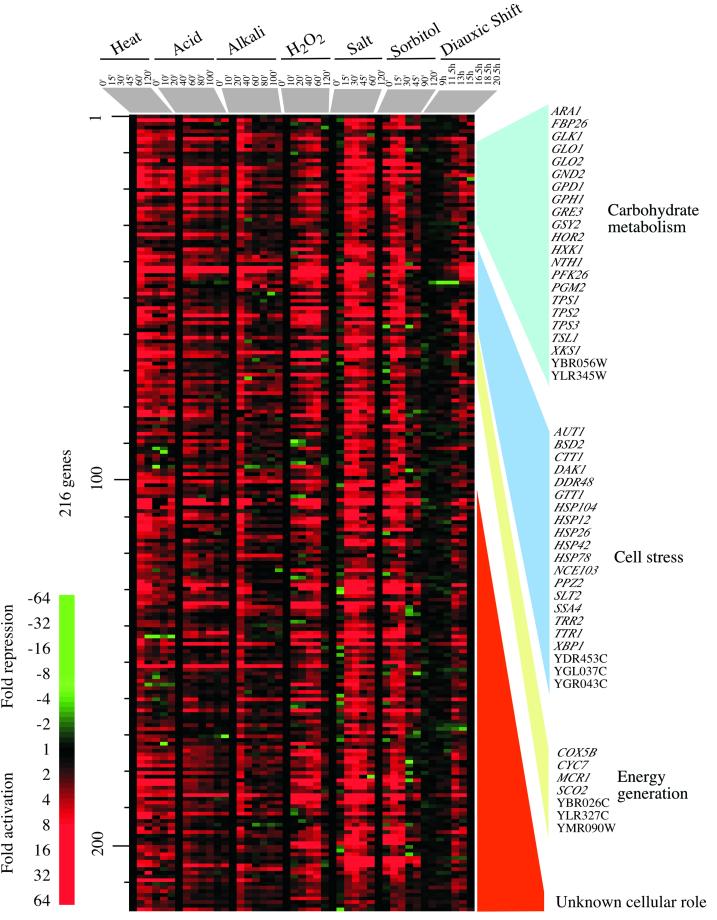
A CER: gene activation. One of the clusters from the hierarchical tree in Figure 1, containing genes whose expression is induced in most of the environmental responses, is represented. These data were sorted so that genes with similar cellular functions, as listed in the Yeast Proteome Database (http://www.proteome.com), are listed together. Details are as described in the legend to Figure 1.
Figure 3
Figure 3
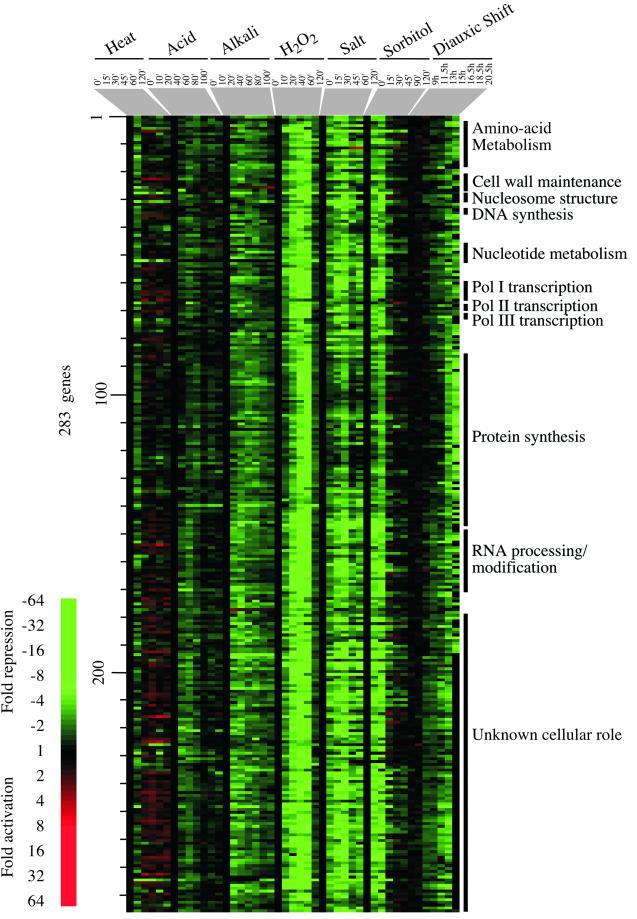
A CER: transient repression of the translation apparatus. Three clusters from the hierarchical tree in Figure 1, containing genes whose expression was repressed in most of the environmental responses, are represented. These clusters were combined, and the genes were sorted according to their cellular roles. Details are as described in the legend to Figure 1.
Figure 4
Figure 4
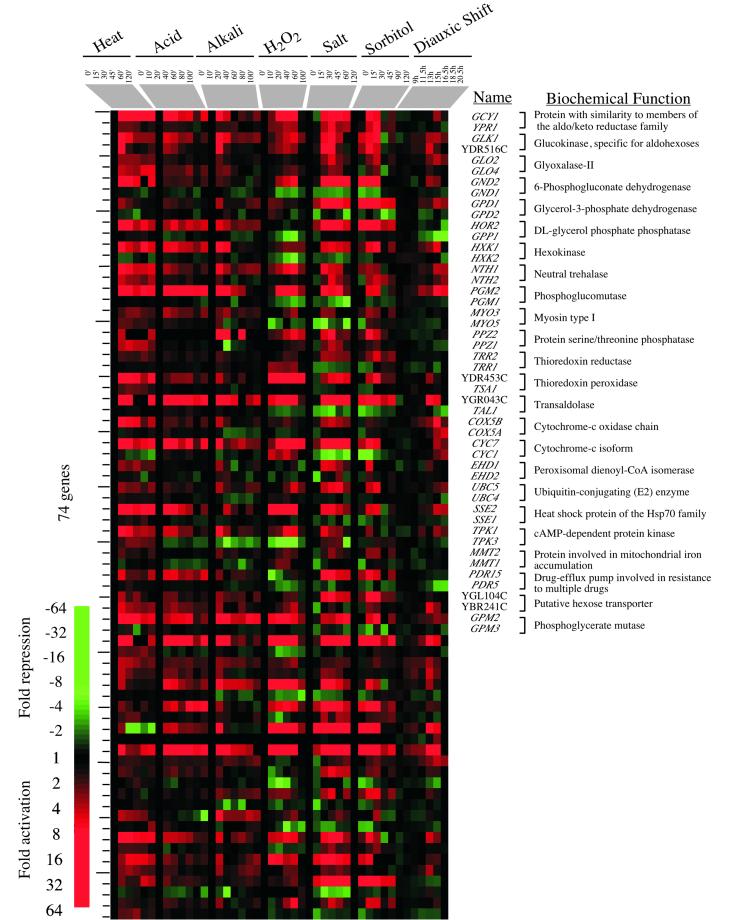
Homologous gene pairs are differentially expressed in response to changes in the environment. There are 37 pairs of genes (74 genes) for which one of the pair is part of the CER and the other is not. Details are described in the text.
Figure 5
Figure 5
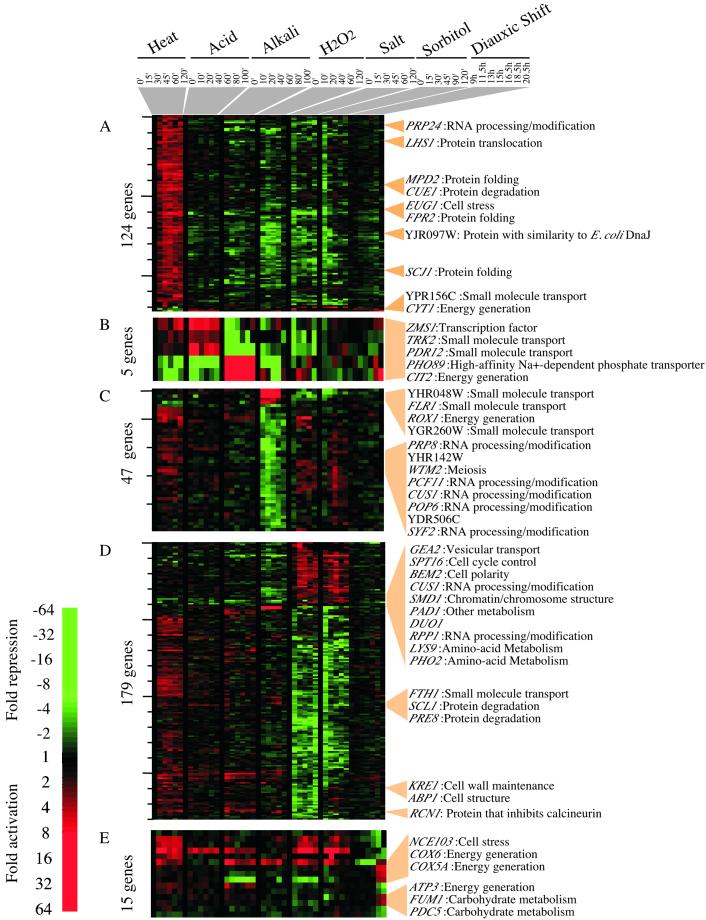
Environmental response-specific gene expression. Environmental response-specific genes were selected based on the criteria described in MATERIALS AND METHODS. The genes displayed are a subset of the environmental response-specific genes. (A) Genes whose expression is uniquely remodeled in response to heat. (B) Genes whose expression is diametrically regulated in response to acid and alkali. (C) Genes whose expression is uniquely remodeled in response to hydrogen peroxide. (D) Genes that respond similarly to salt and sorbitol. (E) Genes whose expression is specific to the diauxic shift. Some of the response-specific genes are listed on the right.
Figure 6
Figure 6
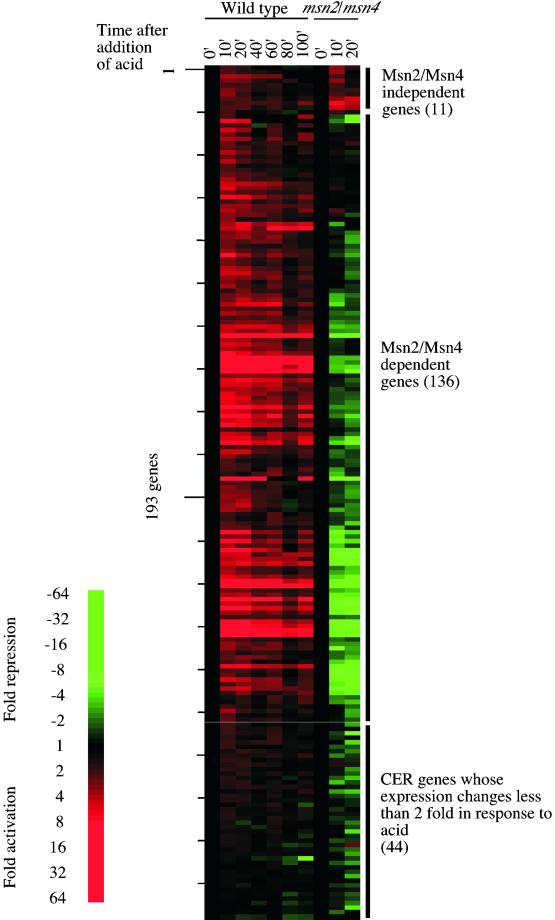
Induction of most acid-induced genes depends on Msn2/Msn4. The genes whose expression changed by at least threefold in response to acid are shown for a wild-type strain and a strain deleted for MSN2 and MSN4. Msn2/Msn4-dependent genes are shown with a bar. Details are as described in the legend to Figure 1.

References

    1. Adams CC, Gross DS. The yeast heat shock response is induced by conversion of cells to spheroplasts and by potent transcriptional inhibitors. J Bacteriol. 1991;173:7429–7435. - PMC - PubMed
    1. Ali A, Bharadwaj S, O'Carroll R, Ovsenek N. HSP90 interacts with and regulates the activity of heat shock factor 1 in Xenopus oocytes. Mol Cell Biol. 1998;18:4949–4960. - PMC - PubMed
    1. Beck T, Hall MN. The TOR signaling pathway controls nuclear localization of nutrient-regulated transcription factors. Nature. 1999;402:689–692. - PubMed
    1. Bharadwaj S, Ali A, Ovsenek N. Multiple components of the HSP90 chaperone complex function in regulation of the heat shock factor 1 in vivo. Mol Cell Biol. 1999;19:8033–8041. - PMC - PubMed
    1. Bihler H, Gaber RF, Slayman CL, Bertl A. The presumed potassium carrier Trk2p in Saccharomyces cerevisiae determines an H+-dependent, K+- independent current. FEBS Lett. 1999;447:115–120. - PubMed

Publication types

MeSH terms