


Pharmacokinetics of the protease inhibitor indinavir in human immunodeficiency virus type 1-infected children
- PMID: 11181346
- PMCID: PMC90359
- DOI: 10.1128/AAC.45.3.701-705.2001
Pharmacokinetics of the protease inhibitor indinavir in human immunodeficiency virus type 1-infected children
Abstract
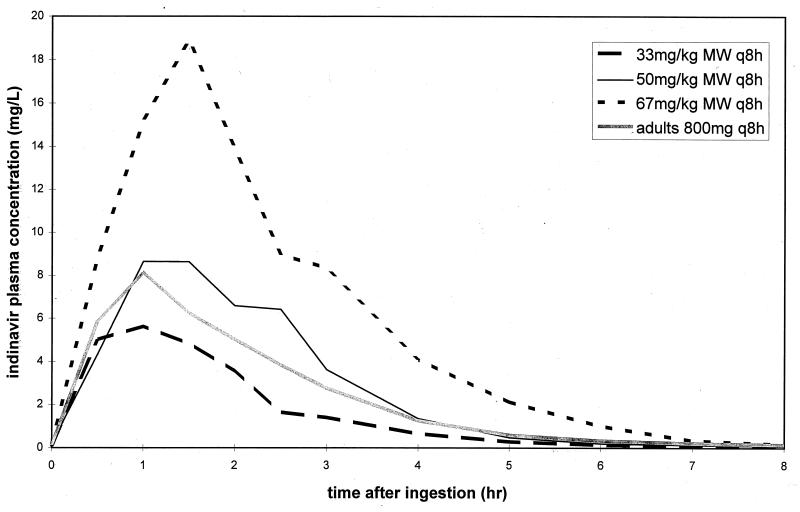
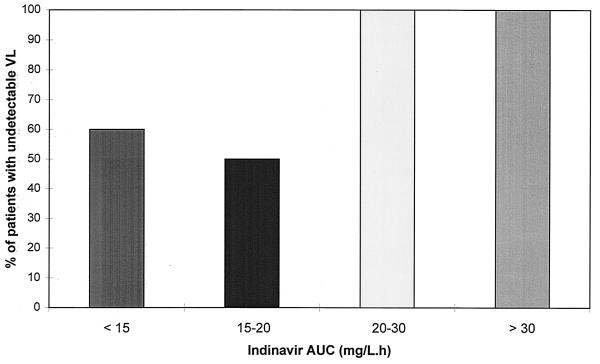
The objective of this study was to evaluate the pharmacokinetics of indinavir in human immunodeficiency virus-infected children as part of a prospective, open, uncontrolled, multicenter study in The Netherlands. Human immunodeficiency virus type 1-infected children were monitored over 6 months of treatment with zidovudine (120 mg/m(2) every 8 h [q8h]), lamivudine (4 mg/kg of body weight q12h), and indinavir (33mg/kg of metabolic weight [MW] q8h). Four weeks after the start of treatment, the steady-state pharmacokinetics of indinavir were determined by high-pressure liquid chromatography. If patients had an indinavir area under the concentration-time curve (AUC) of below 10 or above 30 mg/liter. h, a dose increase or a dose reduction was made and pharmacokinetic measurements were repeated 4 weeks later. Nineteen patients started with the dose of 33 mg/kg of MW q8h. The median AUC (range) was 10.5 (2.8 to 51.0) mg/liter. h. The median AUC (range) in 17 children treated with 50 mg/kg of MW q8h was 20.6 (4.1 to 38.7) mg/liter. h. Finally, five patients had a dose increase to 67 mg/kg of MW q8h, resulting in a median AUC (range) of 36.6 (27.2 to 80.0) mg/liter. h. After 6 months of treatment, there were 11 children with an AUC of below 20 mg/liter. h, of whom 5 (45%) had a detectable viral load, while this was the case in none of the 11 children with an AUC of higher than 20 mg/liter. h. We conclude that the optimal dose of indinavir in children to obtain drug exposure similar to that observed in adult patients is 50 mg/kg of MW q8h, which approximates 600 mg/m(2) q8h. It would even be better to adjust the indinavir dose based on an AUC of greater than 20 mg/liter. h.
Figures
References
-
- Burger D M, de Graaff M, Wuis E W, Koopmans P P, Hekster Y A. Determination of indinavir, an HIV-protease inhibitor, in human plasma by reversed-phase high-performance liquid chromatography. J Chromatogr B. 1997;703:235–241. - PubMed
-
- Burger D M, Hoetelmans R M W, Hugen P W H, Mulder J W, Meenhorst P L, Koopmans P P, Brinkman K, Keuter M, Dolmans W, Hekster Y A. Low plasma concentrations of indinavir are related to virological treatment failure in HIV-1 infected patients on indinavir-containing triple therapy. Antivir Ther. 1998;3:215–220. - PubMed
-
- Butler D R, Kuhn R J, Chandler M H H. Pharmacokinetics of anti-infective agents in paediatric patients. Clin Pharmacokinet. 1994;26:374–395. - PubMed
-
- Dieleman J P, Gyssens I C, van der Ende M E, de Marie S, Burger D M. Urological complaints in relation to indinavir plasma concentrations in HIV-infected patients. AIDS. 1999;13:473–478. - PubMed
-
- Gibaldi M. Biopharmaceutics and clinical pharmacokinetics. Philadelphia, Pa: Lea & Febiger; 1999.
Publication types
MeSH terms
Substances
LinkOut - more resources
Full Text Sources
Medical
