


The role of rigidity in DNA looping-unlooping by AraC
- PMID: 11209047
- PMCID: PMC14602
- DOI: 10.1073/pnas.98.2.427
The role of rigidity in DNA looping-unlooping by AraC
Abstract
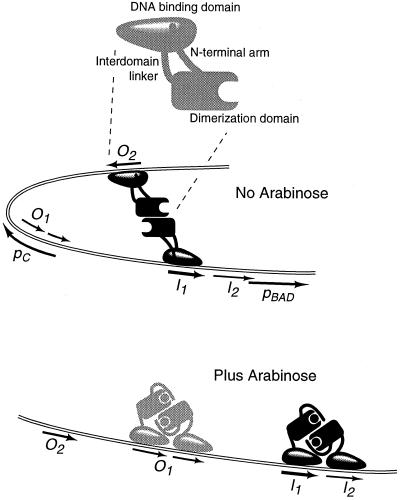
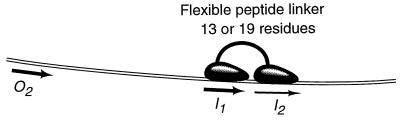
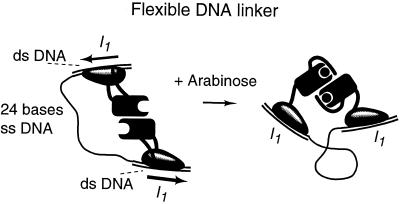
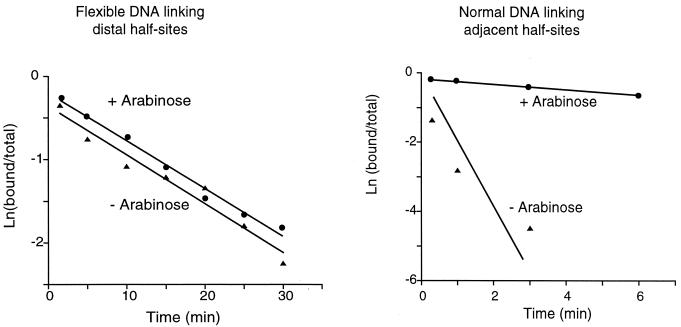
We applied two experiments useful in the study of ligand-regulated DNA binding proteins to AraC, the dimeric regulator of the Escherichia coli l-arabinose operon. In the absence of arabinose, AraC prefers to loop DNA by binding to two half-sites that are separated by 210 base pairs, and in the presence of arabinose it prefers to bind to adjacently located half-sites. The basis for this ligand-regulated shift in binding appears to result from a shift in the rigidity of the system, where rigidity both in AraC protein in the absence of arabinose, and in the DNA are required to generate the free energy differences that produce the binding preferences. Eliminating the dimerization domains and connecting the two DNA binding domains of AraC by a flexible peptide linker should provide a protein whose behavior mimics that of AraC when there is no interaction between its dimerization and DNA binding domains. The resulting protein bound to adjacent half-sites on the DNA, like AraC protein in the presence of arabinose. When the two double-stranded DNA half-sites were connected by 24 bases of single-stranded, flexible DNA, wild-type AraC protein bound to the DNA in the presence and absence of arabinose with equal affinity, showing that AraC modulates its DNA binding affinity in response to arabinose by shifting the relative positions of its DNA binding domains. These results are consistent with the light switch mechanism for the action of AraC, refine the model, and extend the range of experimental tests to which it has been subjected.
Figures
References
Publication types
MeSH terms
Substances
Grants and funding
LinkOut - more resources
Full Text Sources
