. 2001 Mar;183(6):2151-5.
doi: 10.1128/JB.183.6.2151-2155.2001.

Analysis of promoters recognized by PvdS, an extracytoplasmic-function sigma factor protein from Pseudomonas aeruginosa

Affiliations

Analysis of promoters recognized by PvdS, an extracytoplasmic-function sigma factor protein from Pseudomonas aeruginosa

M J Wilson et al. J Bacteriol. 2001 Mar.

Abstract

The alternative sigma factor PvdS is required by Pseudomonas aeruginosa for initiation of transcription from pyoverdine (pvd) promoters. Two divergent PvdS-dependent promoters (pvdE and pvdF) were characterized by deletion analysis, and the minimal promoter region for each included a sequence element, the iron starvation (IS) box, that is present in other pvd promoters. Site-directed mutagenesis showed that the IS box elements were essential for promoter activity in vivo. Band shift assays and in vitro transcription experiments showed that a complex of PvdS and core RNA polymerase required the presence of an IS box in order to bind to and initiate transcription from pvd promoters. These results indicate that IS box elements participate in sequence-specific recognition by PvdS to enable initiation of transcription from pvd promoters and are likely to represent a -35 sequence element for this sigma factor.


Figures

FIG. 1
FIG. 1
The pvdE-pvdF intergenic promoter region. The DNA sequence and the location of the pvdE IS box and the pvdE transcript start site have been described previously (20), and the sequence has been deposited with GenBank (accession no. U07359). The positions of the pvdF IS box and pvdF transcription start site (this work) are also shown. Numbering above the sequence is relative to the pvdF transcript start site, while numbering below the sequence is relative to the pvdE transcript start site. Mutations that were created at the IS box elements (see text) are shown in boldface underneath the wild-type sequences.
FIG. 2
FIG. 2
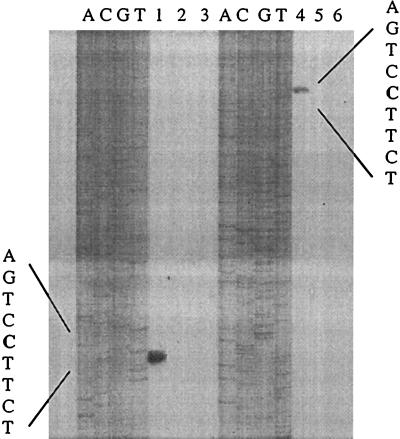
Identification of the 5′ end of pvdF transcript. RNA was prepared from P. aeruginosa grown in King's B medium (6) containing the iron chelator ethylenediamine-(o-hydroxy)phenylacetic acid (EDDA) (200 μg/ml) (lanes 1 and 4) or containing FeCl3 (60 μg/ml) (lanes 2 and 5) and used in primer extension analysis with primers 1 and 2. Lanes 3 and 6, reactions performed without RNA. Sequencing ladders of pvdF DNA obtained with the same oligonucleotides are shown and allowed the precise identification of the 5′ ends of the pvdF transcript. The DNA sequence corresponding to the transcription start site is shown, with the initiating nucleotide in boldface.
FIG. 3
FIG. 3
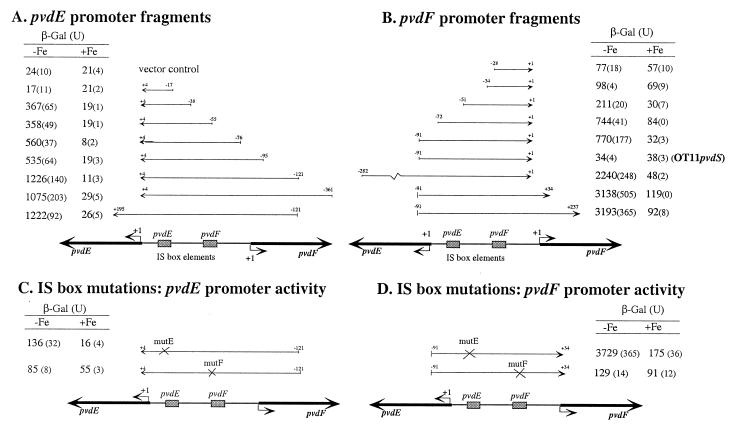
Promoter activities of the pvdE and pvdF promoter deletion fragments in P. aeruginosa. The positions of the fragments are shown relative to a map of the pvdE-pvdF promoter region, with the nucleotides present in each fragment given relative to the transcript start site of the relevant gene. The transcript start sites (+1) and positions of IS box elements are also shown. The amounts of β-Gal produced from each construct in P. aeruginosa during growth in iron-deficient (−Fe) and iron-replete (+Fe) media, with standard deviations from three independent assays in parentheses, were determined using the method of Miller (15) as described previously (4, 20). Promoter fragments cloned into pMP190 were oriented such that lacZ expression was dependent upon pvdE promoter activity (A and C) or pvdF promoter activity (B and D) as shown. Fragments with the wild-type promoter sequence (A and B) or with mutations in the IS box sequence elements (C and D) were used. Vector control, P. aeruginosa OT11 containing pMP190 vector DNA. OT11pvdS, the pMP190 promoter construct was transformed into OT11pvdS (3) and assays were carried out.
FIG. 4
FIG. 4
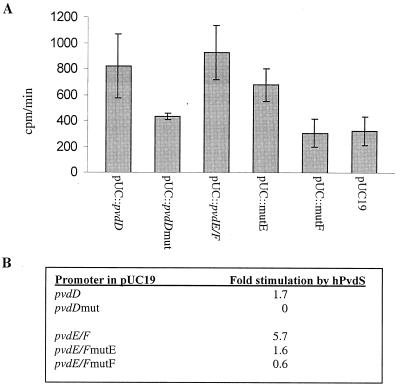
Activities of mutant promoter fragments in vitro with purified PvdS protein. (A) Purified hPvdS was incubated with core RNA polymerase and different plasmid templates as shown. Templates carried wild-type promoter fragments (pvdD [nucleotides −96 to +39] or pvdE-pvdF [−121 to +4 of pvdE and −92 to +34 of pvdF]) or mutations in the IS box of the pvdD promoter (pvdDmut), the pvdE-proximal IS box (mutE), or the pvdF-proximal IS box (mut F) (Fig. 1; Table 1); the mutation in the pvdD IS box is the same as that described previously (20). The rate of RNA production from each plasmid template was measured as described previously (27). Error bars indicate standard deviations. (B) Fold stimulation represents the ability of hPvdS to stimulate activity above that of core enzyme with a pvd promoter template minus the corresponding value obtained with a vector template, calculated using the following equation (2, 27): fold stimulation = [(hPvdS-core − hPvdS only)/core only]pUC::pvd template − [(hPvdS-core − hPvdS only)/core only]pUCvector template.
FIG. 5
FIG. 5
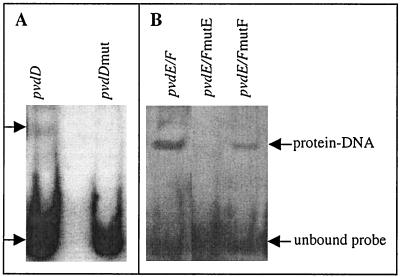
Band shift assays with hPvdS and mutant promoters. (A) Band shift assays were carried out as described previously (27). Core enzyme (3.4 pmol) was incubated with hPvdS (13 pmol) and digoxigenin-labeled DNA fragments containing either the pvdD wild-type promoter fragment (nucleotides −96 to +39) or a pvdD promoter fragment containing a mutation in the IS box. Following electrophoresis and transfer to a nylon membrane, the DNA-protein complexes were detected by immunoblotting with antibodies against digoxigenin. (B) Core and hPvdS were incubated with the wild-type pvdE-pvdF promoter fragment (−121/+4 with respect to the pvdE transcription start site) or with promoter fragments containing a mutation in either the pvdE IS box (mutE) or the pvdF-proximal IS box (mutF), as shown. The positions of DNA-protein complexes are indicated by arrows.

References

    1. Angerer A, Enz S, Ochs M, Braun V. Transcriptional regulation of ferric citrate transport in Escherichia coli K-12. FecI belongs to a new subfamily of ς70-type factors that respond to extracytoplasmic stimuli. Mol Microbiol. 1995;18:163–174. - PubMed
    1. Burgess R R, Travers A A. Purification of the RNA polymerase sigma factor. Methods Enzymol. 1971;21:500–506.
    1. Casabadan M J, Cohen S N. Analysis of gene control signals by DNA fusion cloning in Escherichia coli cells. J Mol Biol. 1980;138:179–207. - PubMed
    1. Cunliffe H E, Merriman T R, Lamont I L. Cloning and characterization of pvdS, a gene required for pyoverdine synthesis in Pseudomonas aeruginosa: PvdS is probably an alternative sigma factor. J Bacteriol. 1995;177:2744–2750. - PMC - PubMed
    1. Datta A K. Efficient amplification using ‘megaprimer’ by asymmetric polymerase chain reaction. Nucleic Acids Res. 1995;23:4530–4531. - PMC - PubMed

Publication types

MeSH terms

Associated data

LinkOut - more resources