


Extraterrestrial amino acids in Orgueil and Ivuna: tracing the parent body of CI type carbonaceous chondrites
- PMID: 11226205
- PMCID: PMC30105
- DOI: 10.1073/pnas.051502898
Extraterrestrial amino acids in Orgueil and Ivuna: tracing the parent body of CI type carbonaceous chondrites
Abstract
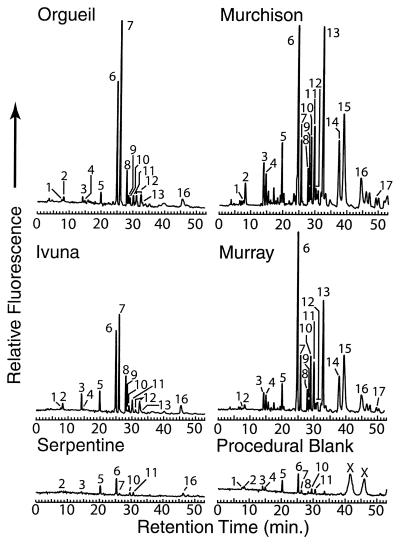
Amino acid analyses using HPLC of pristine interior pieces of the CI carbonaceous chondrites Orgueil and Ivuna have found that beta-alanine, glycine, and gamma-amino-n-butyric acid (ABA) are the most abundant amino acids in these two meteorites, with concentrations ranging from approximately 600 to 2,000 parts per billion (ppb). Other alpha-amino acids such as alanine, alpha-ABA, alpha-aminoisobutyric acid (AIB), and isovaline are present only in trace amounts (<200 ppb). Carbon isotopic measurements of beta-alanine and glycine and the presence of racemic (D/L approximately 1) alanine and beta-ABA in Orgueil suggest that these amino acids are extraterrestrial in origin. In comparison to the CM carbonaceous chondrites Murchison and Murray, the amino acid composition of the CIs is strikingly distinct, suggesting that these meteorites came from a different type of parent body, possibly an extinct comet, than did the CM carbonaceous chondrites.
Figures
References
-
- Cronin J R, Chang S. In: The Chemistry of Life's Origin. Greenberg J M, Mendoza-Gomez C X, Pirronello V, editors. Dordrecht, The Netherlands: Kluwer; 1993. pp. 209–258.
-
- Cloëz S. Comp Rend Acad Sci (Paris) 1864;59:37–40.
-
- Richter H E. Schmidt's Jahrbüher der in-und Auslädischen Gesammelten Medicin. 1865;126:243–249.
-
- Meuníer S. Scientia. 1925. 157–166.
-
- Nagy B, Meinschein W G, Hennessy D J. Ann NY Acad Sci. 1961;93:25–35.
LinkOut - more resources
Full Text Sources
