. 2001 Feb 27;98(5):2582-6.
doi: 10.1073/pnas.051626198. Epub 2001 Feb 13.

BLNK mediates Syk-dependent Btk activation

Affiliations

BLNK mediates Syk-dependent Btk activation

Y Baba et al. Proc Natl Acad Sci U S A. .

Abstract

Btk is a critical molecule in B cell antigen receptor (BCR)-coupled signaling, and its activity is regulated by Lyn and Syk. Although the molecular mechanism of Lyn-dependent Btk activation has been investigated, that of Syk-dependent Btk activation has remained unidentified. We have demonstrated that BLNK mediates Syk-dependent Btk activation. In a reconstitution cell system, coexpression of BLNK allows Syk to phosphorylate Btk on its tyrosine 551, leading to the enhancement of Btk activity. This phosphorylation depends on the interaction of Btk and BLNK by means of the Btk-Src homology 2 domain. The existence of such an activation mechanism is supported by the observation that the BCR-induced Btk phosphorylation and activation are significantly reduced in BLNK-deficient B cells as well as in Syk-deficient B cells. Although previous observations have identified the function of BLNK as the linker that integrates the action of Btk and Syk into downstream effectors such as phospholipase Cgamma2, our present study indicates another function of BLNK that connects the activity of Syk to that of Btk.


Figures
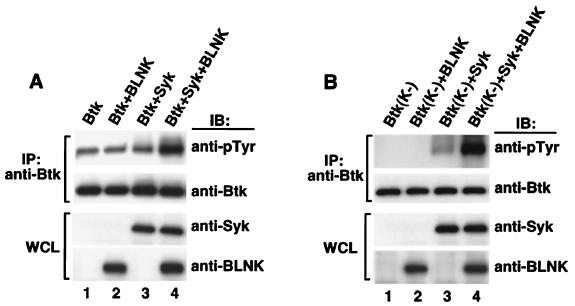
Figure 1
Figure 1
BLNK mediates Syk-dependent Btk phosphorylation. cDNAs of Btk (A) or Btk(K−) (B) were cotransfected into 293T cells with the indicated combinations of Syk and/or BLNK. Btk was immunoprecipitated (IP) from cell lysates with anti-Btk mAb 48-2H, and the immune complexes were separated by 4–20% gradient SDS-PAGE gels, then immunoblotted (IB) with anti-phosphotyrosine (pTyr) mAb 4G10 (Top). The filter was reprobed with anti-Btk mAb 43-3B to confirm the equal amount of precipitated Btk (Second Panel). The whole cell lysates (WCL) were immunoblotted with the anti-Syk Ab (Third Panel) or the anti-BLNK Ab (Bottom) to detect the expression of each protein.
Figure 2
Figure 2
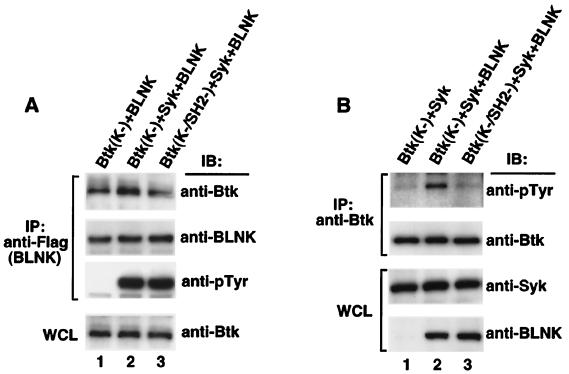
Syk-dependent Btk phosphorylation requires the interaction of BLNK and Btk-SH2 domain. cDNAs of Btk [Btk(K−) or Btk(K−/SH2−)] were cotransfected into 293T cells with the indicated combinations of Syk and/or BLNK. (A) Assessments of the coprecipitation of Btk and BLNK were performed by tagging BLNK with Flag sequence as described in our previous report (12). Flag-tagged BLNK was immunoprecipitated from cell lysates with anti-Flag mAb M2. Immune complexes were immunoblotted with anti-Btk mAb 43-3B for detecting the coprecipitation of Btk (Top), followed by reprobing with anti-BLNK Ab (Second Panel). The Syk-dependent tyrosinephosphorylation of BLNK was detected by immunoblotting with anti-pTyr mAb 4G10 (Third Panel). Equal expression levels of Btk, Syk, and BLNK in each experiment were confirmed by immunoblotting the whole cell lysates with anti-Btk mAb 43-3B (Bottom), anti-Syk Ab and anti-BLNK Ab (not shown). (B) Btk was immunoprecipitated from cell lysates with anti-Btk mAb 48-2H, and the tyrosinephosphorylation was evaluated by anti-pTyr mAb 4G10 (Top). The filter was reprobed with anti-Btk mAb 43-3B to confirm the equal amount of precipitated Btk (Second Panel). The whole cell lysates were immunoblotted with the anti-Syk Ab (Third Panel) or the anti-BLNK Ab (Bottom).
Figure 3
Figure 3
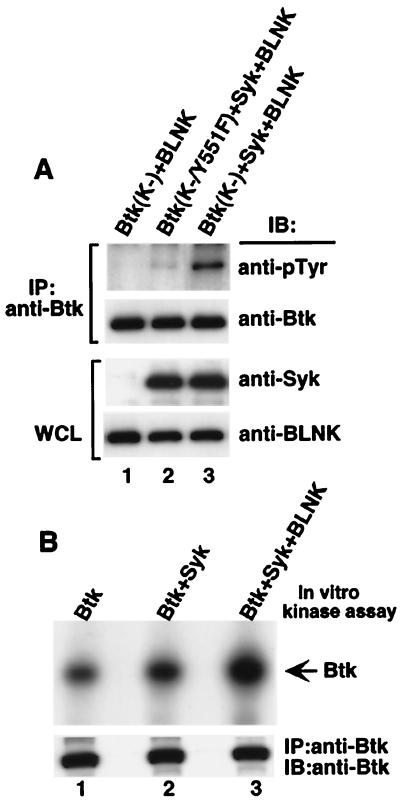
Syk phosphorylates Y551 of Btk and enhances Btk activity in the presence of BLNK. (A) cDNAs of Btk [Btk(K−) or Btk(K−/Y551F)] were cotransfected with Syk and/or BLNK into 293T cells. Btk was immunoprecipitated with anti-Btk mAb 48-2H, and immunoblotted with anti-pTyr mAb 4G10 (Top), followed by reprobing with anti-Btk mAb 43–3B (Second Panel). Expression levels of Syk or BLNK were evaluated by immunoblotting the whole cell lysates with the anti-Syk Ab (Third Panel) or the anti-BLNK Ab (Bottom). (B) Btk expressed in 293T cells with or without Syk and BLNK was immunoprecipitated with anti-Btk mAb 48-2H, and an in vitro kinase assay was carried out as described in Materials and Methods (Top). The second panel indicates the equality of Btk protein in immunoprecipitates.
Figure 4
Figure 4
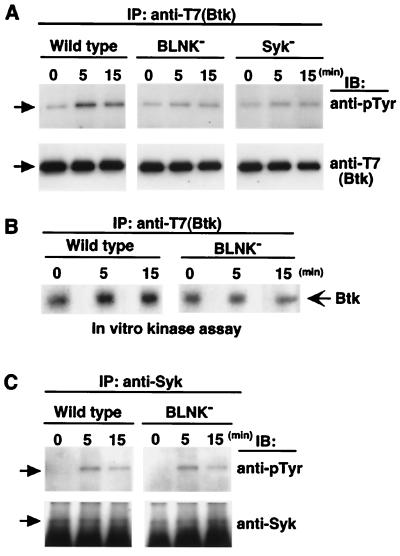
BCR-induced tyrosinephosphorylation and activation of Btk are reduced in BLNK-deficient DT40 cells. Wild-type or mutant (BLNK-deficient and Syk-deficient) DT40 cells expressing T7-Btk were stimulated with anti-chicken IgM mAb M4 (4 μg/ml) for the indicated periods. Lysates were immunoprecipitated with the anti-T7 mAb (A) or the anti-Syk Ab (C), and then immunoblotted with anti-pTyr mAb 4G10 (A and C, Top), followed by reprobing with the anti-T7 mAb (A, Bottom) or the anti-Syk Ab (C, Bottom). (B) After stimulation of wild-type and BLNK-deficient DT40 cells with mAb M4, T7-Btk was immunoprecipitated with the anti-T7 mAb, and an in vitro kinase assay was carried out as described in Materials and Methods. The equality of Btk protein in immunoprecipitates was confirmed by anti-Btk immunoblotting (data not shown).
Figure 5
Figure 5
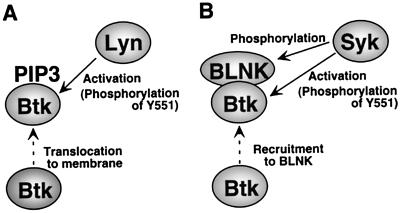
Proposed mechanism of Btk activation. (A) It has been proposed that BCR crosslinking promotes the activation of Lyn and the translocation of Btk to membrane-localized phosphatidylinositol-3,4,5-trisphosphate. This translocation puts Btk in close proximity with Lyn, which subsequently phosphorylates Btk on its tyrosine 551. (B) We propose another Btk activation mechanism that the activated Syk phosphorylates BLNK, and then the recruitment of Btk to the phosphorylated BLNK enables Syk to phosphorylate Btk on its tyrosine 551.

References

    1. Reth M, Wienands J. Annu Rev Immunol. 1997;15:453–479. - PubMed
    1. Tamir I, Cambier J C. Oncogene. 1998;17:1353–1364. - PubMed
    1. Kurosaki T. Annu Rev Immunol. 1999;17:555–592. - PubMed
    1. Hsueh R C, Scheuermann R H. Adv Immunol. 2000;75:283–316. - PubMed
    1. Mahajan S, Fargnoli J, Burkhardt A L, Kut S A, Saouaf S J, Bolen J B. Mol Cell Biol. 1995;15:5304–5311. - PMC - PubMed

Publication types

MeSH terms