


Pseudo-spikes are common in histologically benign lymphoid tissues
- PMID: 11229519
- PMCID: PMC1906903
- DOI: 10.1016/S1525-1578(10)60630-7
Pseudo-spikes are common in histologically benign lymphoid tissues
Abstract
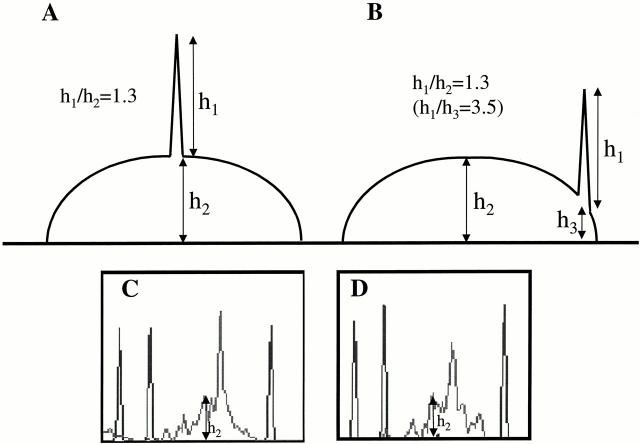
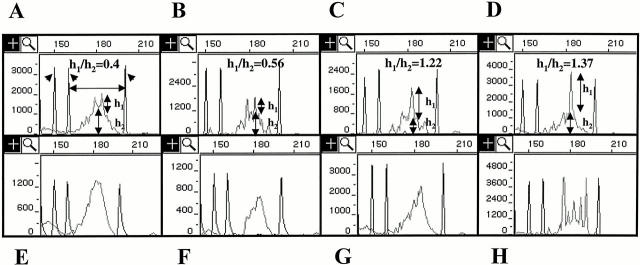
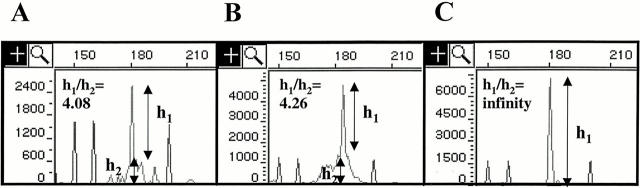
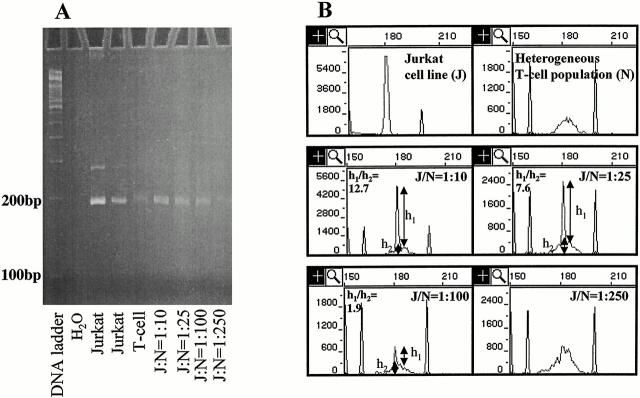
T cell receptor gene rearrangement is a classic marker of T cell clonality and is a useful adjunct in the diagnosis of T cell lymphomas and leukemias. Rearranged V-J gene segments amplified by polymerase chain reaction (PCR) are traditionally analyzed by polyacrylamide gel electrophoresis. We and others have analyzed TCR-gamma PCR products using capillary gel electrophoresis, which produces single nucleotide resolution and provides improved diagnostic sensitivity over conventional methods. However, with this marked increase in resolution and sensitivity, it is necessary to re-define normal variation of TCR-gamma gene rearrangement in control tissues to allow appropriate interpretation of monoclonality if present. Using DNA capillary gel electrophoresis, we examined the spectrum of normal patterns for TCR-gamma in a variety of T-cell-rich, histologically benign tissue types, including spleen, lymph node, tonsil, and blood, and compared this with the patterns in T cell lymphoma samples. We defined relative peak heights as h1/h2, where h1 represents the peak height of the largest peak above the normally distributed population, and h2 represents the peak height of the normally distributed curve. We found spikes in almost 20% of histologically benign samples with relative peak heights that were more than 0.5 and up to 1.5. We designated these as pseudo-spikes, because they may be mistaken for monoclonal spikes. In contrast, the relative peak height of the T cell lymphoma samples that showed clonal rearrangement was much higher than that of the pseudo-spikes, being at least 2 in 11/11 and at least 3 in 10/11 cases. Our data suggest that peaks with relative height of at least 3 represent a true clonal population in diagnostic samples. Peaks with relative heights of less than 1.5 may be insignificant, while peaks with relative heights between 1.5 to 3 may warrant further evaluation. Although capillary gel electrophoresis is superior in assessing T cell clonality, caution must be exercised when interpreting results, because pseudo-spikes appear to be common in benign tissues with lymphoid populations and are not necessarily indicative of clonal malignant T cell population.
Figures
References
-
- Davis MM, Bjorkman PJ: T-cell antigen receptor genes and T-cell recognition Nature 1988 (published erratum appears in Nature 1988, 335:744), 34:395-402 - PubMed
-
- Saito H, Kranz DM, Takagaki Y, Hayday AC, Eisen HN, Tonegawa S: Complete primary structure of a heterodimeric T-cell receptor deduced from cDNA sequences. Nature 1984, 309:757-762 - PubMed
-
- Strominger JL: Developmental biology of T cell receptors. Science 1989, 244:943-950 - PubMed
-
- LeFranc MP, Forster A, Baer R, Stinson MA, Rabbitts TH: Diversity and rearrangement of the human T cell rearranging gamma genes: nine germ-line variable genes belonging to two subgroups. Cell 1986, 45:237-246 - PubMed
-
- Benhattar J, Delacretaz F, Martin P, Chaubert P, Costa J: Improved polymerase chain reaction detection of clonal T-cell lymphoid neoplasms. Diagn Mol Pathol 1995, 4:108-112 - PubMed
MeSH terms
LinkOut - more resources
Full Text Sources
