. 2001 Mar;67(3):1076-84.
doi: 10.1128/AEM.67.3.1076-1084.2001.

Chromate reduction by a pseudomonad isolated from a site contaminated with chromated copper arsenate

Affiliations

Chromate reduction by a pseudomonad isolated from a site contaminated with chromated copper arsenate

J McLean et al. Appl Environ Microbiol. 2001 Mar.

Abstract

A pseudomonad (CRB5) isolated from a decommissioned wood preservation site reduced toxic chromate [Cr(VI)] to an insoluble Cr(III) precipitate under aerobic and anaerobic conditions. CRB5 tolerated up to 520 mg of Cr(VI) liter(-1) and reduced chromate in the presence of copper and arsenate. Under anaerobic conditions it also reduced Co(III) and U(VI), partially internalizing each metal. Metal precipitates were also found on the surface of the outer membrane and (sometimes) on a capsule. The results showed that chromate reduction by CRB5 was mediated by a soluble enzyme that was largely contained in the cytoplasm but also found outside of the cells. The crude reductase activity in the soluble fraction showed a K(m) of 23 mg liter(-1) (437 microM) and a V(max) of 0.98 mg of Cr h(-1) mg of protein(-1) (317 nmol min(-1) mg of protein(-1)). Minor membrane-associated Cr(VI) reduction under anaerobiosis may account for anaerobic reduction of chromate under nongrowth conditions with an organic electron donor present. Chromate reduction under both aerobic and anaerobic conditions may be a detoxification strategy for the bacterium which could be exploited to bioremediate chromate-contaminated or other toxic heavy metal-contaminated environments.


Figures
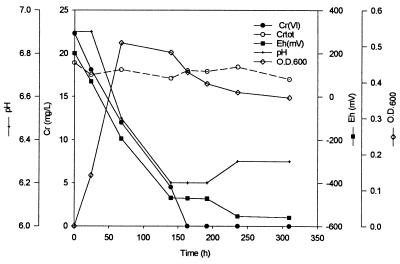
FIG. 1
FIG. 1
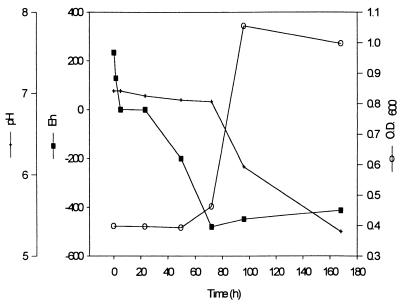
Batch bioreactor results in VBA medium (VB with amino acids and CaCl2) at an initial cell density of 6 × 10⁸ cells ml−1. Cr(VI) reduction, total Cr [Cr(III)] plus Cr(VI)] in solution after filtration (Crtot), pH, Eh, and OD600 are shown.
FIG. 2
FIG. 2
Bioreactor control in VBA medium with no Cr(VI) added.
FIG. 3
FIG. 3
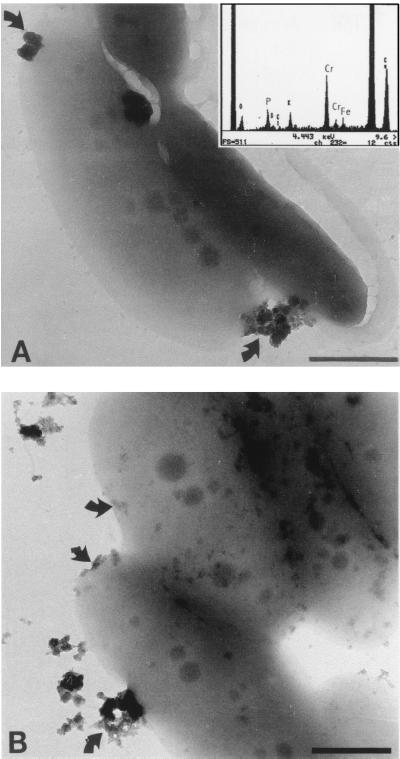
Whole mounts of CRB5 from VB medium with 20 mg of Cr(VI) liter−1. (A) Cr(III) precipitates were found as discrete particles bound to the cell surface (arrows). One cell has pulled away from the support film after interaction with the electron beam. An EDS spectrum from the dense particles generated a large Cr peak and a small Fe peak, indicating that it is most likely an amorphous Cr(III) hydroxide or mixed Fe-Cr hydroxide. (B) Amorphous chromium precipitates (arrows) forming on cells. Bars, 500 nm.
FIG. 4
FIG. 4
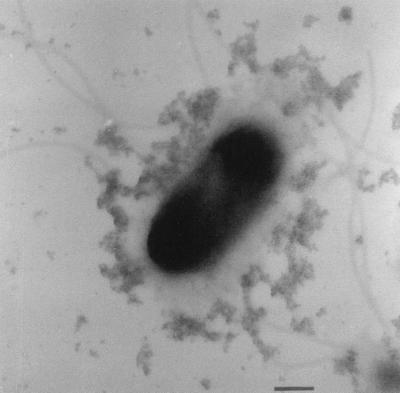
Unstained whole mount of the peritrichous flagellated CRB5 with precipitates on its capsule. Cr has also accumulated on the outer membrane of the cell, which appears dark in the electron micrograph. Bar, 500 nm.
FIG. 5
FIG. 5
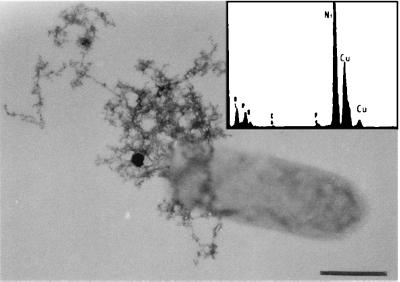
Whole mount of a cell grown in VB medium with 40 mg of Cu liter−1. A number of cells were found to have extensive accumulations of Cu in a matrix of capsular polymers. Bar, 500 nm. An EDS spectrum generated from the precipitates generated a large Cu peak. The Ni peak is from the nickel support grid.
FIG. 6
FIG. 6
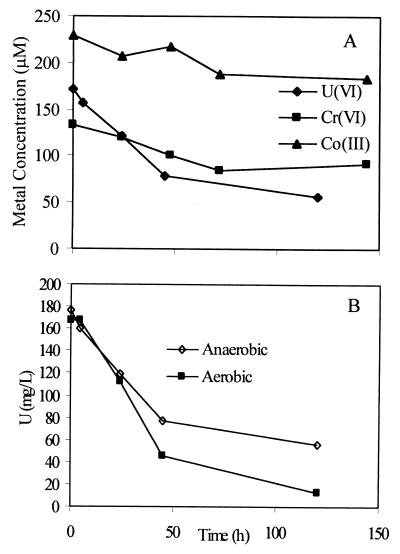
Reduction of alternate electron acceptors. (A) Anaerobic reduction of Cr(VI), Co(III), and U(VI) in bicarbonate buffer with lactate as an electron donor. (B) U(VI) reduction under anaerobic and aerobic conditions.
FIG. 7
FIG. 7
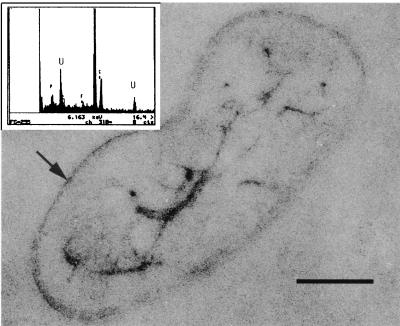
Internal accumulation of uranium confirmed by thin section. Uranium was also bound on the cell envelope (small arrow). Bar, 500 nm. An EDS spectrum of internal uranium precipitates is also shown. The P peak is from the polyphosphate granules; the Cu peak is from the copper support grid.
FIG. 8
FIG. 8
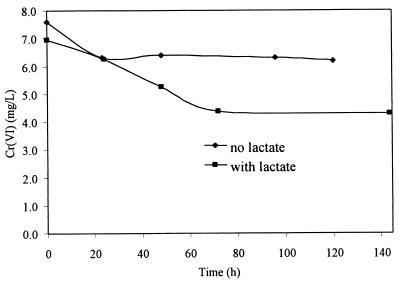
Anaerobic chromate reduction by washed cells in bicarbonate buffer with and without lactate as an electron donor.
FIG. 9
FIG. 9
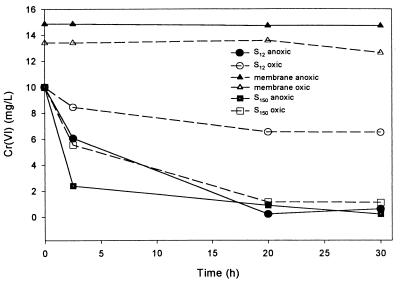
Cr(VI) reduction by cellular fractions isolated after differential centrifugation and mechanical breakage. Cells were harvested from a stationary (unshaken) culture incubated at 22°C. Anaerobic reduction (solid lines with closed symbols) and aerobic reduction (dashed lines with open symbols) of cell fractions are shown.
FIG. 10
FIG. 10
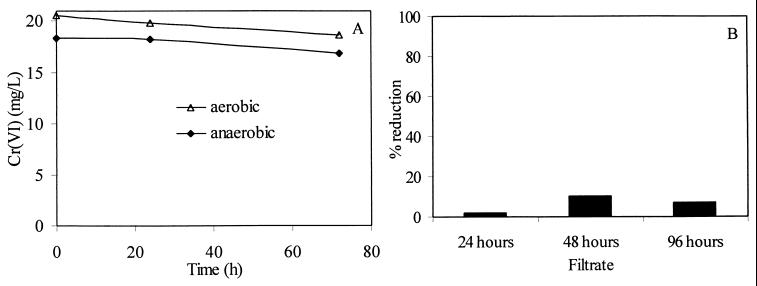
(A) Cr(VI) reduction in the isolated periplasmic fraction under aerobic and anaerobic conditions. (B) Percent chromate reduction in cell-free culture filtrates obtained at different incubation times. The initial Cr(VI) concentration was 20 mg liter−1.
FIG. 11
FIG. 11
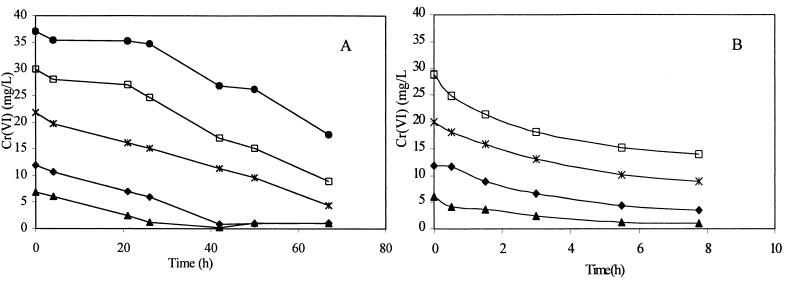
(A) Cr(VI) reduction of intact cells in VB medium at five different initial Cr(VI) concentrations. (B) Chromate reduction in the soluble fraction of cell extracts (S150). The supernatant fraction was assayed anaerobically at various initial chromate concentrations in 0.1 M HEPES buffer at 30°C.

References

    1. Alvarez A H, Moreno-Sanchez R, Cervantes C. Chromate efflux by means of the ChrA chromate resistance protein from Pseudomonas aeruginosa. Appl Microbiol Biotechnol. 1999;181:7398–7400. - PMC - PubMed
    1. American Public Health Association. Standard methods for the examination of water and wastewater. 17th ed. Washington, D.C.: American Public Health Association; 1989.
    1. Beveridge T J. The bacterial surface: general considerations towards design and function. Can J Microbiol. 1988;34:363–372. - PubMed
    1. Beveridge T J. The structure of bacteria. In: Leadbetter E R, Poindexter J S, editors. Bacteria in nature: a treatise on the interaction of bacteria and their habitats. Vol. 3. New York, N.Y: Plenum Publishing Co.; 1989. pp. 1–65.
    1. Beveridge T J, Murray R G E. Uptake and retention of metals by cell walls of Bacillus subtilis. J Bacteriol. 1976;127:1502–1518. - PMC - PubMed

Publication types