. 2001 Mar;67(3):1318-27.
doi: 10.1128/AEM.67.3.1318-1327.2001.

Bacterial populations colonizing and degrading rice straw in anoxic paddy soil

Affiliations

Bacterial populations colonizing and degrading rice straw in anoxic paddy soil

S Weber et al. Appl Environ Microbiol. 2001 Mar.

Abstract

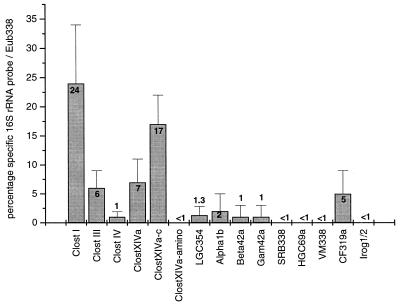
Rice straw is a major substrate for the production of methane, a greenhouse gas, in flooded rice fields. The bacterial community degrading rice straw under anoxic conditions was investigated with molecular methods. Rice straw was incubated in paddy soil anaerobically for 71 days. Denaturing gradient gel electrophoresis (DGGE) of the amplified bacterial 16S rRNA genes showed that the composition of the bacterial community changed during the first 15 days but then was stable until the end of incubation. Fifteen DGGE bands with different signal intensities were excised, cloned, and sequenced. In addition, DNA was extracted from straw incubated for 1 and 29 days and the bacterial 16S rRNA genes were amplified and cloned. From these clone libraries 16 clones with different electrophoretic mobilities on a DGGE gel were sequenced. From a total of 31 clones, 20 belonged to different phylogenetic clusters of the clostridia, i.e., clostridial clusters I (14 clones), III (1 clone), IV (1 clone), and XIVa (4 clones). One clone fell also within the clostridia but could not be affiliated to one of the clostridial clusters. Ten clones grouped closely with the genera Bacillus (3 clones), Nitrosospira (1 clone), Fluoribacter (1 clones), and Acidobacterium (2 clones) and with clone sequences previously obtained from rice field soil (3 clones). The relative abundances of various phylogenetic groups in the rice straw-colonizing community were determined by fluorescence in situ hybridization (FISH). Bacteria were detached from the incubated rice straw with an efficiency of about 80 to 90%, as determined by dot blot hybridization of 16S rRNA in extract and residue. The number of active (i.e., a sufficient number of ribosomes) Bacteria detected with a general eubacterial probe (Eub338) after 8 days of incubation was 61% of the total cell counts. This percentage decreased to 17% after 29 days of incubation. Most (55%) of the active cells on day 8 belonged to the genus Clostridium, mainly to clostridial clusters I (24%), III (6%), and XIVa (24%). An additional 5% belonged to the Cytophaga-Flavobacterium cluster of the Cytophaga-Flavobacterium-Bacteroides phylum, 4% belonged to the alpha, beta, and gamma Proteobacteria, and 1.3% belonged to the Bacillus subbranch of the gram-positive bacteria with a low G+C content. The results show that the bacterial community colonizing and decomposing rice straw developed during the first 15 days of incubation and was dominated by members of different clostridial clusters, especially clusters I, III, and XIVa.


Figures
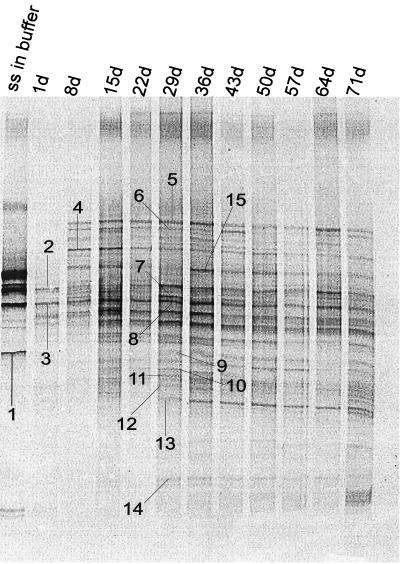
FIG. 1
FIG. 1
DGGE patterns of the 16S rDNA fragments of straw samples incubated in soil slurries for different times (1 to 71 days; lanes 2 to 12 [starting from the left]) and from one straw sample (ss) incubated in phosphate buffer for 2 months (lane 1). DGGE bands 1 to 15 were excised from the gels, and the DNA was extracted, amplified, and cloned. Clones with the same electrophoretic mobility as that of the original band were sequenced.
FIG. 2
FIG. 2
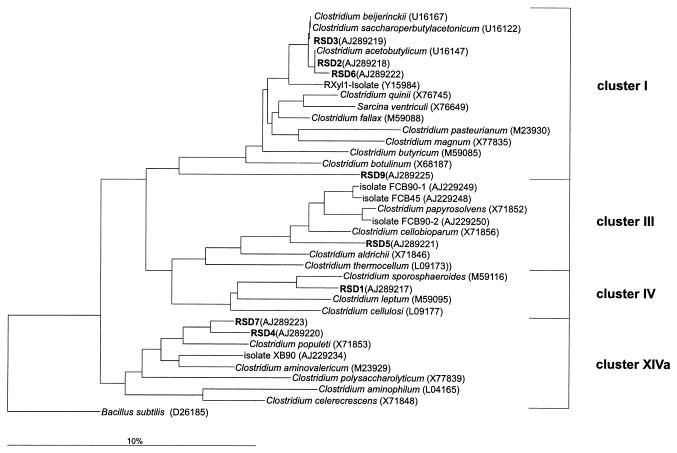
Phylogenetic dendrogram constructed with partial (about 400 bp) 16S rDNA sequences showing the relationship of RSD clones from DGGE gels to members of the genus Clostridium (sensu Collins et al. [9]). The tree was constructed with the neighbor-joining method of the ARB program package and the Jukes-Cantor correction. To omit highly variable regions within the 16S rRNA, a filter with 50% invariance for the genus Clostridium was used. Scale bar, 10% estimated difference in nucleotide sequence position. As the outgroup, Bacillus subtilis was used.
FIG. 3
FIG. 3
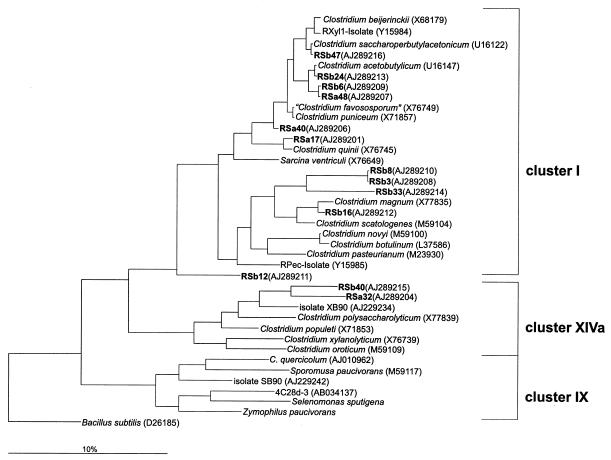
Phylogenetic dendrogram constructed with 16S rDNA sequences (about 750 bp) showing the relationship of RSa and RSb clones to members of the genus Clostridium (sensu Collins et al. [9]). The tree was constructed with the neighbor-joining method of the ARB program package and the Jukes-Cantor correction. To omit highly variable regions within the 16S rRNA, a filter with 50% invariance for the genus Clostridium was used. Scale bar, 10% estimated difference in nucleotide sequence position. As the outgroup, Bacillus subtilis was used.
FIG. 4
FIG. 4
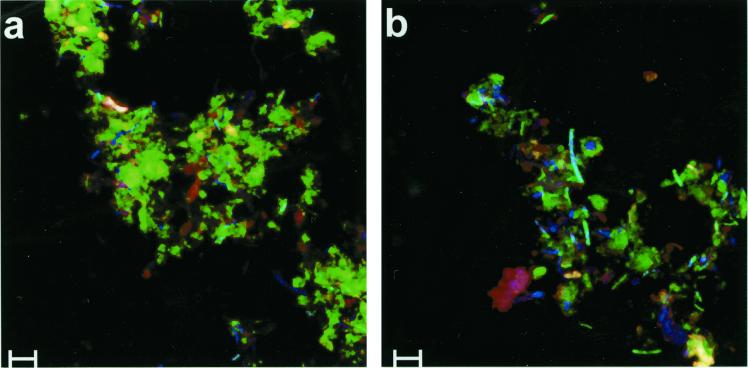
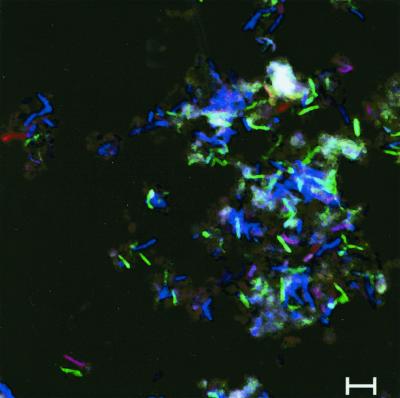
FISH of fixed cells detached mechanically from straw incubated in soil slurries without (a) and with (b) prior treatment by toluidine blue. Two 16S rDNA probes were used simultaneously: CY5-labeled bacterial-domain probe Eub338 (blue) and FITC-labeled probe Clost I (green). One sample (b) was additionally treated with toluidine blue to reduce autofluorescence, especially in the green channel. Scale bars, 5 μm.
FIG. 5
FIG. 5
Quantification by FISH of the composition of the bacterial community on rice straw incubated for 8 days in rice field soil. The bacterial populations were detached from the straw, fixed with formaldehyde, and hybridized with different group-specific 16S rRNA probes (Table 1). For each group-specific probe about 600 Eub338-marked cells were counted. The percentage of the specific signal was calculated in relation to the number of Eub338-stained cells (mean ± standard deviation; n ≥ 10).
FIG. 6
FIG. 6
FISH of fixed cells detached mechanically from straw incubated for 8 days in soil slurries. Three 16S rDNA probes were used simultaneously. CY5-labeled bacterial-domain probe Eub338 (blue) was used together with CY3-labeled probe Clost XIVa (red), specific for parts of clostridial cluster XIVa, and FITC-labeled probe Clost XIVa-c (green), designed from 16S rDNA sequence data (clones RSa32 and RSb40). The overlay of probes Eub338 and Clost XIVa resulted in pink cells; the overlay of Eub338 and Clost XIVa-c resulted in green-to-turquoise cells. The number of cells hybridized simultaneously with the group-specific probes Clost XIVa and Clost XIVa-c (resulting in white cells) was less then 1% of all Eub338-detected cells. Scale bars, 5 μm.

References

    1. Amann R I, Binder B J, Olson R J, Chrisholm S W, Devereux R, Stahl D A. Combination of 16S rRNA-targeted oligonucleotide probes with flow cytometry for analyzing mixed microbial populations. Appl Environ Microbiol. 1990;56:1919–1925. - PMC - PubMed
    1. Amann R I, Krumholz L, Stahl D A. Fluorescent-oligonucleotide probing of whole cells for determinative, phylogenetic, and environmental studies in microbiology. J Bacteriol. 1990;172:762–770. - PMC - PubMed
    1. Amann R I, Ludwig W, Schleifer K H. Phylogenetic identification and in situ detection of individual microbial cells without cultivation. Microbiol Rev. 1995;59:143–169. - PMC - PubMed
    1. Assmus B, Hutzler P, Kirchhof G, Amann R, Lawrence J R, Hartmann A. In situ localization of Azospirillum brasilense in the rhizosphere of wheat with fluorescently labeled, rRNA-targeted oligonucleotide probes and scanning confocal laser microscopy. Appl Environ Microbiol. 1995;61:1013–1019. - PMC - PubMed
    1. Brosius J, Dull T J, Sleeter D D, Noller H F. Gene organization and primary structure of a ribosomal RNA operon from Escherichia coli. J Mol Biol. 1981;148:107–127. - PubMed

MeSH terms

LinkOut - more resources