


doi: 10.1128/AEM.67.3.1363-1365.2001.
Acetate oxidation coupled to Fe(iii) reduction in hyperthermophilic microorganisms
Affiliations
- PMID: 11229932
- PMCID: PMC92735
- DOI: 10.1128/AEM.67.3.1363-1365.2001
Item in Clipboard
Acetate oxidation coupled to Fe(iii) reduction in hyperthermophilic microorganisms
Appl Environ Microbiol.
2001 Mar.
Abstract
No hyperthermophilic microorganisms have previously been shown to anaerobically oxidize acetate, the key extracellular intermediate in the anaerobic oxidation of organic matter. Here we report that two hyperthermophiles, Ferroglobus placidus and "Geoglobus ahangari," grow at 85 degrees C by oxidizing acetate to carbon dioxide, with Fe(III) serving as the electron acceptor. These results demonstrate that acetate could potentially be metabolized within the hot microbial ecosystems in which hyperthermophiles predominate, rather than diffusing to cooler environments prior to degradation as has been previously proposed.
Figures
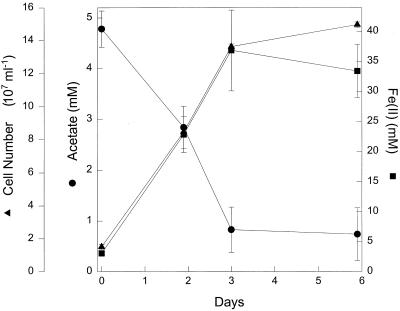
Growth of F. placidus at 85°C with acetate as an electron donor and poorly crystalline Fe(III) as an electron acceptor. The results are the means of triplicate cultures; error bars indicate the standard deviations.
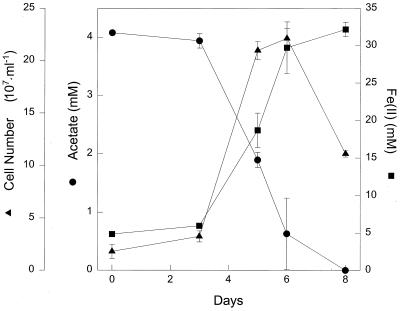
Growth of “G. ahangari” at 85°C with acetate as an electron donor and poorly crystalline Fe(III) as an electron acceptor. The results are the means of triplicate cultures; error bars indicate the standard deviations.
References
-
- Amend J P, Amend A C, Valenza M. Determination of volatile fatty acids in the hot springs of Vulcano, Aeolian Islands, Italy. Org Geochem. 1998;28:699–705.
-
- Hafenbradl D, Keller M, Dirmeier R, Rachel R, Roßnagel P, Burggraf S, Huber H, Stetter K O. Ferroglobus placidus gen nov., sp. nov., a novel hyperthermophilic archaeum that oxidizes Fe+2 at neutral pH under anoxic conditions. Arch Microbiol. 1996;166:308–314. - PubMed
-
- Helgesen H C, Knox A M, Owens C E, Shock E L. Petroleum, oil field waters, and authigenic mineral assemblages: are they in metastable equilibrium in hydrocarbon reservoirs? Geochim Cosmochim Acta. 1993;57:3295–3339.
Publication types
MeSH terms
Substances
LinkOut - more resources
Full Text Sources
Molecular Biology Databases
