


Rotavirus strain diversity in Blantyre, Malawi, from 1997 to 1999
- PMID: 11230392
- PMCID: PMC87838
- DOI: 10.1128/JCM.39.3.836-843.2001
Rotavirus strain diversity in Blantyre, Malawi, from 1997 to 1999
Abstract
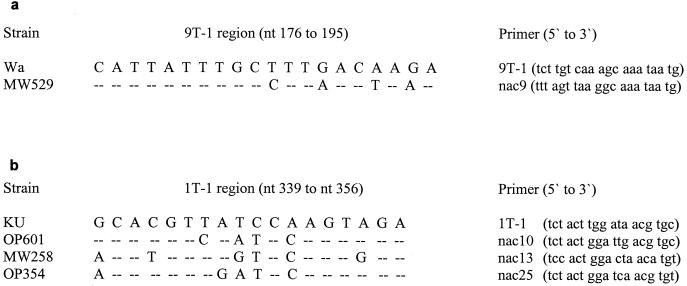
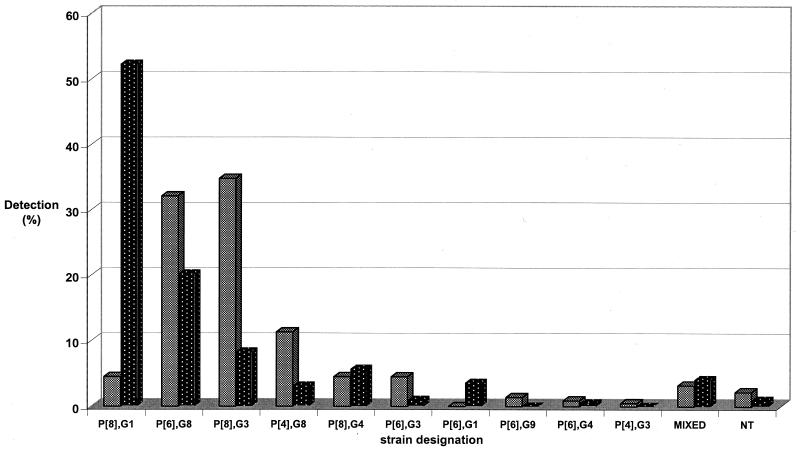
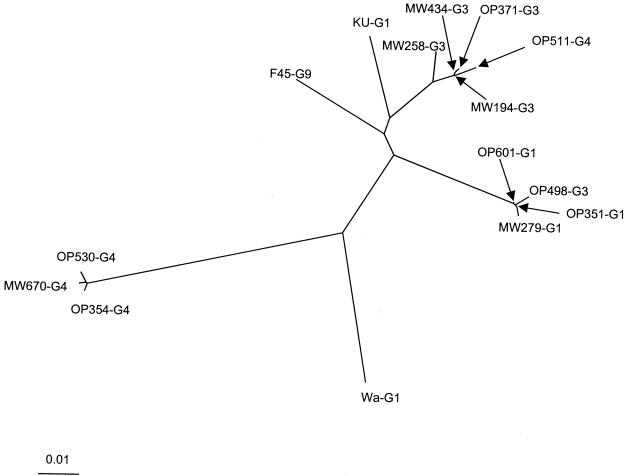
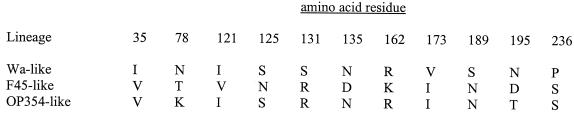
In a 2-year study of viral gastroenteritis in children in Blantyre, Malawi, the diversity of rotavirus strains was investigated by using electropherotyping, reverse transcription-PCR amplification of the VP7 and VP4 genes (G and P genotyping), and nucleotide sequencing. Of 414 rotavirus strains characterized, the following strain types were identified: P[8], G1 (n = 111; 26.8%); P[6], G8 (n = 110; 26.6%); P[8], G3 (n = 93; 22.5%); P[4], G8 (n = 31; 7.5%); P[8], G4 (n = 21; 5.1%); P[6], G3 (n = 12; 2.9%); P[6], G1 (n = 7; 1.7%); P[6], G9 (n = 3; 0.7%); P[6], G4 (n = 3; 0.7%); P[4], G3 (n = 1; 0.2%); and mixed (n = 15; 3.6%). While all strains could be assigned a G type, seven strains (1.7%) remained P nontypeable. The majority of serotype G8 strains and all serotype G9 strains had short electropherotype profiles. All remaining typeable strains had long electropherotypes. Divergent serotype G1 rotaviruses, which contained multiple base substitutions in the 9T-1 primer binding site, were commonly identified in the second year of surveillance. Serotype G2 was not identified. Overall, G8 was the most frequently identified VP7 serotype (n = 144; 34.8%) and P[8] was the most frequently detected VP4 genotype (n = 227; 54.8%). Partial sequence analysis of the VP4 gene of genotype P[8] rotaviruses identified three distinct clusters, which predominantly (but not exclusively) comprised strains belonging to a distinct VP7 serotype (G1, G3, or G4). As a result of mutations in the 1T-1 primer binding site, strains belonging to each cluster required a separate primer for efficient typing. One cluster, represented by P[8], G4 strain OP354, was highly divergent from the established Wa and F45 VP4 P[8] lineages. As is the case for some other countries, the diversity of rotaviruses in Malawi implies that rotavirus vaccines in development will need to protect against a wider panel of serotypes than originally envisioned.
Figures
References
-
- Adah M I, Rohwedder A, Olaleye O D, Werchau H. Nigerian rotavirus serotype G8 could not be typed by PCR due to nucleotide mutation at the 3′ end of the primer binding site. Arch Virol. 1997;142:1881–1887. - PubMed
-
- Adah M I, Rohwedder A, Olaleye O D, Durojaiye O A, Werchau H. Further characterization of field strains of rotavirus from Nigeria. VP4 genotype P6 most frequently identified among symptomatically infected children. J Trop Pediatr. 1997;43:267–274. - PubMed
-
- Bernstein D I, Glass R I, Rodgers G, Davidson B L, Sack D A. Evaluation of rhesus rotavirus monovalent and tetravalent reassortant vaccines in US children. JAMA. 1995;273:1191–1196. - PubMed
Publication types
MeSH terms
Substances
Associated data
- Actions
- Actions
- Actions
- Actions
- Actions
- Actions
- Actions
- Actions
- Actions
- Actions
- Actions
- Actions
Grants and funding
LinkOut - more resources
Full Text Sources
Medical
Research Materials
