doi: 10.1128/CDLI.8.2.449-453.2001.
Suppression of endotoxin- and staphylococcal exotoxin-induced cytokines and chemokines by a phospholipase C inhibitor in human peripheral blood mononuclear cells
Affiliations
- PMID: 11238238
- PMCID: PMC96079
- DOI: 10.1128/CDLI.8.2.449-453.2001
Item in Clipboard
Suppression of endotoxin- and staphylococcal exotoxin-induced cytokines and chemokines by a phospholipase C inhibitor in human peripheral blood mononuclear cells
Clin Diagn Lab Immunol.
2001 Mar.
Abstract
Excessive release of proinflammatory cytokines from cells stimulated with lipopolysaccharide (LPS) or staphylococcal exotoxin (SE) mediates the pathophysiologic manifestations of septic shock. Tricyclodecan-9-yl (D609), an inhibitor of phosphatidylcholine-specific phospholipase C, suppressed LPS- or SE-induced cytokines and chemokines in human peripheral blood mononuclear cells. These data suggest a potential role for D609 in the treatment of septic shock.
Figures
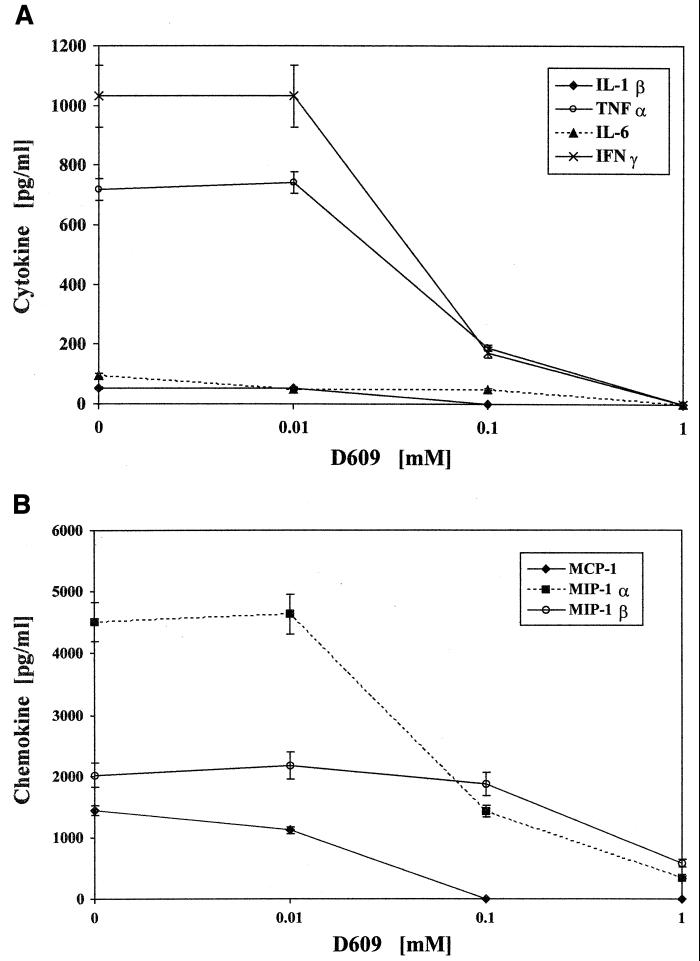
Dose-response inhibition of IL-1β, TNF-α, IL-6, and IFN-γ production (A) and of MCP-1, MIP-1α, and MIP-1β production (B) by PBMC stimulated with 150 ng of SEB/ml in the presence of various D609 concentrations. Values represent means ± standard errors of the means for duplicate samples from two experiments. Inhibition at all concentrations of D609, with the exception of 0.01 mM, was statistically significant by comparison to control SEB-stimulated cells (P < 0.02).
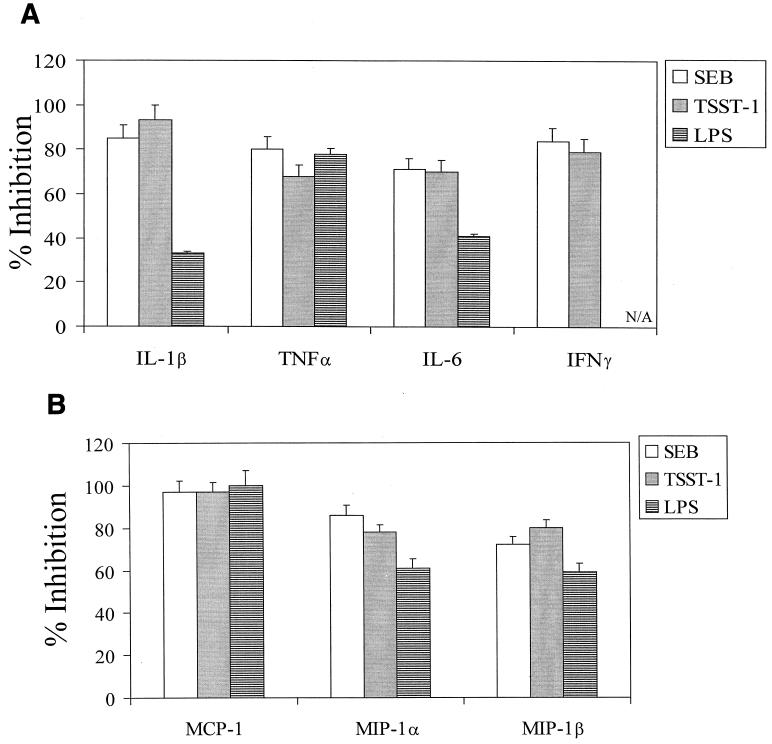
Inhibition of production of IL-1β, TNF-α, IL-6, and IFN-γ (A) and of MCP-1, MIP-1α, and MIP-1β (B) by PBMC stimulated with either SEB (150 ng/ml), TSST-1 (150 ng/ml), or LPS (100 ng/ml) in the presence of 0.2 mM D609. Values represent means ± standard errors of the means for PBMC cultures from 12 blood donors for experiments with SEB and TSST, and a subset of 3 donors for LPS. Results are statistically significant (P < 0.02) between SE and SE-plus-D609 samples and between LPS and LPS-plus-D609 samples. N/A, not applicable.
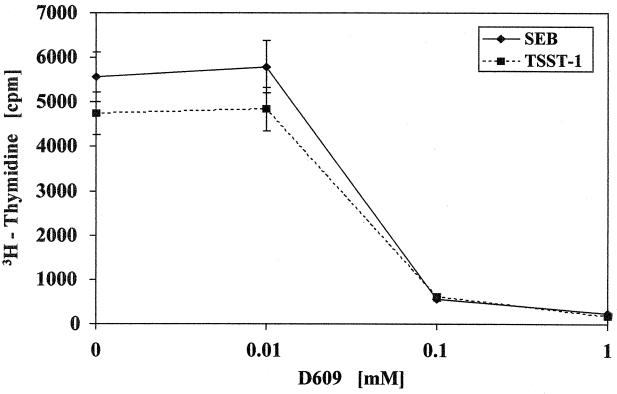
Inhibition of T-cell proliferation in PBMC stimulated with SEB or TSST-1 at 150 ng/ml by varying concentrations of D609. Values are mean counts ± standard errors of the means for triplicate cultures and represent five experiments. Results are statistically significant (P < 0.01) between SE and SE-plus-D609 samples.
References
-
- Abraham E, Glauser M P, Butler T, et al. P55 tumor necrosis factor receptor fusion protein in the treatment of patients with severe sepsis and septic shock: a randomized controlled multicenter clinical trial. JAMA. 1997;277:1531–1538. - PubMed
-
- Bergdoll M S, Schlievert P M. Toxic shock syndrome toxin. Lancet. 1984;ii:691.
-
- Calandra T, Baumgartner J D, Grau G E, et al. Prognostic values of tumor necrosis factor/cachectin, interleukin-1, interferon-alpha, and interferon-gamma in the serum of patients with septic shock. J Infect Dis. 1990;161:982–987. - PubMed
-
- Chatila T, Geha R S. Signal transduction of microbial superantigens via MHC class II molecules. Immunol Rev. 1993;131:43–59. - PubMed
Publication types
MeSH terms
Substances
LinkOut - more resources
Full Text Sources