. 2001 Mar;107(5):595-601.
doi: 10.1172/JCI11902.

Bonzo/CXCR6 expression defines type 1-polarized T-cell subsets with extralymphoid tissue homing potential

Affiliations

Bonzo/CXCR6 expression defines type 1-polarized T-cell subsets with extralymphoid tissue homing potential

C H Kim et al. J Clin Invest. 2001 Mar.

Abstract

Chemokine receptor expression is finely controlled during T-cell development. We show that newly identified chemokine receptor Bonzo/CXCR6 is expressed by subsets of Th1 or T-cytotoxic 1 (Tc1) cells, but not by Th2 or Tc2 cells, establishing Bonzo as a differential marker of polarized type 1 T cells in vitro and in vivo. Priming of naive T cells by dendritic cells induces expression of Bonzo on T cells. IL-12 enhances this dendritic cell-dependent upregulation, while IL-4 inhibits it. In blood, 35-56% of Bonzo+ CD4 T cells are Th1 cells, and 60-65% of Bonzo+ CD8 T cells are Tc1 cells, while few Bonzo+ cells are type 2 T cells. Almost all Bonzo+ Tc1 cells contain preformed granzyme A and display cytotoxic effector phenotype. Most Bonzo+ T cells lack L-selectin and/or CCR7, homing receptors for lymphoid tissues. Instead, Bonzo+ T cells are dramatically enriched among T cells in tissue sites of inflammation, such as rheumatoid joints and inflamed livers. Bonzo may be important in trafficking of effector T cells that mediate type 1 inflammation, making it a potential target for therapeutic modulation of inflammatory diseases.


Figures

Figure 1
Figure 1
Bonzo is expressed by blood CD4+ Th1 memory/effector T cells. (a) Expression of Bonzo by CD27+/– memory CD4. (bd) Cytokine production by Bonzo+/– CD4 T cells. Th1 cells are producers of IFN-γ but not IL-4; Th2 cells are producers of IL-4 but not IFN-γ; Th0 cells are producers of both IFN-γ and IL-4. CD4 T cells prestained with anti-Bonzo and anti-CD45RA were activated by PMA and ionomycin for 4 hours before further staining of intracellular cytokines. Data are representative of at least four experiments using T cells from different donors. Symbols in c represent different donors. Bars indicate averages of four independent experiments (c). ASignificant difference P < 0.03 between CD27+ and CD27 T cells in a or Bonzo+ and Bonzo memory T cells in c.
Figure 2
Figure 2
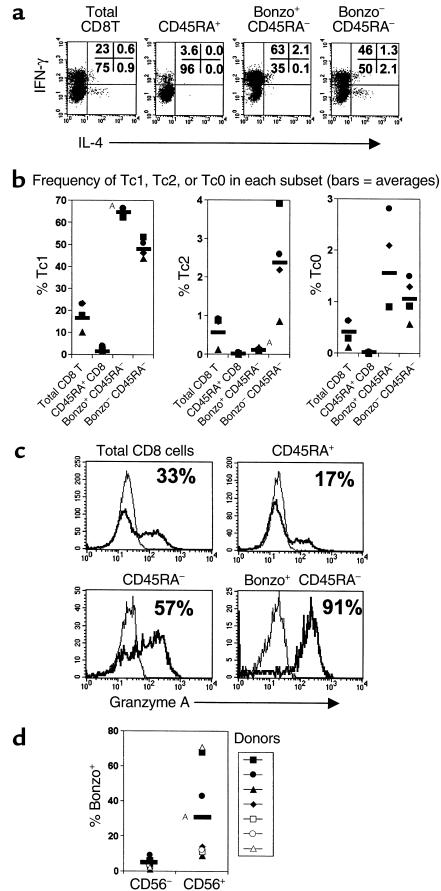
Bonzo is expressed by blood CD8+ Tc1 memory/effector T cells. (a and b) Production of IFN-γ and IL-4 by Bonzo+/– T cells. Expression of intracellular granzyme A (c) and surface effector cytotoxic cell marker CD56 (d) by Bonzo+/– CD8 T cells. Tc1 cells are producers of IFN-γ but not IL-4; Tc2 cells are producers of IL-4 but not IFN-γ; Tc0 cells are producers of both IFN-γ and IL-4. Data are representative of at least four experiments with different donors. Symbols in b and d represent different donors. Bars represent averages of multiple donors. Thick and thin lines in c represent staining with anti-granzyme A and isotype control Ab’s respectively. ASignificant differences P < 0.04 between Bonzo+ and Bonzo CD45RA CD8 T cells.
Figure 3
Figure 3
Homing receptor expression by Bonzo+ and Bonzo CD4 or CD8 T-cell subsets. Expression of CCR7 and L-selectin/CD62L was examined on peripheral blood Bonzo+ and Bonzo CD4 (a) or CD8 (b) populations. Data are representative of at least three experiments with different donors. Averages (with SD) of three independent experiments are shown in lower panels. ASignificant differences P < 0.05 between Bonzo positive and negative populations.
Figure 4
Figure 4
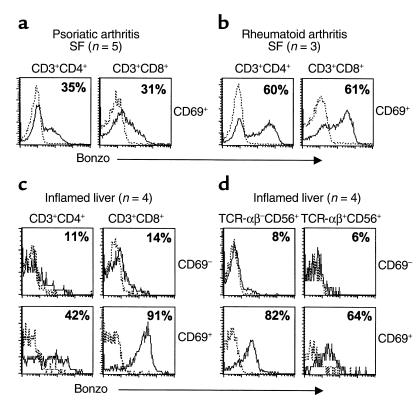
Bonzo is expressed on activated lymphocytes in tissue sites. FACS analysis of lymphocytes in the synovial fluid (SF) from patients with psoriatic arthritis (a) or rheumatoid arthritis (b) revealed that Bonzo is expressed on approximately 30% of both CD4 (range 24–35%) and CD8 (range 20–31%) lymphocytes in PsA and about 60–68% of CD4 and about 61–70% of CD8 T cells in RA, all of which expressed the activation marker CD69. In inflamed (alcoholic and HCV+) cirrhotic livers, Bonzo was expressed at high levels on CD69+ CD4 (range 3–11% for CD69 and 24–56% for CD69+) and CD8 (range 7–60% for CD69 and 50–91% for CD69+) lymphocytes (c). Bonzo expression was also high on TCR-αβCD56+ NK cells (50–92%) and TCR-αβ+CD56+ T cells (64–89%) expressing CD69 (d). Representative Bonzo expression from an alcoholic cirrhotic liver is shown (c and d). Number of independent tissue samples of each type examined (n) is shown.
Figure 5
Figure 5
DCs induce naive T cells to express Bonzo. Naive (CD45RO) CD4 T cells were cultured with mature monocyte-derived DCs (at a ratio 10:1) for 5 days followed by 3-day expansion in IL-2. Naive T-cell primings with DCs were performed also in the presence of IL-4 or IL-12. Data are representative of at least three independent experiments.

Comment in

  • Chemokines: the times they are a-changin'.
    Márquez G, Martínez-A C. Márquez G, et al. J Clin Invest. 2001 Apr;107(7):791-2. doi: 10.1172/JCI12608. J Clin Invest. 2001. PMID: 11285294 Free PMC article. Review. No abstract available.

References

    1. Butcher EC, Williams M, Youngman K, Rott L, Briskin M. Lymphocyte trafficking and regional immunity. Adv Immunol. 1999;72:209–253. - PubMed
    1. Murphy PM, et al. International union of pharmacology. XXII. Nomenclature for chemokine receptors. Pharmacol Rev. 2000;52:145–176. - PubMed
    1. Foxman EF, Campbell JJ, Butcher EC. Multistep navigation and the combinatorial control of leukocyte chemotaxis. J Cell Biol. 1997;139:1349–1360. - PMC - PubMed
    1. Mantovani A. The chemokine system: redundancy for robust outputs. Immunol Today. 1999;20:254–257. - PubMed
    1. Kim CH, Pelus LM, White JR, Broxmeyer HE. Differential chemotactic behavior of developing T cells in response to thymic chemokines. Blood. 1998;91:4434–4443. - PubMed

Publication types

MeSH terms