. 2001 Mar;107(5):603-10.
doi: 10.1172/JCI10881.

Activation of the murine EP3 receptor for PGE2 inhibits cAMP production and promotes platelet aggregation

Affiliations

Activation of the murine EP3 receptor for PGE2 inhibits cAMP production and promotes platelet aggregation

J E Fabre et al. J Clin Invest. 2001 Mar.

Abstract

The importance of arachidonic acid metabolites (termed eicosanoids), particularly those derived from the COX-1 and COX-2 pathways (termed prostanoids), in platelet homeostasis has long been recognized. Thromboxane is a potent agonist, whereas prostacyclin is an inhibitor of platelet aggregation. In contrast, the effect of prostaglandin E2 (PGE2) on platelet aggregation varies significantly depending on its concentration. Low concentrations of PGE2 enhance platelet aggregation, whereas high PGE2 levels inhibit aggregation. The mechanism for this dual action of PGE2 is not clear. This study shows that among the four PGE2 receptors (EP1-EP4), activation of EP3 is sufficient to mediate the proaggregatory actions of low PGE2 concentration. In contrast, the prostacyclin receptor (IP) mediates the inhibitory effect of higher PGE2 concentrations. Furthermore, the relative activation of these two receptors, EP3 and IP, regulates the intracellular level of cAMP and in this way conditions the response of the platelet to aggregating agents. Consistent with these findings, loss of the EP3 receptor in a model of venous inflammation protects against formation of intravascular clots. Our results suggest that local production of PGE2 during an inflammatory process can modulate ensuing platelet responses.


Figures
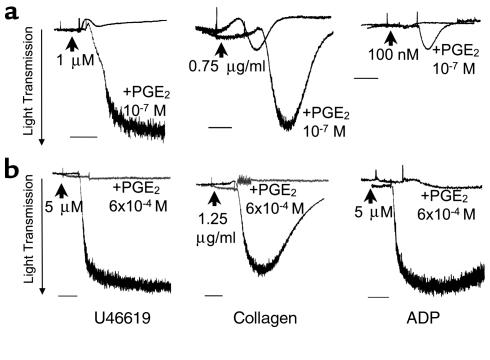
Figure 1
Figure 1
The dual effect of PGE2 on platelet aggregation. (a) Wild-type platelets are exposed to a low concentration of U46619 (1 μM), collagen (0.75 μg/ml), or ADP (100 nM) in the absence or presence of 10–7 M PGE2. At these low levels of stimulation, these agonists do not induce aggregation, except in the presence of PGE2. (b) Higher PGE2 concentrations inhibit the full aggregation induced by 5 μM U46619, 1.25 μg/ml collagen, or 5 μM ADP. Scale bars represent 1 minute. These experiments were repeated three times, and representative traces are shown. The mean of the maximal aggregation was calculated for samples treated with PGE2 and the aggregating agent and for samples treated with the aggregating agent alone. In all cases, the maximal aggregation was significantly higher in the PGE2-treated samples (P < 0.01; unpaired t test).
Figure 2
Figure 2
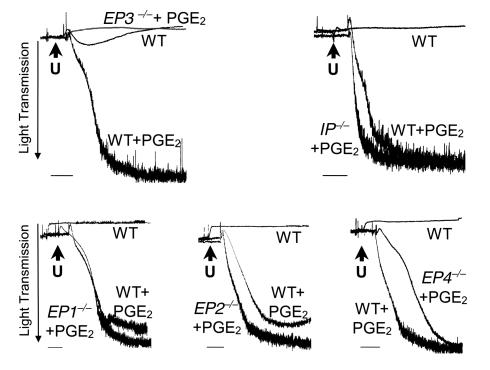
The PGE2-induced potentiation of aggregation is mediated by the EP3 receptor. Comparison of PGE2 (10–7 M) mediated potentiation of aggregation induced by U46619 (1 μM; indicated by the letter “U”) treatment of wild-type platelets (WT) and platelets deficient for each of the prostaglandin receptors. PGE2-induced potentiation is observed in all the samples, with the exception of those lacking the EP3 receptor. Bars = 1 minute. Similar results were obtained on three consecutive experiments, and representative traces are shown. The maximal aggregation induced by PGE2 treatment of EP receptor-deficient platelets in each experiment was calculated, and the mean was compared with similarly treated wild-type platelets. A significant difference (unpaired t test; P < 0.01) was observed only on comparison of the EP3-deficient platelet with wild-type controls.
Figure 3
Figure 3
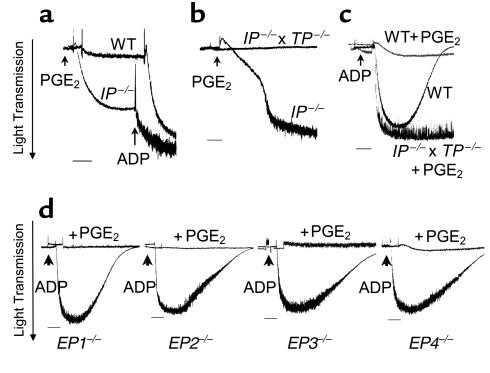
The PGE2-induced inhibition of aggregation is mediated by the IP receptor. (a) PGE2 (10–4 M) alone is sufficient to induce aggregation of IP-deficient platelets, but not wild-type platelets. Further aggregation observed upon addition of ADP reveals that the response to PGE2 in IP-deficient platelets is submaximal. (b) PGE2 (10–4 M) induced aggregation of IP-deficient platelets. The failure to observe aggregation of platelets deficient in both the IP and the TP receptors under similar conditions suggests that high concentrations of PGE2 induced aggregation through the TP receptor. (c) PGE2 (6 × 10⁻⁴ M) fails to abolish ADP (5 μM) induced aggregation in platelets lacking both the IP and TP receptors. (d) Comparison of aggregation induced by 5 μM ADP in the presence and absence of 6 × 10⁻⁴M PGE2, in platelets deficient in each of the EP receptors. Bars = 1 minute. Three experiments were carried out, and representative traces from these experiments are shown. Differences observed on comparison of the mean maximal aggregation for the various genotypes (ac) or between PGE2-treated and untreated samples (d) are significant (P < 0.01; unpaired t test).
Figure 4
Figure 4
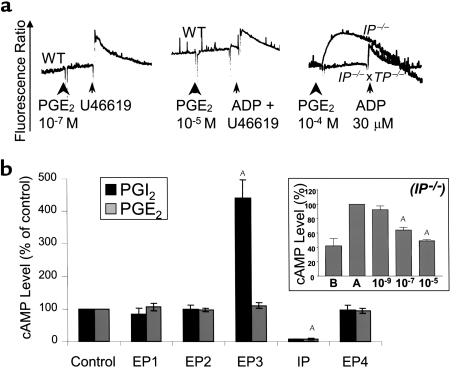
Effects of PGE2 on cytosolic calcium and cAMP levels. (a) Absence of internal calcium mobilization upon treatment of wild-type platelets with 10–7 and 10–5 M PGE2. Change in fluorescence upon subsequent addition of 10 μM U46619 demonstrated that these platelets were able to mobilize their internal calcium stores. After exposure to 10–5 M PGE2, platelets did not respond strongly to 30 μM ADP because of the inhibitory effect of high PGE2 concentration on calcium mobilization. PGE2 (10–4 M) induced calcium mobilization in IP-deficient, but not in IP- and TP-deficient platelets. Experiments examining calcium mobilization in wild-type platelets were repeated five times. Experiments examining calcium mobilization in Ip–/– and Ip–/– × Tp –/– platelets were repeated four times, and similar results were observed in all experiments. A representative trace is shown. (b) Effects of 5 × 10⁻⁵ M PGE2 and 7 × 10⁻⁹ M PGI2 on accumulated cAMP production in each of the receptor-deficient mouse lines compared with their age- and strain-matched controls. Values were normalized to the cAMP level obtained in appropriate control animals (DBA for Ep1–/–, 129 for Ep2–/–, Ep3–/–, and Ip–/–, and mixed background for Ep4–/– mice), and the bars represent the mean of the percent change observed in four experiments (each bar graph represents the values obtained from 16 mice). Error bars = SEM. ASignificant difference: P < 0.01 (ANOVA test, and Dunnett as post test). Inset: effect of increasing concentration of PGE2 on cAMP level elevated by treatment of platelets of IP-deficient platelets with 10–5 M adenosine. Bar A (inset), the cAMP level in platelets treated with 10–5 M adenosine was set at 100%; Bar B (inset), cAMP level in untreated platelets. The remaining bars indicate the percentage of maximal cAMP observed in platelets treated with 10–5 M adenosine and the indicated amount of PGE2 (10–9, 10–7, and 10–5 M). Three experiments were carried out. Error bars = SEM. ASignificant difference: P < 0.01 (ANOVA test, and Dunnett as post test).
Figure 5
Figure 5
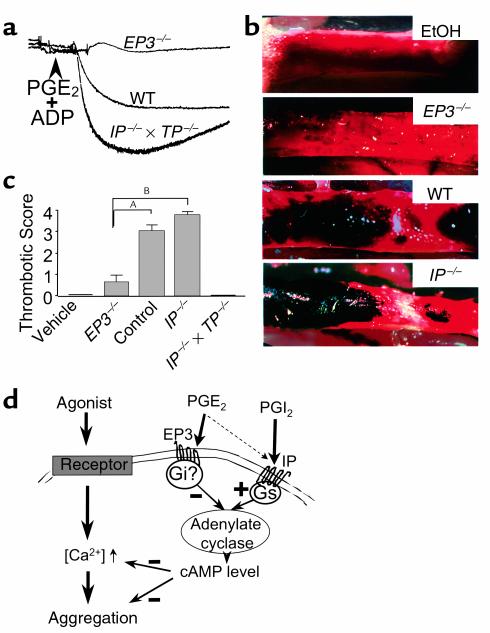
Ex vivo and in vivo implications for PGE2 modulation of cAMP platelet content. (a) Wild-type platelets collected on sodium citrate exposed to 8 × 10⁻⁵ M PGE2, then treated with 5 μM ADP did not display a full aggregation (intermediate trace). The PGE2 concentration used was similar to that used for studies described in Figure 4b. In the same experimental conditions, Ep3–/– platelets, which have higher intracellular cAMP levels, do not aggregate (upper trace). By contrast, platelets lacking the receptor for prostacyclin and thus containing lower cAMP levels aggregated maximally (lower trace). Similar results were obtained in two consecutive experiments. (b) Photomicrographs of venous thrombosis in vivo, induced by periadventitial application of arachidonic acid. Shown are the effect of vehicle (ethanol, EtOH), and the effect induced by arachidonic acid in EP3-deficient, wild-type, and IP-deficient mice. ×15. (c) Thrombotic scores in EP3-deficient, wild-type, IP-deficient, and IP- and TP-deficient mice. Thrombosis was scored as follows: 0, no apparent thrombus; 1, small and isolated thrombus; 2, mural thrombi; 3, partially occlusive thrombi; 4, occlusive thrombi. The scores were 0 in wild-type veins treated with vehicle (n = 6) or in Ip–/– × Tp–/– veins (n = 10). Errors bars = SEM. Data were analyzed using a Kruskal-Wallis test followed by Dunn’s tests. This showed significant differences between Ep3–/– mice (0.60 ± 0.34; n = 14), and control (3.00 ± 0.32; n = 18) or Ip–/– mice (3.75 ± 0.17; n = 16). AP < 0.01. BP < 0.001. (d) Proposed model for the role of cAMP in platelets exposed to prostaglandins. PGE2 preferentially stimulates the EP3 receptor, resulting in a decrease in adenylate cyclase activity and opposing the stimulatory effect induced by the IP receptor. The resulting cAMP level in platelets affects both calcium mobilization and aggregation induced by these agents.

References

    1. Smith WL. Prostaglandin biosynthesis and its compartmentation in vascular smooth muscle and endothelial cells. Annu Rev Physiol. 1986;48:251–262. - PubMed
    1. Bishop-Bailey D, et al. Induction of cyclooxygenase-2 in human saphenous vein and internal mammary artery. Arterioscler Thromb Vasc Biol. 1997;17:1644–1648. - PubMed
    1. Bishop-Bailey D, Pepper JR, Larkin SW, Mitchell JA. Differential induction of cyclooxygenase-2 in human arterial and venous smooth muscle: role of endogenous prostanoids. Arterioscler Thromb Vasc Biol. 1998;18:1655–1661. - PubMed
    1. Mitchell JA, Larkin S, Williams TJ. Cyclooxygenase-2: regulation and relevance in inflammation. Biochem Pharmacol. 1995;50:1535–1542. - PubMed
    1. Stemme V, Swedenborg J, Claesson H, Hansson GK. Expression of cyclo-oxygenase-2 in human atherosclerotic carotid arteries. Eur J Vasc Endovasc Surg. 2000;20:146–152. - PubMed

Publication types

MeSH terms