


A positive regulator of mitosis, Sok2, functions as a negative regulator of meiosis in Saccharomyces cerevisiae
- PMID: 11238897
- PMCID: PMC86706
- DOI: 10.1128/MCB.21.5.1603-1612.2001
A positive regulator of mitosis, Sok2, functions as a negative regulator of meiosis in Saccharomyces cerevisiae
Abstract
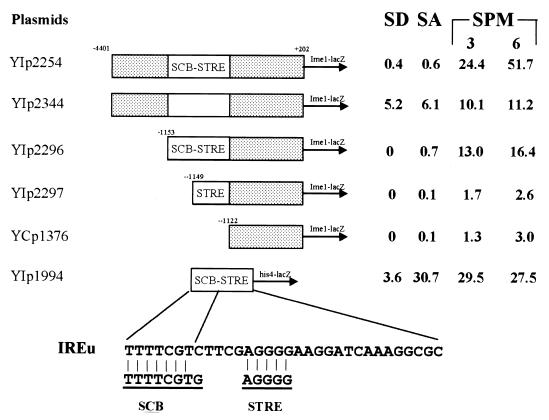
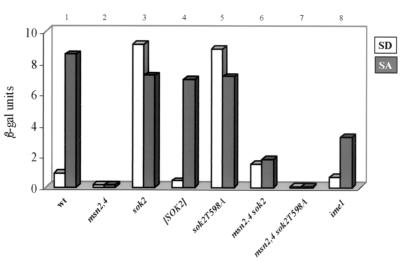
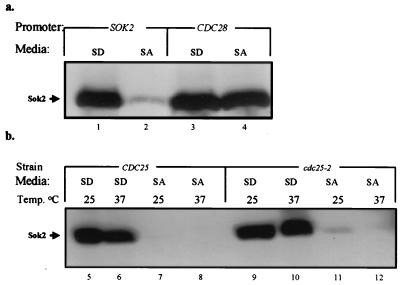
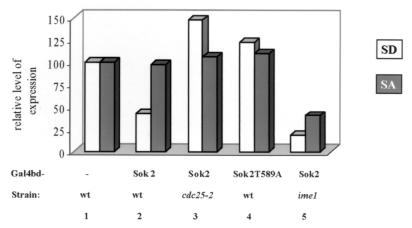
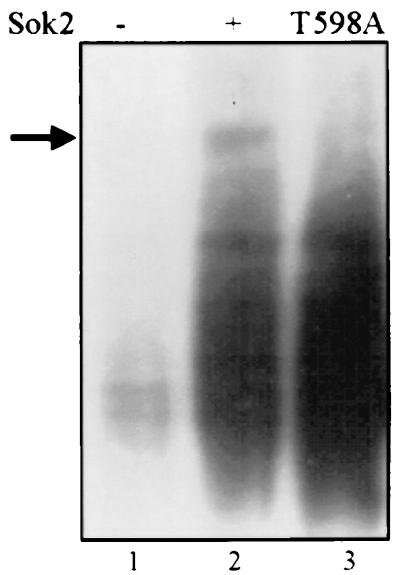
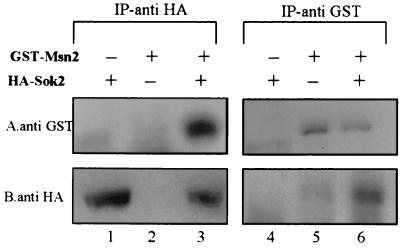
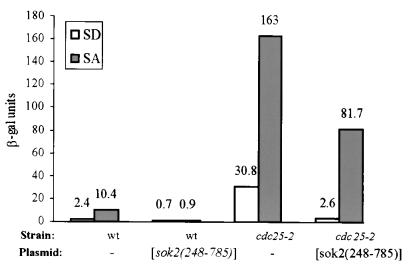
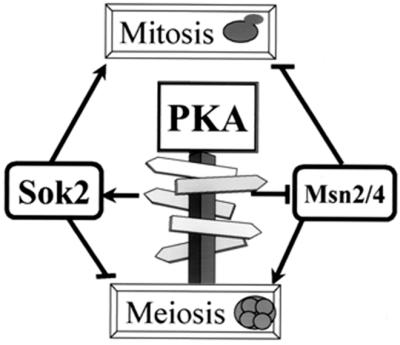
The choice between meiosis and alternative developmental pathways in budding yeast depends on the expression and activity of transcriptional activator Ime1. The transcription of IME1 is repressed in the presence of glucose, and a low basal level of IME1 RNA is observed in vegetative cultures with acetate as the sole carbon source. IREu, a 32-bp element in the IME1 promoter, exhibits upstream activation sequence activity depending on Msn2 and -4 and the presence of acetate. We show that in the presence of glucose IREu functions as a negative element and that Sok2 mediates this repression activity. We show that Sok2 associates with Msn2. Sok2 functions as a general repressor whose availability and activity depend on glucose. The activity of Sok2 as a repressor depends on phosphorylation of T598 by protein kinase A (PKA). Relief of repression of Sok2 depends on both the N-terminal domain of Sok2 and Ime1. In the absence of glucose and the presence of Ime1 Sok2 is converted to a weak activator. Overexpression of Sok2 or mild expression of Sok2 with its N-terminal domain deleted leads to a decrease in sporulation. Previously it was reported that overexpression of Sok2 suppresses the growth defect resulting from a temperature-sensitive PKA; thus Sok2 has a positive role in mitosis. We show that Candida albicans Efg1, a homolog of Sok2, complements sok2 Delta in repressing IREu. Our results demonstrate that Sok2, a positive regulator of mitosis, and Efg1, a positive regulator of filamentation, function as negative regulators of meiosis. We suggest that cells use the same regulators with opposing effects to ensure that meiosis will be an alternative to mitosis.
Figures
References
-
- Ansari K, Martin S, Farkasovsky M, Ehbrecht I M, Kuntzel H. Phospholipase C binds to the receptor-like GPR1 protein and controls pseudohyphal differentiation in Saccharomyces cerevisiae. J Biol Chem. 1999;274:30052–30058. - PubMed
-
- Breeden L, Nasmyth K. Cell cycle control of the yeast HO gene: cis-and trans-acting regulators. Cell. 1987;48:389–397. - PubMed
-
- Broach J R. RAS genes in Saccharomyces cerevisiae: signal transduction in search of a pathway. Trends Genet. 1991;7:28–33. - PubMed
-
- Courey A J, Tjian R. Analysis of Sp1 in vivo reveals multiple transcriptional domains, including a novel glutamine-rich activation motif. Cell. 1988;55:887–898. - PubMed
Publication types
MeSH terms
Substances
LinkOut - more resources
Full Text Sources
Molecular Biology Databases
