


Defining the minimal length of sequence homology required for selective gene isolation by TAR cloning
- PMID: 11239009
- PMCID: PMC29761
- DOI: 10.1093/nar/29.6.e32
Defining the minimal length of sequence homology required for selective gene isolation by TAR cloning
Abstract
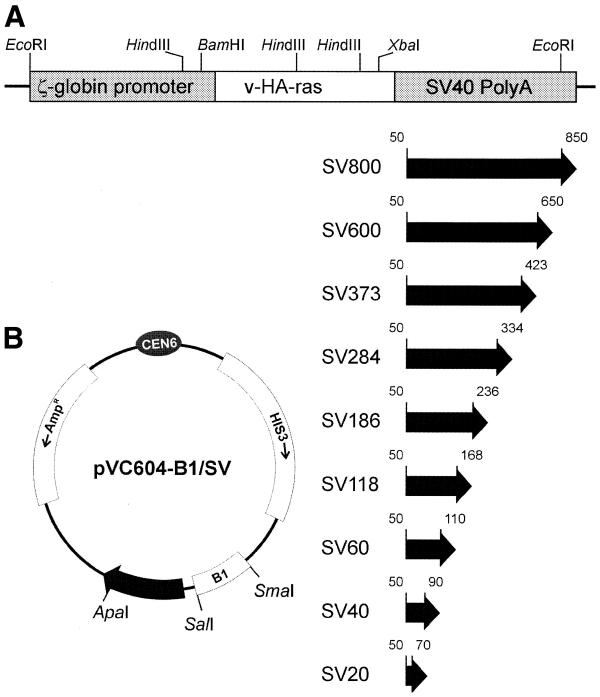
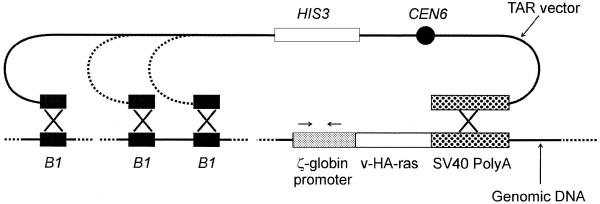
The transformation-associated recombination (TAR) cloning technique allows selective and accurate isolation of chromosomal regions and genes from complex genomes. The technique is based on in vivo recombination between genomic DNA and a linearized vector containing homologous sequences, or hooks, to the gene of interest. The recombination occurs during transformation of yeast spheroplasts that results in the generation of a yeast artificial chromosome (YAC) containing the gene of interest. To further enhance and refine the TAR cloning technology, we determined the minimal size of a specific hook required for gene isolation utilizing the Tg.AC mouse transgene as a targeted region. For this purpose a set of vectors containing a B1 repeat hook and a Tg.AC-specific hook of variable sizes (from 20 to 800 bp) was constructed and checked for efficiency of transgene isolation by a radial TAR cloning. When vectors with a specific hook that was >/=60 bp were utilized, approximately 2% of transformants contained circular YACs with the Tg.AC transgene sequences. Efficiency of cloning dramatically decreased when the TAR vector contained a hook of 40 bp or less. Thus, the minimal length of a unique sequence required for gene isolation by TAR is approximately 60 bp. No transgene-positive YAC clones were detected when an ARS element was incorporated into a vector, demonstrating that the absence of a yeast origin of replication in a vector is a prerequisite for efficient gene isolation by TAR cloning.
Figures
References
-
- Kouprina N. and Larionov,V. (1999) Selective isolation of mammalian genes by TAR cloning. In Boyle,A.L. (ed.), Current Protocols in Human Genetics. John Wiley and Sons, New York, NY, Vol. 1, pp. 5.17.1–5.17.21. - PubMed
MeSH terms
Substances
LinkOut - more resources
Full Text Sources
Other Literature Sources
Miscellaneous
