


Emergence of compulsive behavior and tantrums in children with Prader-Willi syndrome
- PMID: 11246711
- PMCID: PMC6744612
- DOI: 10.1352/0895-8017(2001)106<0039:EOCBAT>2.0.CO;2
Emergence of compulsive behavior and tantrums in children with Prader-Willi syndrome
Erratum in
- Am J Ment Retard 2001 May;106(3):208
Abstract
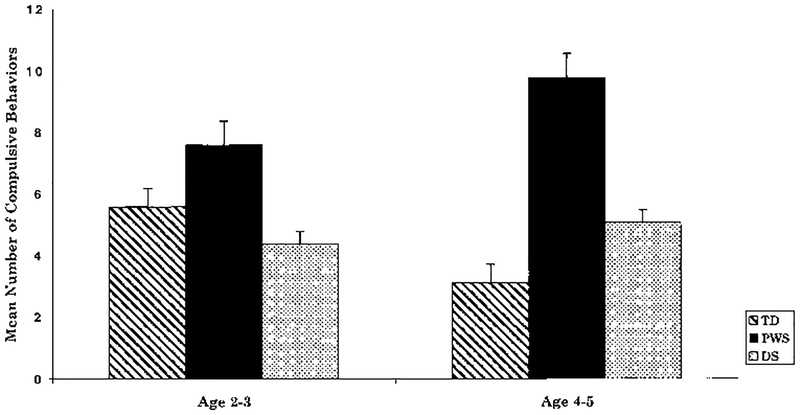
Many adults with Prader-Willi syndrome are affected by behaviors such as tantrums, skin-picking, and compulsions. The nature and extent of these problems suggest more attention be directed to their emergence in childhood. Our purpose was to investigate behavior problems in children with this syndrome and identify the age at which these behaviors emerge. Parents of children with Prader-Willi syndrome, Down syndrome, and those developing typically completed questionnaires. Children with Prader-Willi syndrome exhibited more compulsions, skin-picking, and tantrums than did the other groups. A discriminant analysis of behavior variables derived two statistically significant functions that were interpreted as developmental milestones and problematic behavior. These functions correctly predicted membership for 79% of grouped cases.
Figures
References
-
- Achenbach TM, & Edelbrock C (1983). Manual for the Child Behavior Checklist and Revised Behavior Profile. Burlington: University of Vermont, Department of Psychiatry.
-
- Bath HI (1994). Temper tantrums in group care. Child and Youth Care Forum, 23, 5–27.
-
- Beange H, & Caradus V (1974). The Prader-Willi syndrome. Australian Journal of Mental Retardation, 3, 9–11.
-
- Bodfish JW, Crawford TW, Powell SB, Parker DE, Golden RN, & Lewis MH (1995). Compulsions in adults with mental retardation: Prevalence, phenomenology, and comorbidity with stereotypy and self-injury. American Journal on Mental Retardation, 100, 183–192. - PubMed
-
- Burd L, Vesely B, Martsolf J, & Kerveshian J (1990). Prevalence study of Prader-Willi syndrome in North Dakota. American Journal of Medical Genetics, 37, 97–99. - PubMed
Publication types
MeSH terms
Grants and funding
LinkOut - more resources
Full Text Sources
Medical