


Acceleration of atherogenesis by COX-1-dependent prostanoid formation in low density lipoprotein receptor knockout mice
- PMID: 11248083
- PMCID: PMC30658
- DOI: 10.1073/pnas.061607398
Acceleration of atherogenesis by COX-1-dependent prostanoid formation in low density lipoprotein receptor knockout mice
Abstract
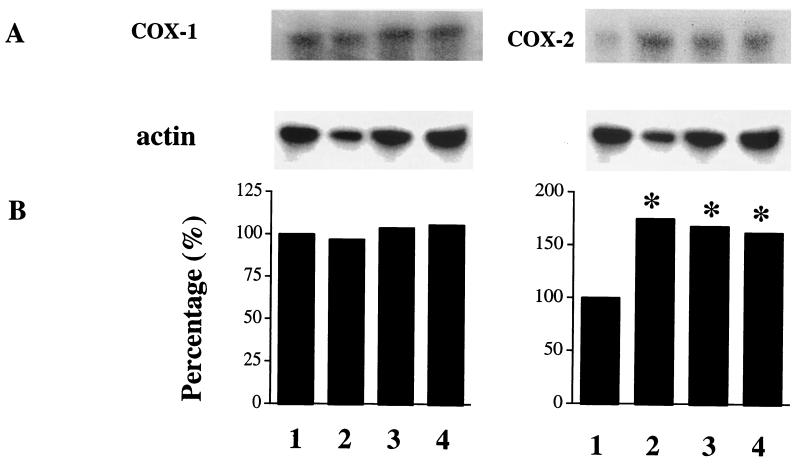
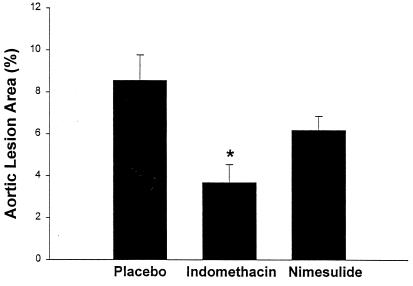
The cyclooxygenase (COX) product, prostacyclin (PGI(2)), inhibits platelet activation and vascular smooth-muscle cell migration and proliferation. Biochemically selective inhibition of COX-2 reduces PGI(2) biosynthesis substantially in humans. Because deletion of the PGI(2) receptor accelerates atherogenesis in the fat-fed low density lipoprotein receptor knockout mouse, we wished to determine whether selective inhibition of COX-2 would accelerate atherogenesis in this model. To address this hypothesis, we used dosing with nimesulide, which inhibited COX-2 ex vivo, depressed urinary 2,3 dinor 6-keto PGF(1alpha) by approximately 60% but had no effect on thromboxane formation by platelets, which only express COX-1. By contrast, the isoform nonspecific inhibitor, indomethacin, suppressed platelet function and thromboxane formation ex vivo and in vivo, coincident with effects on PGI(2) biosynthesis indistinguishable from nimesulide. Indomethacin reduced the extent of atherosclerosis by 55 +/- 4%, whereas nimesulide failed to increase the rate of atherogenesis. Despite their divergent effects on atherogenesis, both drugs depressed two indices of systemic inflammation, soluble intracellular adhesion molecule-1, and monocyte chemoattractant protein-1 to a similar but incomplete degree. Neither drug altered serum lipids and the marked increase in vascular expression of COX-2 during atherogenesis. Accelerated progression of atherosclerosis is unlikely during chronic intake of specific COX-2 inhibitors. Furthermore, evidence that COX-1-derived prostanoids contribute to atherogenesis suggests that controlled evaluation of the effects of nonsteroidal anti-inflammatory drugs and/or aspirin on plaque progression in humans is timely.
Figures



References
-
- Falk E. Circulation. 1985;71:699–708. - PubMed
-
- Davies M J. Cardiovasc Clin. 1987;18:151–159. - PubMed
-
- ISIS-2 (Second International Study of Infarct Survival) Collaborative Group. Lancet. 1988;2:349–360. - PubMed
-
- Chen Z M, Sandercock P, Pan H C, Counsell C, Collins R, Liu L S, Xie J X, Warlow C, Peto R. Stroke (Dallas) 2000;31:1240–1249. - PubMed
Publication types
MeSH terms
Substances
Grants and funding
LinkOut - more resources
Full Text Sources
Other Literature Sources
Medical
Molecular Biology Databases
Research Materials
