


Investigation of mechanisms that mediate reactive hyperaemia in guinea-pig hearts: role of K(ATP) channels, adenosine, nitric oxide and prostaglandins
- PMID: 11250871
- PMCID: PMC1572664
- DOI: 10.1038/sj.bjp.0703929
Investigation of mechanisms that mediate reactive hyperaemia in guinea-pig hearts: role of K(ATP) channels, adenosine, nitric oxide and prostaglandins
Abstract
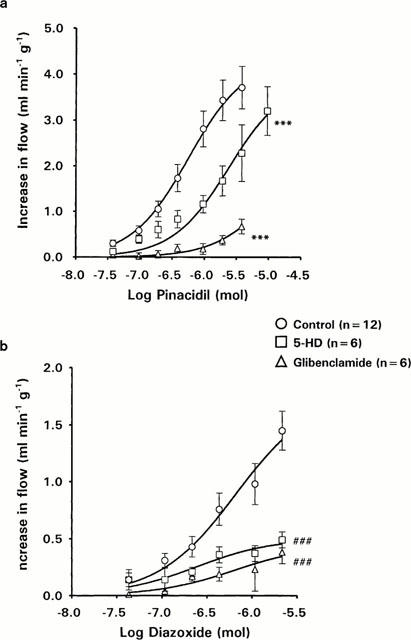
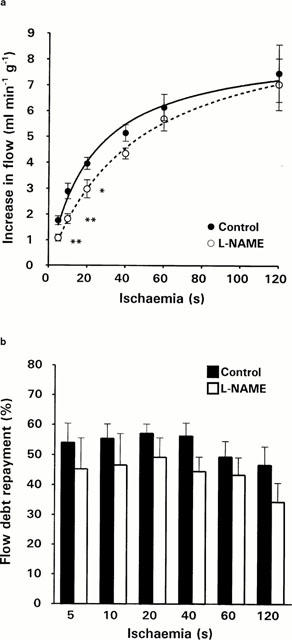
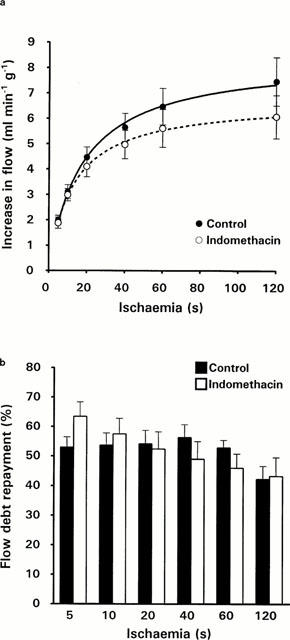
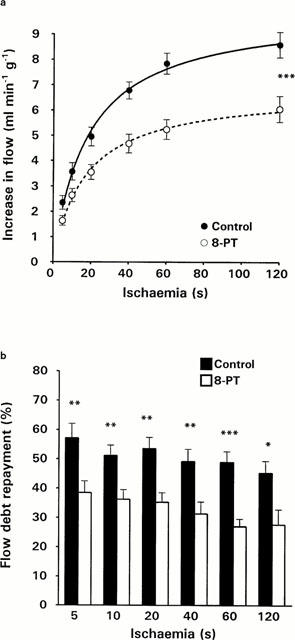
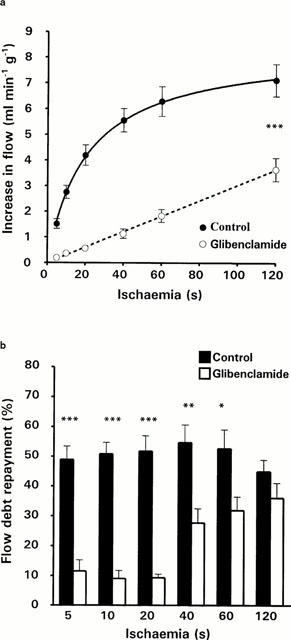
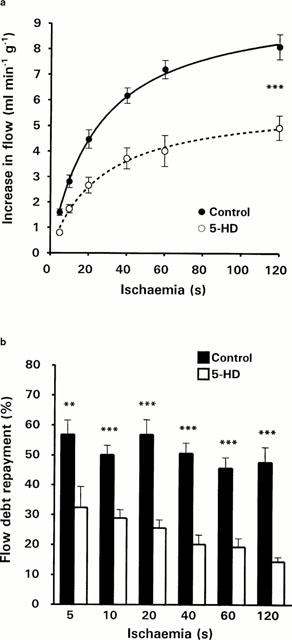
1. Reactive hyperaemia is a transient vasodilatation following a brief ischaemic period. ATP-dependent K(+) (K(ATP)) channels may be important in mediating this response, however it is unclear whether mitochondrial K(ATP) channels contribute to this in the heart. 2. We examined the involvement of K(ATP) channels and the relative role of mitochondrial channels as mediators of coronary reactive hyperaemia and compared them to mechanisms involving NO, prostaglandins and adenosine in the guinea-pig isolated heart. 3. Reactive hyperaemic vasodilatation (peak vasodilator response and flow debt repayment) were assessed after global zero-flow ischaemia (5 -- 120 s) in the presence of nitro-L-arginine methyl ester (L-NAME, 10(-5) M, n=9), 8-phenyltheophylline (8-PT, 10(-6) M, n=12) and indomethacin (10(-5) M, n=12). 4. Glibenclamide (10(-6) M, n=12) a non-selective K(ATP) channel inhibitor and 5-hydroxy-decanoic acid (5-HD, 10(-4) M, n=10) a selective mitochondrial K(ATP) channel inhibitor were also used. The specificity of the effects of glibenclamide and 5-HD (n=6 each) were confirmed using pinacidil (38 nmol -- 10 micromol) and diazoxide (42 nmol -- 2 micromol). Glibenclamide was most effective in blocking the hyperaemic response (by 87%, P<0.001) although 5-HD and 8-PT also had a marked effect (40% inhibition, P<0.001 and 32%, P<0.001, respectively). L-NAME and indomethacin had little effect. 5. Perfusion with L-NAME and glibenclamide significantly reduced baseline coronary flow (22%, P<0.01 and 33%, P<0.01) while 8-PT, indomethacin and 5-HD had no effect. 6. K(ATP) channels are the major mediators of the coronary reactive hyperaemic response in the guinea-pig. Although mitochondrial K(ATP) channels contribute, they appear less important than sarcolemmal channels.
Figures
References
-
- ANDRIEU S., LEBRET M., MACLOUF J., BEVERELLI F., GIUDICELLI J.F., BERDEAUX A. Effects of antiaggregant and antiinflammatory doses of aspirin on coronary hemodynamics and myocardial reactive hyperemia in conscious dogs. J. Cardiovasc. Pharmacol. 1999;33:264–272. - PubMed
-
- AVERSANO T., OUYANG P., SILVERMAN H. Blockade of the ATP-sensitive potassium channel modulates reactive hyperaemia in the canine coronary circulation. Circ. Res. 1991;69:618–622. - PubMed
-
- AVERSANO T., OUYANG P., SILVERMAN H., ZIEGELSTEIN R.C., GIPS S. Effect of blockade of the ATP-sensitive potassium channel on metabolic coronary vasodilation in the dog. Pharmacology. 1993;47:360–368. - PubMed
-
- DAUT J., MAIER-RUDOLPH W., VON-BECKERATH N., MEHRKE G., GUNTER K., GOEDEL-MEINEN L. Hypoxic dilation of coronary arteries is mediated by ATP-sensitive potassium channels. Science. 1990;247:1341–1344. - PubMed
Publication types
MeSH terms
Substances
LinkOut - more resources
Full Text Sources
Medical
