Non-templated addition of nucleotides to the 3' end of nascent RNA during RNA editing in Physarum
- PMID: 11250906
- PMCID: PMC145535
- DOI: 10.1093/emboj/20.6.1405
Non-templated addition of nucleotides to the 3' end of nascent RNA during RNA editing in Physarum
Abstract
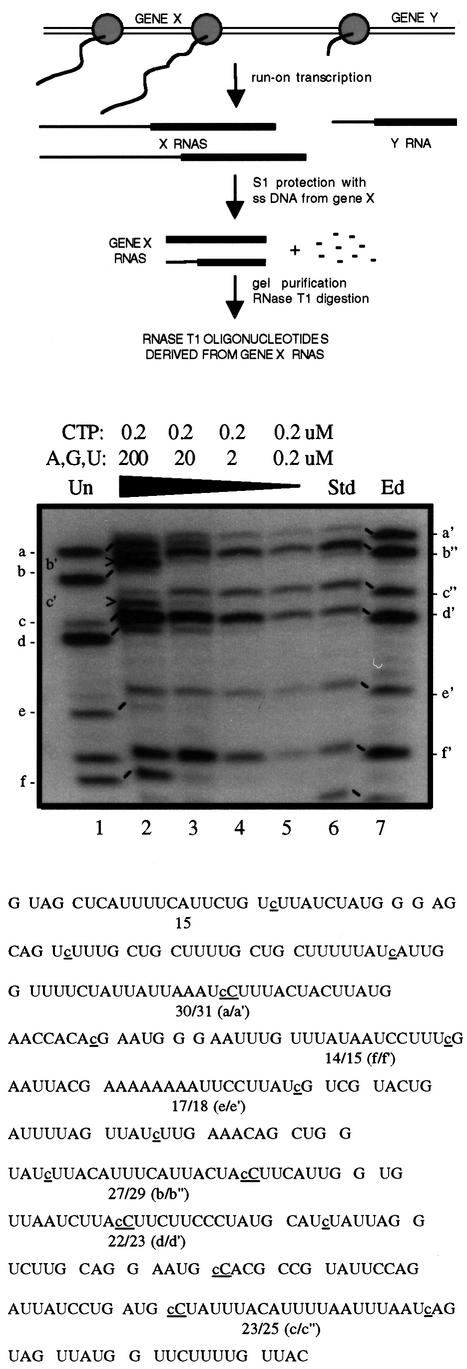
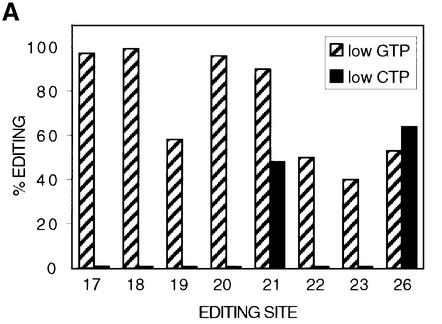
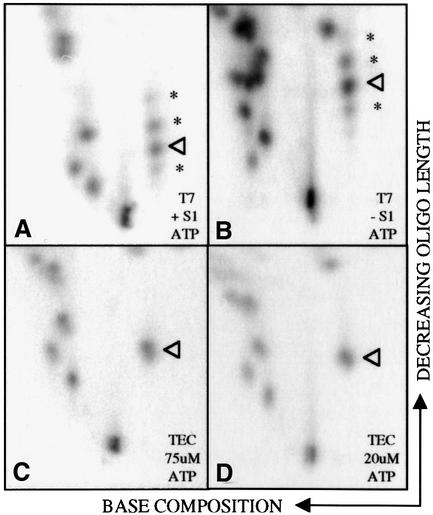
RNAs in Physarum: mitochondria contain extra nucleotides that are not encoded by the mitochondrial genome, at least in the traditional sense. While it is known that insertion of non-encoded nucleotides is linked to RNA synthesis, the exact nature of this relationship remains unclear. Here we demonstrate that the efficiency of editing is sensitive not only to the concentration of the nucleotide that is inserted, but also to the concentration of the nucleotide templated just downstream of an editing site. These data strongly support a co-transcriptional mechanism of Physarum: RNA editing in which non-encoded nucleotides are added to the 3' end of nascent RNAs. These results also suggest that transcription elongation and nucleotide insertion are competing processes and that recognition of editing sites most likely involves transient pausing by the Physarum: mitochondrial RNA polymerase. In addition, the pattern of nucleotide concentration effects, the context of editing sites and the accuracy of the mitochondrial RNA polymerase argue that the mechanism of Physarum: editing is distinct from that of other co-transcriptional editing systems.
Figures
References
-
- Barik S., Ghosh,B., Whalen,W., Lazinski,D. and Das,A. (1987) An antitermination protein engages the elongating transcription apparatus at a promoter-proximal recognition site. Cell, 50, 885–899. - PubMed
-
- Bass B.L. (1993) RNA editing: new uses for old players in the RNA world. In Gesteland,R.F. and Atkins,J.F. (eds), The RNA World. Cold Spring Harbor Laboratory Press, Cold Spring Harbor, NY, pp. 383–418.
Publication types
MeSH terms
Substances
Grants and funding
LinkOut - more resources
Full Text Sources