. 2001 Mar;13(3):553-70.
doi: 10.1105/tpc.13.3.553.

Expression and post-transcriptional regulation of maize transposable element MuDR and its derivatives

Affiliations

Expression and post-transcriptional regulation of maize transposable element MuDR and its derivatives

G N Rudenko et al. Plant Cell. 2001 Mar.

Abstract

The transposition of Mu elements underlying Mutator activity in maize requires a transcriptionally active MuDR element. Despite variation in MuDR copy number and RNA levels in Mutator lines, transposition events are consistently late in plant development, and Mu excision frequencies are similar. Here, we report previously unsuspected and ubiquitous MuDR homologs that produce both RNA and protein. MuDR transcript levels are proportional to MuDR copy number, and homolog transcript levels increase in active Mutator lines. A subset of homologs exhibits constitutive transcription in MuDR(-) and epigenetically silenced MuDR lines, suggesting independent transcriptional regulation. Surprisingly, immunodetection demonstrated nearly invariant levels of MuDR and homolog protein products in all tested Mutator and non-Mutator stocks. These results suggest a strict control over protein production, which might explain the uniform excision frequency of Mu elements. Moreover, the nonfunctional proteins encoded by homologs may negatively regulate Mutator activity and represent part of the host defense against this transposon family.


Figures
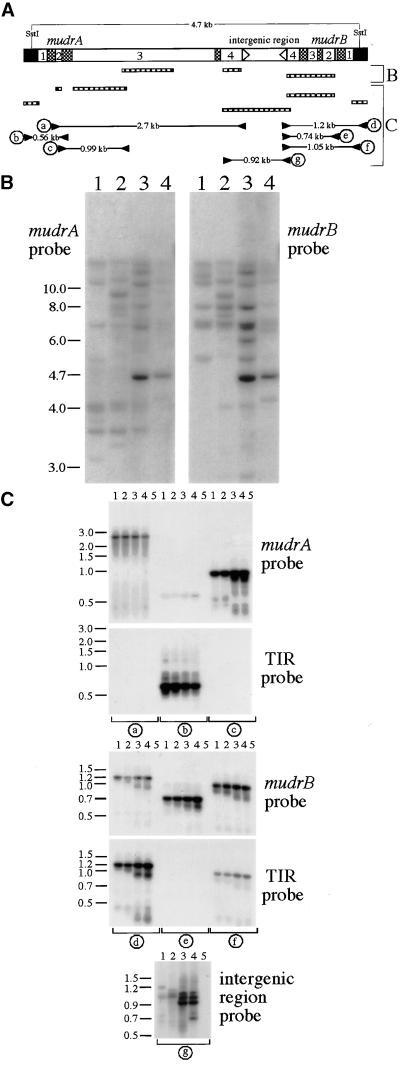
Figure 1.
Figure 1.
Molecular Identification of mudrA and mudrB Homologous Sequences in Various Maize Lines. (A) Diagram of the MuDR transposable element. MuDR terminates in nearly identical 215-bp TIRs (black boxes) and contains the convergently transcribed mudrA and mudrB genes, which are annotated with numbers indicating exons, cross-hatched boxes indicating introns, and arrowheads indicating poly(A) addition sites. Bracket B shows MuDR regions recognized by hybridization probes (hatched boxes) used to analyze the diagnostic 4.7-kb SstI fragment (B). Note that the mudrA probe was a mix of two mudrA-specific fragments. The hatched boxes in bracket C are probes (corresponding to components of MuDR) used in hybridization analysis; also shown are the PCR strategy, primer pairs, and expected sizes of successfully amplified products from the mudrA and mudrB genes analyzed in (C). The detailed description of the hybridization probes and PCR analysis can be found in Methods. (B) DNA samples from mature embryos of two non-Mutator lines, A188/B73 hybrid (lanes 1) and bz2 inbred W23 (lanes 2), and two lines with transcriptionally active MuDR elements, bz2-mu2 (lanes 3) and Robertson's purple Mutator (lanes 4), were digested with SstI and processed by sequential DNA gel blot hybridization as described in (A). (C) Ten nanograms of genomic DNA from the same maize lines in (B) were analyzed by PCR as described in (A). Lanes 5 are no DNA control samples.
Figure 2.
Figure 2.
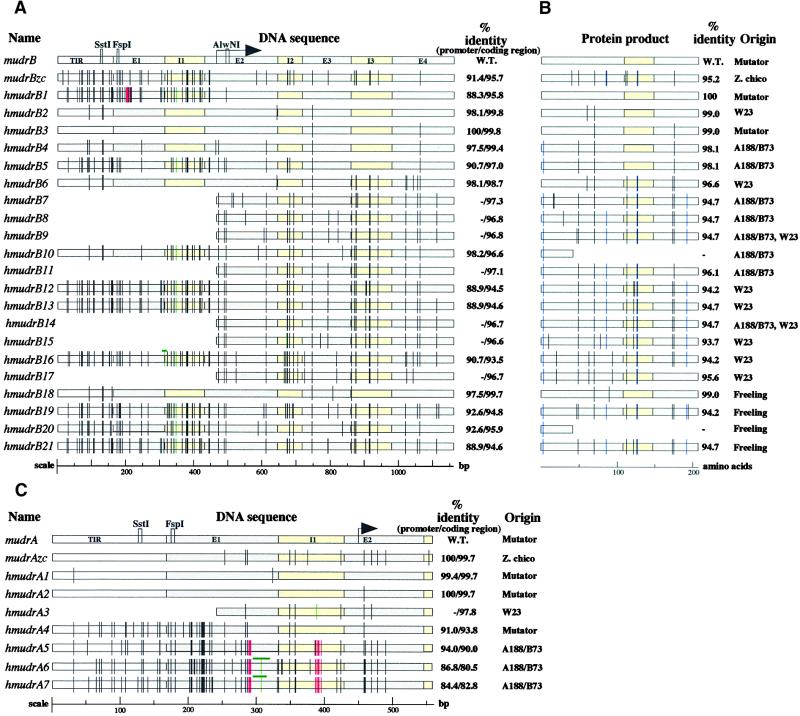
Sequence Analysis of MuDR Homologs. (A) Alignment and analysis of sequenced mudrB homologs. Wild-type (W.T.) mudrB is the top line, followed by the previously reported mudrB from the land race Zapalote chico, mudrBzc; the remaining sequences were recovered in this study, and their origins are listed in the column at right (B). Note that some homolog types were recovered from independent inbred lines. The TIR regions, introns, and exons are drawn to scale; the arrow indicates the translation initiation start site. Observed DNA mutations are indicated by vertical bars or boxes according to a color code: black, single base pair substitutions; green, insertions; red, deletions. As an internal control to account for potential point mutations that might have been derived as a result of clone propagation in Escherichia coli, six full-length wild-type mudrB genes were sequenced from an active Mutator line; these genes had the same sequence as the original MuDR isolate (Hershberger et al. 1995). In addition, single base DNA substitutions have been noted previously in three MuDR clones (Hershberger et al., 1995) and in the independently isolated MuA2 element (James et al., 1993). (B) The MURB protein homologs encoded by each sequenced gene in (A) are shown as retaining intron 3 (207–amino acid form of MURB), with black bars corresponding to conservative substitutions and blue bars representing nonconservative substitutions. Truncated protein products are shown for hmudrB10 and hmudrB20, which share the same mutation creating a stop codon. (C) Graphic alignment of sequenced regions corresponding to the mudrA gene. Annotations are the same as given in (A).
Figure 3.
Figure 3.
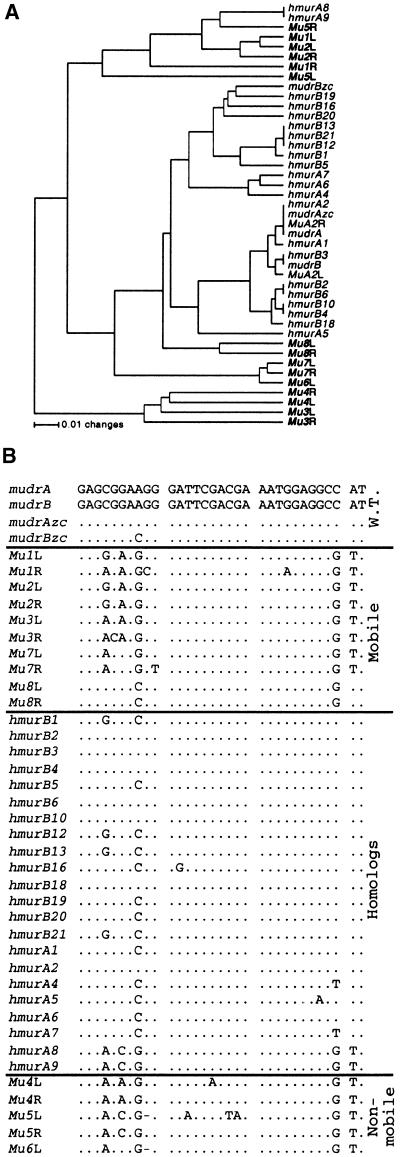
Evolutionary Comparison between Members of MuDR/Mu Family. (A) Unrooted relatedness tree of the TIRs of all sequenced Mu transposable elements. The left (L) and right (R) TIRs are shown; MuDR and related elements described in this study are shown in lightface, and the nonautonomous elements Mu1 to Mu8 are shown in boldface. The tree was generated by the UPGMA method using the Jukes-Cantor model for estimation of distances as implemented in the PAUP4.0b program (Sinauer, Sunderland, MA). Sequences were aligned manually with the aid of Sequencher 3.1.1 (GeneCodes, Ann Arbor, MI) software. (B) Alignment of the 32-bp MURA transposase binding site. Elements were classified based on known genetic properties (Walbot and Rudenko, 2001). At the top (labeled W.T. for wild type) are the sequences for MuDR and MuDRzc. Next are the mobile Mu elements, then the hMuDR elements, and the nonmobile Mu elements. Dots represent matching bases, and dashes represent missing bases.
Figure 4.
Figure 4.
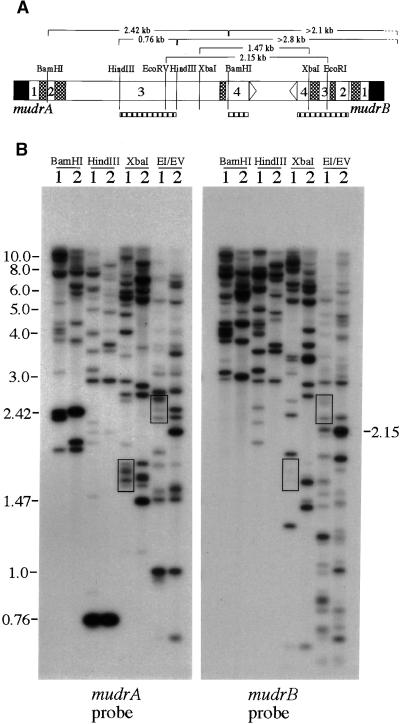
Molecular Organization of Homologous MuDR Genes. (A) Diagram of MuDR and the sizes of expected restriction fragments analyzed in (B). The hatched boxes represent DNA hybridization probes. Note that the mudrA probe is composed of a mixture of exon 3– and exon 4–specific fragments, as described in Methods. (B) DNA samples from the bz2 non-Mutator, W23 inbred line (lanes 1), and the bz2-mu2 active Mutator line (lanes 2) were digested with restriction enzymes as described in (A). Sequential DNA gel blot analysis with mudrA- and mudrB-specific probes demonstrates hybridization of both probes to fragments of the same size, as appropriate, based on the restriction map of MuDR. Some of the most prominent cohybridizing bands (boxes) that differ in size from the wild-type MuDR span the repeat-rich intergenic region, for which length variation has already been reported (Gutiérrez-Nava et al., 1998). Other features are discussed in the text. EI/EV, EcoRI/EcoRV.
Figure 5.
Figure 5.
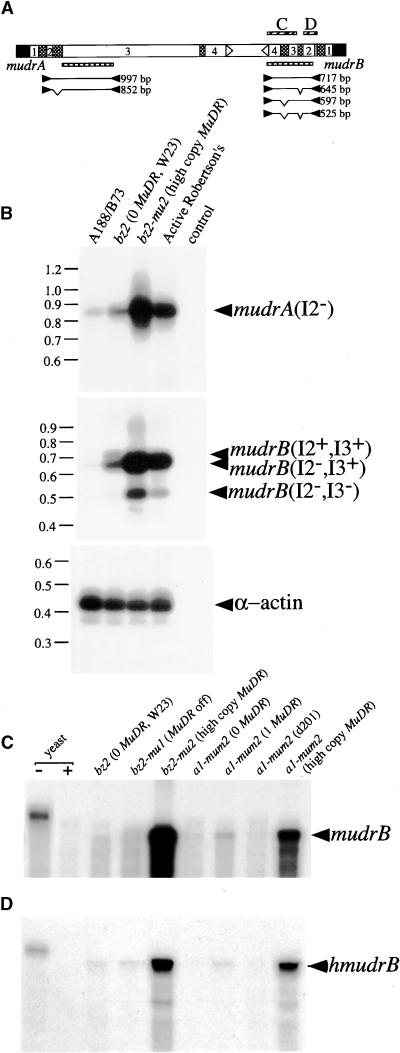
RNA Expression Patterns. (A) Diagram of primers (closed arrowheads), expected products (lines along with calculated sizes), and corresponding hybridization probes (hatched boxes) used in RT-PCR reported in (B) and the riboprobes (cross-hatched boxes) used in RPA analysis reported in (C) and (D). (B) Semiquantitative RT-PCR demonstrates the presence of MuDR- and hMuDR-derived transcripts in mature embryos of two non-Mutator and two Mutator lines. Amplification of α-actin transcripts was included as an internal loading control. Arrowheads indicate the composition of individual products as retaining or lacking individual introns. (C) RPA analysis to detect mudrB. Three active MuDR stocks show different levels of mudrB transcripts, reflecting MuDR copy numbers from 1 to >20. The position of the fully protected probe is indicated by the arrowhead at right; this corresponds to MuDR region 3782 to 4222 (see Table 2). Yeast RNA hybridized to the riboprobe and subsequently unprocessed (−) or processed (+) with the mixture of RNases served as an internal control. (D) RPA analysis to detect hmudrB using probe 4298 to 4496, which is specific for a subset of homologs (see Tables 1 and 2). Other annotations are as in (C).
Figure 6.
Figure 6.
Independent Transcriptional Activity of hMuDR Elements Is Conferred by Evolutionarily Diverged Promoters. (A) Gel-purified RT-PCR products corresponding to the MuDR region 4086 to 4722 were digested with AlwNI and analyzed by DNA gel blot analysis. The positions and compositions of three resulting products are indicated. (B) The epigenetic status of hMuDR promoters was analyzed by DNA gel blot hybridization after FspI digestion of genomic DNA from two MuDR lines (lanes 1 and 2) and two MuDR+ lines (lanes 3 and 4), as described in the legend to Figure 1.
Figure 7.
Figure 7.
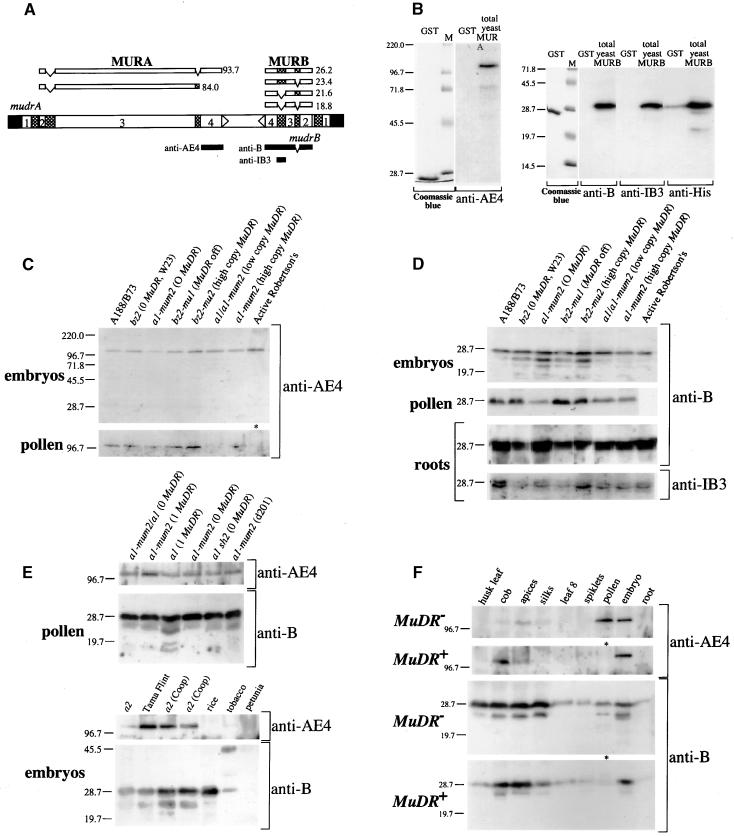
Immunodetection of MURA and MURB Proteins. (A) The alternatively spliced transcripts and calculated molecular masses of the respective protein products (in kD) are shown above the MuDR diagram. The polypeptide domains used for generation of antibodies are indicated below the diagram. (B) Specificity of purified antibodies against the GST tag alone (5 μg) and yeast protein extracts (10 μg) expressing His-tagged full-length MURA and MURB proteins that were used for affinity purification of antibodies. M, molecular mass markers (in kD). (C) Detection of MURA in mature embryos and pollen of various maize lines by immunoblot analysis. The sample array contains non-Mutator lines (hybrid A188/B73 and inbred W23), the a1-mum2 reporter line with no copies of MuDR, an epigenetically silenced bz2-mu1 high-copy MuDR line, and active Mutator lines, including the original purple Mutator line derived by Robertson (1978). As a result of pollen sterility, the pollen extract was prepared from a young tassel of the Robertson's line (asterisk). (D) Immunodetection of MURB using different antibodies. The root samples were separated on higher percentage gels to demonstrate that the predominant MURB band consists of two distinct polypeptides. Other annotations are as in (C). (E) Immunoanalysis to demonstrate the presence of MURB and MURA polypeptides in other maize lines, including those reported previously to have no MURB protein, and in other plant species. (F) Accumulation of MURA and MURB proteins in developmentally staged tissues of non-Mutator inbred line W23 and the original Robertson's purple Mutator line.

References

    1. Andrews, J.D., and Gloor, G.B. (1995). A role for the KP leucine-zipper in regulating P-element transposition in Drosophila melanogaster. Genetics 141, 587–594. - PMC - PubMed
    1. Benito, M.-I., and Walbot, V. (1997). Characterization of the maize Mutator transposable element MURA transposase as a DNA-binding protein. Mol. Cell. Biol. 17, 5165–5175. - PMC - PubMed
    1. Bennetzen, J.L. (1996). The Mutator transposable element system of maize. Curr. Top. Microbiol. Immunol. 204, 195–229. - PubMed
    1. Chandler, V.L., and Hardeman, K.J. (1992). The Mu elements of Zea mays. Adv. Genet. 30, 77–122. - PubMed
    1. Chandler, V.L., and Walbot, V. (1986). DNA modification of a maize transposable element correlates with loss of activity. Proc. Natl. Acad. Sci. USA 83, 1767–1771. - PMC - PubMed

Publication types

MeSH terms