


Review
doi: 10.1136/jcp.54.3.176.
Antioxidants in health and disease
Affiliations
- PMID: 11253127
- PMCID: PMC1731363
- DOI: 10.1136/jcp.54.3.176
Item in Clipboard
Review
Antioxidants in health and disease
J Clin Pathol.
2001 Mar.
Abstract
Free radical production occurs continuously in all cells as part of normal cellular function. However, excess free radical production originating from endogenous or exogenous sources might play a role in many diseases. Antioxidants prevent free radical induced tissue damage by preventing the formation of radicals, scavenging them, or by promoting their decomposition. This article reviews the basic chemistry of free radical formation in the body, the consequences of free radical induced tissue damage, and the function of antioxidant defence systems, with particular reference to the development of atherosclerosis.
Figures
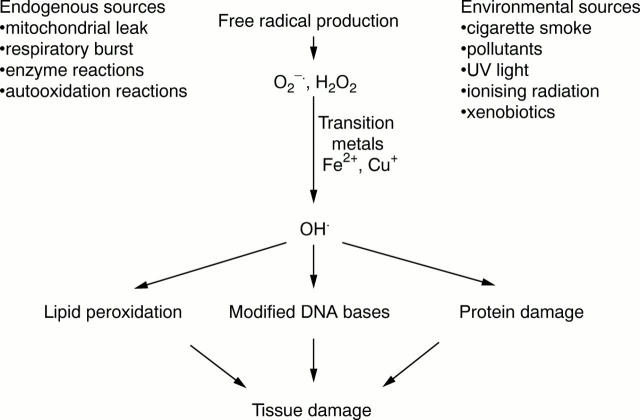
Figure 1 Major sources of free radicals in the body and the consequences of free radical damage.
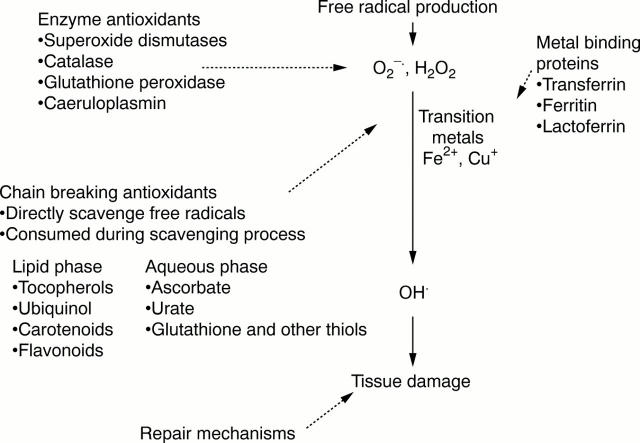
Figure 2 Antioxidant defences against free radical attack. Antioxidant enzymes catalyse the breakdown of free radical species, usually in the intracellular environment. Transition metal binding proteins prevent the interaction of transition metals such as iron and copper with hydrogen peroxide and superoxide producing highly reactive hydroxyl radicals. Chain breaking antioxidants are powerful electron donors and react preferentially with free radicals before important target molecules are damaged. In doing so, the antioxidant is oxidised and must be regenerated or replaced. By definition, the antioxidant radical is relatively unreactive and unable to attack further molecules.
References
Publication types
MeSH terms
Substances
LinkOut - more resources
Full Text Sources
Other Literature Sources
Medical
