


Homozygosity mapping places the acrodermatitis enteropathica gene on chromosomal region 8q24.3
- PMID: 11254458
- PMCID: PMC1275625
- DOI: 10.1086/319514
Homozygosity mapping places the acrodermatitis enteropathica gene on chromosomal region 8q24.3
Abstract
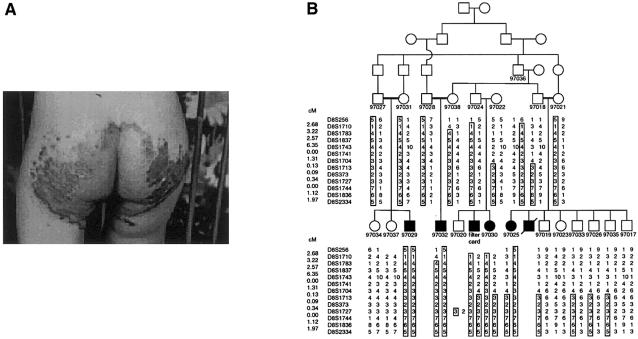
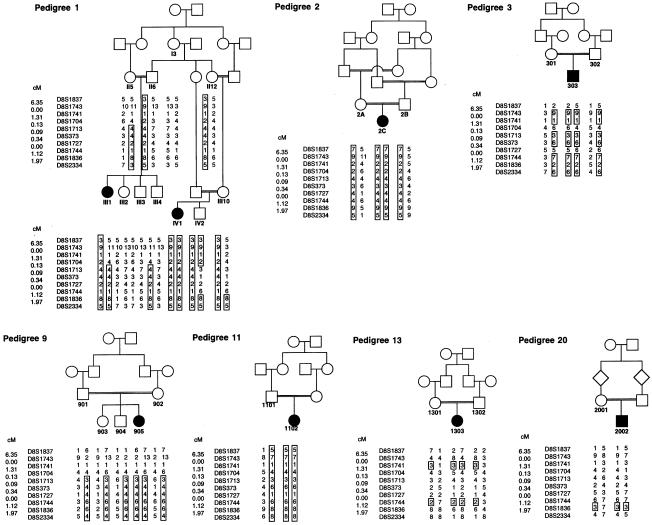
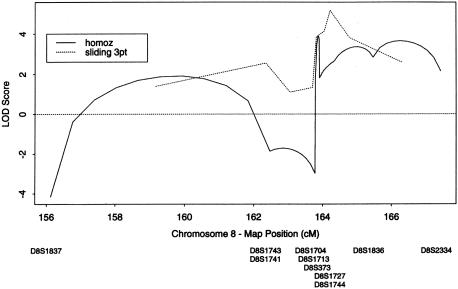
Acrodermatitis enteropathica (AE) is a rare autosomal recessive pediatric disease characterized by dermatitis, diarrhea, alopecia, and growth failure. The disease results from insufficient uptake of zinc by the intestine and can be fatal unless the diet is supplemented with zinc. To map the gene responsible for AE, a genomewide screen was performed on 17 individuals, including 4 affected individuals, in a consanguineous Jordanian family. Three markers-D8S373, D10S212, and D6S1021-had a pattern consistent with tight linkage to a recessive disease: one allele in the affected sibs and multiple alleles in unaffected sibs and parents. Two-point parametric linkage analysis using FASTLINK identified one region, D8S373, with a maximum LOD score >1.5 (1.94 at D8S373: recombination fraction.001). Twelve additional markers flanking D8S373 were used to genotype the extended family, to fine-map the AE gene. All five affected individuals-including one who was not genotyped in the genomewide screen-were found to be homozygous for a common haplotype, spanning approximately 3.5 cM, defined by markers D8S1713 and D8S2334 on chromosomal region 8q24.3. To support these mapping data, seven consanguineous Egyptian families with eight patients with AE were genotyped using these markers, and six patients from five families were found to be homozygous in this region. Multipoint analysis with all consanguineous families, by Mapmaker/Homoz, resulted in a maximum LOD score of 3.89 between D8S1713 and D8S373. Sliding three-point analysis resulted in a maximum LOD score of 5.16 between markers D8S1727 and D8S1744.
Figures
References
Electronic-Database Information
-
- Center for Inherited Disease Research, http://www.cidr.jhmi.edu/ (for the Weber version 9 marker set)
-
- Center for Medical Genetics, Marshfield Medical Research Foundation, http://research.marshfieldclinic.org/genetics/ (for order and genetic distances of markers on 8q)
-
- GeneMap’99, http://www.ncbi.nlm.nih.gov/genemap99/
-
- Online Mendelian Inheritance in Man (OMIM), http://www.ncbi.nlm.nih.gov/Omim/ (for AE [MIM 201100]) - PubMed
-
- UniGene, http://www.ncbi.nlm.nih.gov/UniGene/
References
-
- Atherton DJ, Muller DP, Aggett PJ, Harries JT (1979) A defect in zinc uptake by jejunal biopsies in acrodermatitis enteropathica. Clin Sci 56:505–507 - PubMed
-
- Davies NT (1980) Studies on the absorption of zinc by rat intestine. Br J Nutr 43:189–203 - PubMed
-
- Dillaha CJ, Lorincz AL, Aavik OR (1953) Acrodermatitis enteropathica: review of the literature and report of a case successfully treated with diodoquin. JAMA 152:509–512 - PubMed
Publication types
MeSH terms
Substances
Grants and funding
LinkOut - more resources
Full Text Sources
