. 2001 Apr;69(4):1983-93.
doi: 10.1128/IAI.69.4.1983-1993.2001.

Differential regulation of Bvg-activated virulence factors plays a role in Bordetella pertussis pathogenicity

Affiliations

Differential regulation of Bvg-activated virulence factors plays a role in Bordetella pertussis pathogenicity

S M Kinnear et al. Infect Immun. 2001 Apr.

Abstract

Bordetella pertussis, the causative agent of whooping cough, regulates expression of many virulence factors via a two-component signal transduction system encoded by the bvgAS regulatory locus. It has been shown by transcription activation kinetics that several of the virulence factors are differentially regulated. fha is transcribed within 10 min following a bvgAS-inducing signal, while prn is transcribed after 1 h and ptx is not transcribed until 2 to 4 h after induction. These genes therefore represent early, intermediate, and late classes of bvg-activated promoters, respectively. Although there have been many insightful studies into the mechanisms of BvgAS-mediated regulation, the role that differential regulation of virulence genes plays in B. pertussis pathogenicity has not been characterized. We provide evidence that alterations to the promoter regions of bvg-activated genes can alter the kinetic pattern of expression of these genes without changing steady-state transcription levels. In addition, B. pertussis strains containing these promoter alterations that express either ptx at an early time or fha at a late time demonstrate a significant reduction in their ability to colonize respiratory tracts in an intranasal mouse model of infection. These data suggest a role for differential regulation of bvg-activated genes, and therefore for the BvgAS regulatory system, in the pathogenicity of B. pertussis.


Figures
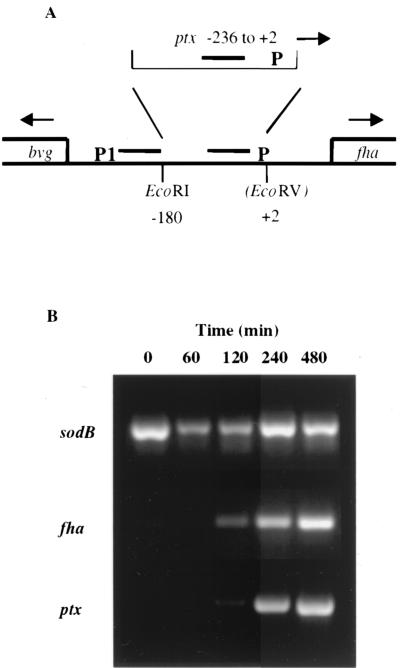
FIG. 1
FIG. 1
Promoter exchange activation kinetics. KMC3, a strain in which the promoter region of the early bvg-activated gene, fha, was replaced with the late bvg-activated ptx promoter region by allelic exchange, was used to determine if the promoter region is responsible for temporal transcriptional regulation. (A) Schematic diagram of the fha promoter replacement by the ptx promoter. Bars, BvgA-binding sequences; P, promoters of the respective genes. (B) RT-PCR analysis of KMC3 was used to detect transcripts of the bvg-independent standard gene (sodB) and fha and ptx at times 0, 60, 120, 240, and 480 min after induction of the Bvg system. RT-PCR products were run on ethidium bromide-stained agarose gels to determine the abundance of transcript at each time point. In wild-type strain Tohama I, fha transcription is present at 30 min after induction and maximal transcription is present at 60 min after induction (see Fig. 1 of reference 17).
FIG. 2
FIG. 2
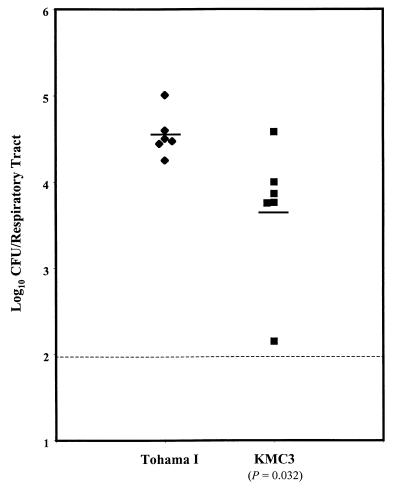
Effect of mutation in KMC3 on colonization. Wild-type B. pertussis strain Tohama I and fha promoter mutant strain KMC3 (5 × 10⁴ CFU of each) were used to intranasally inoculate groups of six mice. There was a statistically significant reduction in the ability of the fha mutant strain to colonize the respiratory tracts of mice compared to that of wild-type strain Tohama I. The P value is shown. Bars, geometric means; dotted line, lower limit of detection.
FIG. 3
FIG. 3
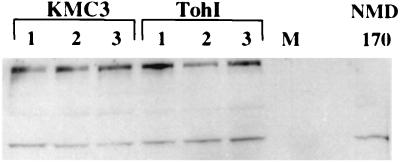
Western blot analysis of FHA expression. Whole-cell lysates from three cultures each of KMC3 and Tohama I (TohI), as well as a whole-cell lysate from NMD170 (an FHA strain of B. pertussis), were analyzed by Western immunoblotting. FHA was detected with an FHA-specific goat polyclonal antibody. The upper high-molecular-weight band, missing in NMD170, represents FHA, while the predominant lower band is presumably a cross-reacting protein. M, rainbow marker (Amersham).
FIG. 4
FIG. 4
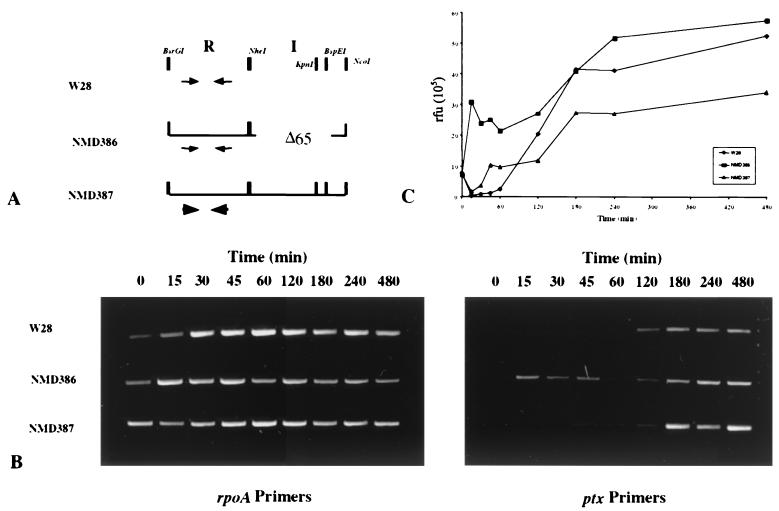
RT-PCR analysis of ptx promoter mutant activation kinetics. (A) Schematic diagram of changes made to the promoter and bvg-activating regions of ptx. Changes were introduced to the chromosome of wild-type B. pertussis strain W28. NMD386 has a deletion of 65 bp in the intervening-sequence region (I), and NMD387 has a replacement of the ptx inverted repeats (arrows) with the inverted repeats of fha (arrowheads) in the repeat region (R). The inverted repeats are sites of primary BvgA binding at these promoters (20). (B) RT-PCR was used to detect transcripts of rpoA and ptx after induction of the Bvg system in wild-type B. pertussis strain W28 and the ptx promoter mutant strains, NMD386 and NMD387. The time course of induction is shown on ethidium bromide-stained agarose gels at 0, 15, 30, 45, 60, 120, 180, 240, and 480 min for the bvg-dependent ptx promoter and bvg-independent standard rpoA. Results from a typical experiment are shown. (C) Samples from the time course of induction were run on an agarose gel, stained with Vistra green, and quantitated using a FluorImager SI system from Molecular Dynamics. ⧫, W28; ■, NMD386; ▴, NMD387. The band intensities were normalized to the rpoA standard and plotted. rfu, relative fluorescence units.
FIG. 5
FIG. 5
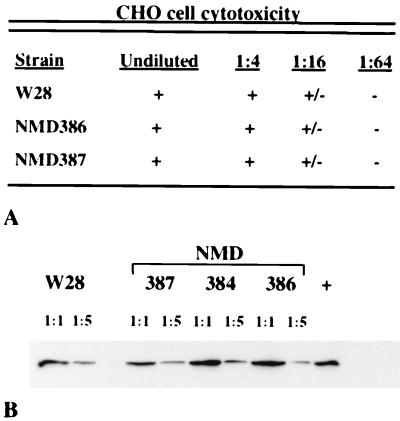
Analysis of PT expression: (A) CHO cell clustering activity of culture supernatants of strains W28, NMD386, and NMD387. (B) The levels of PT secreted by W28, NMD387, NMD384 (a strain similar to NMD386 with a 21-bp deletion in the intervening-sequence region), and NMD386 were compared by Western immunoblotting of TCA-precipitated supernatant proteins. The S1 subunit of PT was detected with monoclonal antibody X2X5. One set of supernatant proteins from cultures grown in triplicate are shown here. Densitometric analysis of bands from all cultures showed no significant difference in the level of secreted PT. +, purified PT control.
FIG. 6
FIG. 6
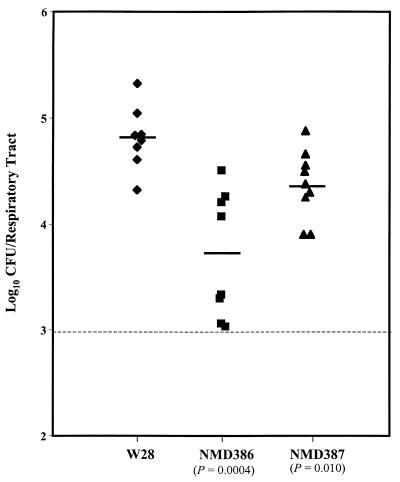
Colonization of mice by ptx promoter mutants. Wild-type B. pertussis strain W28 and ptx promoter mutant strains NMD386 (early in vitro ptx activation) and NMD387 (intermediate in vitro ptx activation) (5 × 10⁴ CFU of each) were intranasally inoculated into groups of eight or nine mice. P values for comparisons between the wild-type and mutant strains are shown. Bars, geometric means; dotted line, lower limit of detection.
FIG. 7
FIG. 7
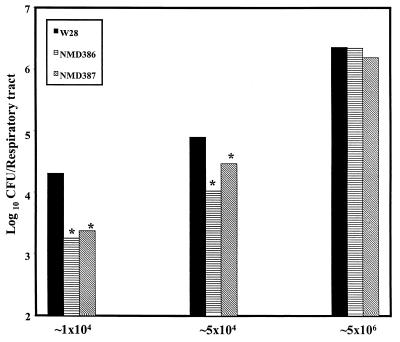
Effect of inoculation dose on colonization by ptx promoter mutants. Groups of six to eight mice were inoculated with approximately 1 × 10⁴, 5 × 10⁴, and 5 × 10⁶ CFU of wild-type B. pertussis strain W28 and the ptx promoter mutant strains, NMD386 and NMD387. Mean values are plotted. Asterisk, statistically significant difference between the wild-type and mutant strains within a dose group.
FIG. 8
FIG. 8
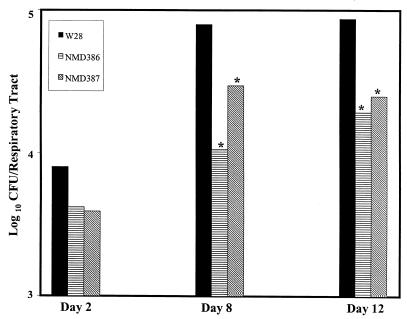
Time course of colonization. Groups of six to eight mice were intranasally inoculated with 5 × 10⁴ CFU of wild-type B. pertussis strain W28 or the ptx promoter mutant strains, NMD386 and NMD387. After 2, 8, and 12 days the trachea and lungs of the mice were harvested and plated to determine CFU. Mean values are plotted. Asterisk, statistically significant difference between the wild-type and mutant strains within a time point.
FIG. 9
FIG. 9
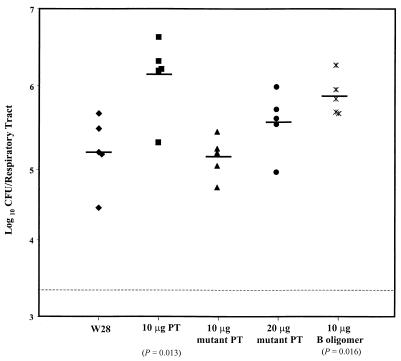
Effect on colonization of addition of purified PT to inoculum. Ten to 20 μg of purified holotoxin, mutant holotoxin, or the B oligomer of PT was added to 5 × 10⁴ CFU of wild-type B. pertussis strain W28 and intranasally inoculated into groups of five mice. Significant P values from comparisons to the no-toxin group (W28) are shown. Bars, geometric means; dotted line, lower limit of detection.
FIG. 10
FIG. 10
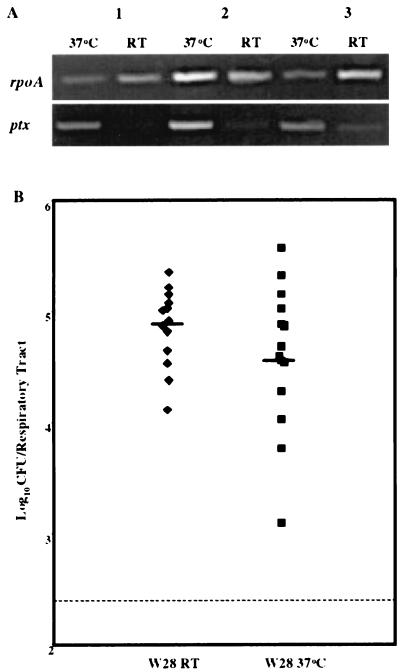
Effect of preinoculation temperature on ptx expression and W28 colonization. (A) RT-PCR was used to detect transcripts of the bvg-independent rpoA gene and the bvg-dependent ptx gene after 1 h of incubation of resuspended W28 cells at either 37°C or room temperature (RT). Results of three independent experiments are shown on ethidium bromide-stained agarose gels. Normalization of the ptx products to the rpoA standard indicated an average 84% decrease in ptx expression between 37°C and room temperature incubations. (B) Wild-type B. pertussis strain W28 (5 × 10⁴) preincubated for 1 h at either room temperature or at 37°C was intranasally inoculated into groups of seven mice. Bars, geometric means; dotted line, lower limit of detection.

References

    1. Aintablian N, Walpita P, Sawyer M H. Detection of Bordetella pertussis and respiratory syncytial virus in air samples from hospital rooms. Infect Control Hosp Epidemiol. 1998;19:918–923. - PubMed
    1. Akerley B J, Cotter P A, Miller J F. Ectopic expression of the flagellar regulon alters development of the Bordetella-host interaction. Cell. 1995;80:611–620. - PubMed
    1. Arico B, Miller J F, Roy C R, Stibitz S, Monack D, Falkow S, Gross R, Rappuoli R. Sequences required for expression of Bordetella pertussis virulence factors share homology with prokaryotic signal transduction proteins. Proc Natl Acad Sci USA. 1989;86:6671–6675. - PMC - PubMed
    1. Bartoloni A, Pizza M, Bigio M, Nucci D, Ashworth L A, Irons L I, Robinson A, Burns D, Manclark C, Sato H, Rappuoli R. Binding of a protective epitope of pertussis toxin by in vitro refolding of recombinant fragments. Bio/Technology. 1988;6:709–712.
    1. Boucher P E, Murakami K, Ishihama A, Stibitz S. Nature of DNA binding and RNA polymerase interaction of the Bordetella pertussis BvgA transcriptional activator at the fha promoter. J Bacteriol. 1997;179:1755–1763. - PMC - PubMed

Publication types

LinkOut - more resources