. 2001 Apr;45(4):1058-64.
doi: 10.1128/AAC.45.4.1058-1064.2001.

Peptide deformylase as an antibacterial drug target: target validation and resistance development

Affiliations

Peptide deformylase as an antibacterial drug target: target validation and resistance development

C M Apfel et al. Antimicrob Agents Chemother. 2001 Apr.

Abstract

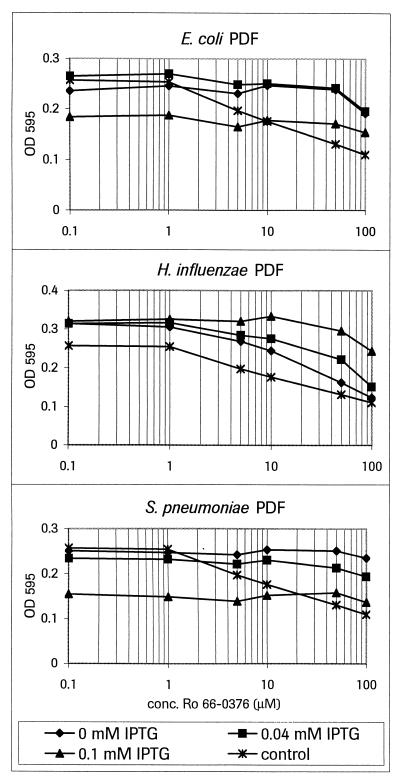
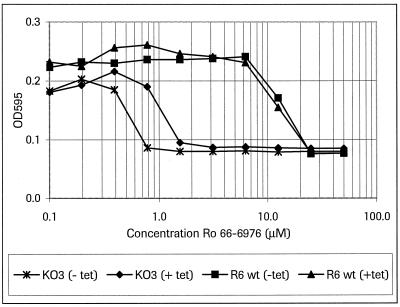
New inhibitors of peptide deformylase (PDF) which are very potent against the isolated enzyme and show a certain degree of antibacterial activity have recently been synthesized by our group. Several lines of experimental evidence indicate that these inhibitors indeed interfere with the target enzyme in the bacterial cell. (i) The inhibition of Escherichia coli growth could be counteracted by overexpression of PDF from different organisms, including E. coli, Streptococcus pneumoniae, and Haemophilus influenzae. Conversely, reduced expression of PDF in S. pneumoniae resulted in an increased susceptibility to the inhibitors. (ii) Proteome analysis on two-dimensional gels revealed a shift for many proteins towards lower pI in the presence of PDF inhibitors, as would be expected if the proteins still carry their N-formyl-Met terminus. (iii) PDF inhibitors show no antimicrobial activity against E. coli under conditions that make growth independent of formylation and deformylation. The antibacterial activity in E. coli was characterized as bacteriostatic. Furthermore, the development of resistance in E. coli was observed to occur with high frequency (10(-7)). Resistant mutants show a reduced growth rate, and DNA sequence analysis revealed mutations in their formyl transferase gene. Taking all these aspects into account, we conclude that PDF may not be an optimal target for broad-spectrum antibacterial agents.


Figures
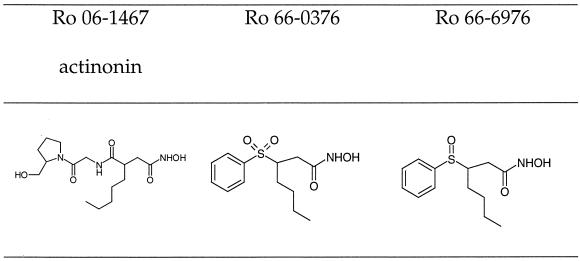
FIG. 1
FIG. 1
Chemical structures of PDF inhibitors.
FIG. 2
FIG. 2
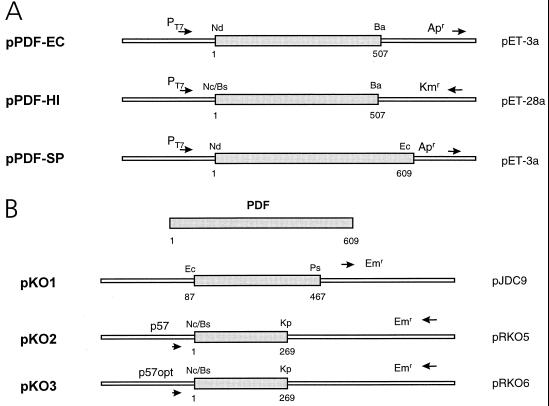
Plasmids used in this study. (A) Plasmids used for controlled expression of pdf genes from E. coli, H. influenzae, and S. pneumoniae. (B) Plasmids for generating controlled pdf gene disruptions in S. pneumoniae. A small internal fragment of the gene was cloned into pJDC9, resulting in pKO1. An amino-terminal fragment of the pdf gene was cloned into the insertion vectors pRKO5 and pRKO6, resulting in plasmids pKO2 and pKO3, which allow tetracycline-regulated pdf expression in the transformants. For details, see Material and Methods. The numbers indicate the nucleotides, starting with 1 at the putative initiation codon of each gene. Abbreviations for restriction enzymes: Ba, BamHI; Bs, BsaI; Ec, EcoRI; Kp, KpnI; Nc, NcoI; Nd, NdeI; Ps, PstI.
FIG. 3
FIG. 3
Counteracting effect of overexpressing PDF from different species on growth inhibition by Ro 66-0376. E. coli BL21 transformed with the indicated plasmids was grown to an OD578 of 0.05 and distributed into 96-well plates. Increasing amounts of IPTG (as indicated) were used to induce the expression of the PDFs, and increasing amounts of the inhibitor Ro 66-0376 were added. The OD595 was measured after 5 h of incubation. The E. coli strain harboring vector pET-3a is shown as the control (noninduced). Conc., concentration.
FIG. 4
FIG. 4
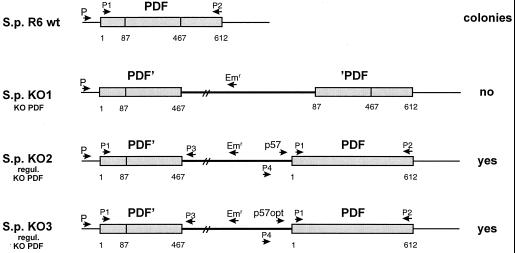
Schematic representation of the chromosomal pdf mutants of S. pneumoniae R6 with integrational plasmids. The numbers indicate the nucleotides, starting with 1 at the initiation codon of each gene. P1 to P4 indicate the primers used in the PCR to prove the correct integration of the plasmids. regul., regulatable.
FIG. 5
FIG. 5
Effect of reduced PDF expression on growth inhibition by Ro 66-6976 in S. pneumoniae. Strains R6 and KO3 were grown to an OD620 of 0.05 and distributed into 96-well plates. Increasing amounts of the inhibitor Ro 66-6976 with or without 20 ng of tetracycline (tet)/ml were added. The OD595 was measured after 16 h of incubation. One representative experiment is shown. wt, wild type.
FIG. 6
FIG. 6
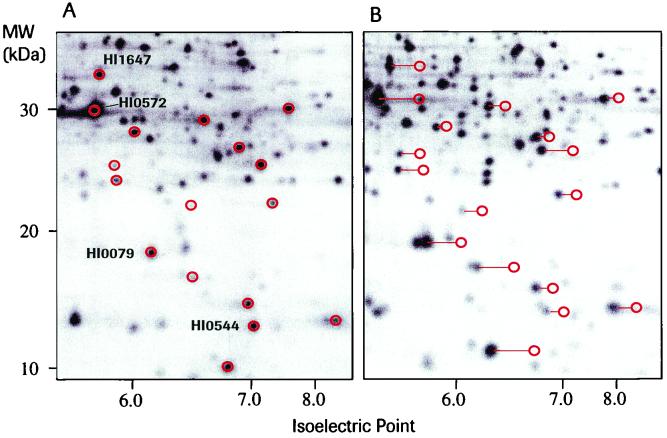
Isoelectric point shifts in proteins triggered by treatment with inhibitors of PDF. in H. influenzae as visualized by 2D PAGE of pulse-labeled protein extracts. Only sections of the 2D gels are shown. (A) Control culture without of addition of inhibitor. The red circles indicate spots that were shifted after the addition of deformylase inhibitors. The spots for which a detailed analysis of the amplitude of the shifts was undertaken are labeled. (B) Culture treated with 16 μg of Ro 06-1467/ml for 90 min. The red circles indicate the positions of spots without treatment. The lines illustrate the spot shifts.
FIG. 7
FIG. 7
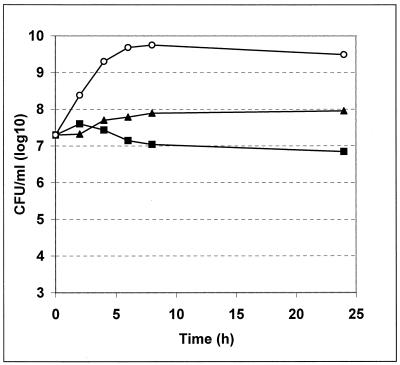
Time-kill kinetics with E. coli DC2. The effect of the addition of Ro 66-0376 (32 μg/ml; solid squares) compared to that of erythromycin (32 μg/ml; solid triangles) on CFU is shown. Open circles, untreated control.

References

    1. Adams J M. On the release of the formyl group from nascent protein. J Mol Biol. 1968;33:571–589. - PubMed
    1. Alloing G, de Philip P, Claverys J P. Three highly homologous membrane-bound lipoproteins participate in oligopeptide transport by the Ami system of the gram-positive Streptococcus pneumoniae. J Mol Biol. 1994;241:44–58. - PubMed
    1. Apfel C, Banner D W, Bur D, Dietz M, Hirata T, Hubschwerlen C, Locher H, Page M G, Pirson W, Rosse G, Specklin J L. Hydroxamic acid derivatives as potent peptide deformylase inhibitors and antibacterial agents. J Med Chem. 2000;43:2324–2331. - PubMed
    1. Apfel C M, Takacs B, Fountoulakis M, Stieger M, Keck W. Use of genomics to identify bacterial undecaprenyl pyrosphosphate synthetase: cloning, expression, and characterization of the essential uppS gene. J Bacteriol. 1999;181:483–492. - PMC - PubMed
    1. Apfel C M, Evers S, Hubschwerlen C, Pirson W, Page M G P, Keck W. Peptide deformylase as an antibacterial drug target: assays for detection of its inhibition in Escherichia coli cell homogenates and intact cells. Antimicrob Agents Chemother. 2001;45:1053–1057. - PMC - PubMed

Publication types

MeSH terms

LinkOut - more resources