. 2001 Apr;21(7):2312-23.
doi: 10.1128/MCB.21.7.2312-2323.2001.

Drosophila Mediator complex is broadly utilized by diverse gene-specific transcription factors at different types of core promoters

Affiliations

Drosophila Mediator complex is broadly utilized by diverse gene-specific transcription factors at different types of core promoters

J M Park et al. Mol Cell Biol. 2001 Apr.

Abstract

To decipher the mechanistic roles of Mediator proteins in regulating developmental specific gene expression and compare them to those of TATA-binding protein (TBP)-associated factors (TAFs), we isolated and analyzed a multiprotein complex containing Drosophila Mediator (dMediator) homologs. dMediator interacts with several sequence-specific transcription factors and basal transcription machinery and is critical for activated transcription in response to diverse transcriptional activators. The requirement for dMediator did not depend on a specific core promoter organization. By contrast, TAFs are preferentially utilized by promoters having a specific core element organization. Therefore, Mediator proteins are suggested to act as a pivotal coactivator that integrates promoter-specific activation signals to the basal transcription machinery.


Figures
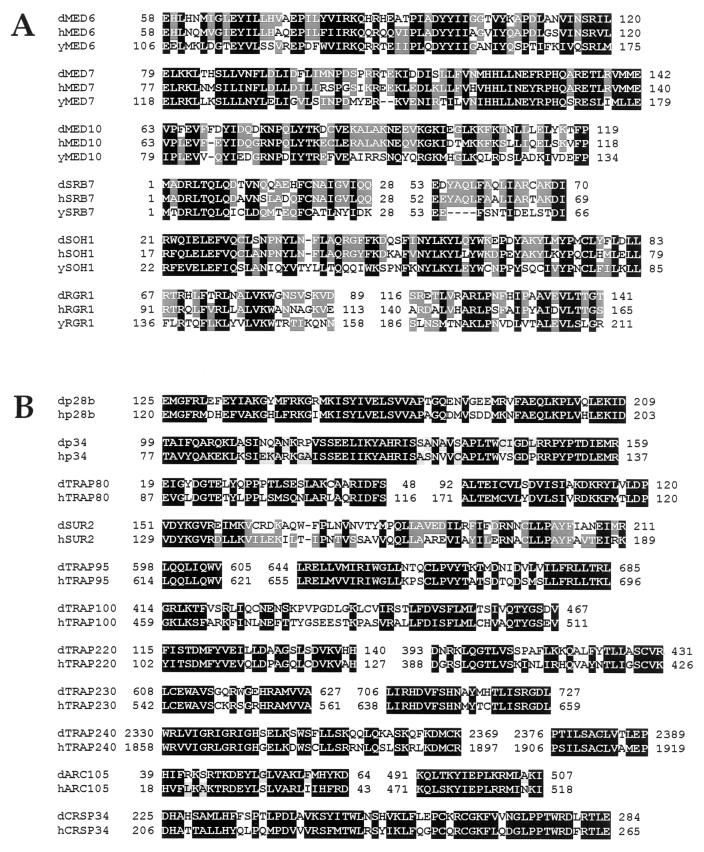
FIG. 1
FIG. 1
Amino acid sequence alignment of dMediator Homologs. (A) Mediator homologs conserved in Drosophila, human, and yeast (denoted by prefixes “d,” “h,” and “y,” respectively). The conserved residues are marked with boxes (black boxes for residues where all three sequences are identical or similar; gray boxes where two of the three are identical or similar). Only the conserved regions are shown. (B) Metazoan-specific Mediator homologs. The conserved amino acid sequences are marked as in panel A. hp28b and hp34 are the human homologs of mouse Mediator proteins p28b and p34 (13).
FIG. 2
FIG. 2
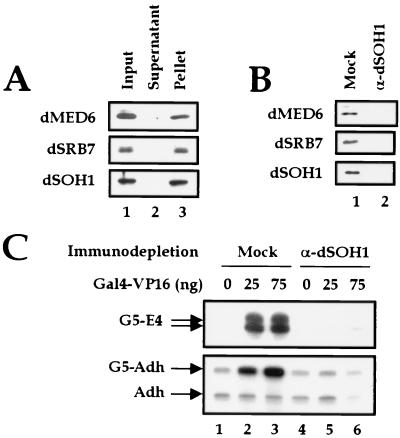
Identification of the dMediator complex. (A) Immunoprecipitation of nuclear extracts with anti-dMED6 Ab. Equivalent amounts of nuclear extract input, supernatant, and pellet of the immunoprecipitation were resolved by SDS-PAGE and immunoblotted with the antibodies indicated at the left. (B) Immunodepletion of nuclear extracts with anti-β-galactosidase (Mock) and anti-dSOH1 (α-dSOH1). The supernatants obtained after incubation were analyzed as in panel A. (C) Transcriptional activation of the E4 and Adh promoter constructs by Gal4-VP16 in nuclear extracts. Before the in vitro transcription assay, the nuclear extracts were immunodepleted with anti-β-galactosidase (Mock) or anti-dSOH1 (α-dSOH1). The amount (nanograms) of recombinant Gal4-VP16 added to the reactions is indicated at the top. The transcripts from the E4 templates containing five copies of the Gal4 DNA binding sites (G5-E4) and the alcohol dehydrogenase proximal (Adh) templates with or without five copies of the Gal4 binding sites (G5-Adh and Adh, respectively) are indicated by arrows at the left.
FIG. 3
FIG. 3
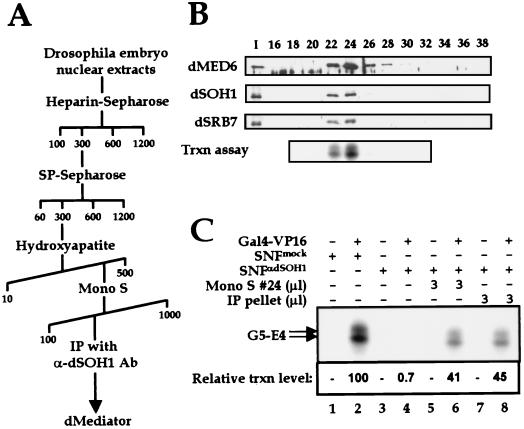
Purification of dMediator. (A) Outline of dMediator purification. The numbers indicate the concentrations (millimolar) of potassium acetate (heparin-Sepharose, SP-Sepharose, and Mono S) or potassium phosphate (hydroxyapatite). (B) Immunoblot and transcriptional (Trxn) analyses of Mono S fractions. Equal amounts of the input (I) samples were loaded on the Mono S column, and the eluted fractions (numbers above the lanes) were resolved by SDS-PAGE and immunoblotted with the Abs indicated at the left. Mono S fractions 18 to 32 were added to the transcription reactions containing the Gal4-VP16 protein and soluble nuclear fraction immunodepleted with anti-dSOH1. (C) Transcription assay of dMediator activity. The Gal4-VP16 protein and soluble nuclear fraction (SNF) immunodepleted with anti-β-galactosidase (SNFmock) or anti-dSOH1 (SNFαdSOH1) were used in transcription reactions as in Fig. 2C. The Mono S peak fraction (#24) and immunopurified dMediator (IP pellet) were added to the reactions as described above.
FIG. 4
FIG. 4
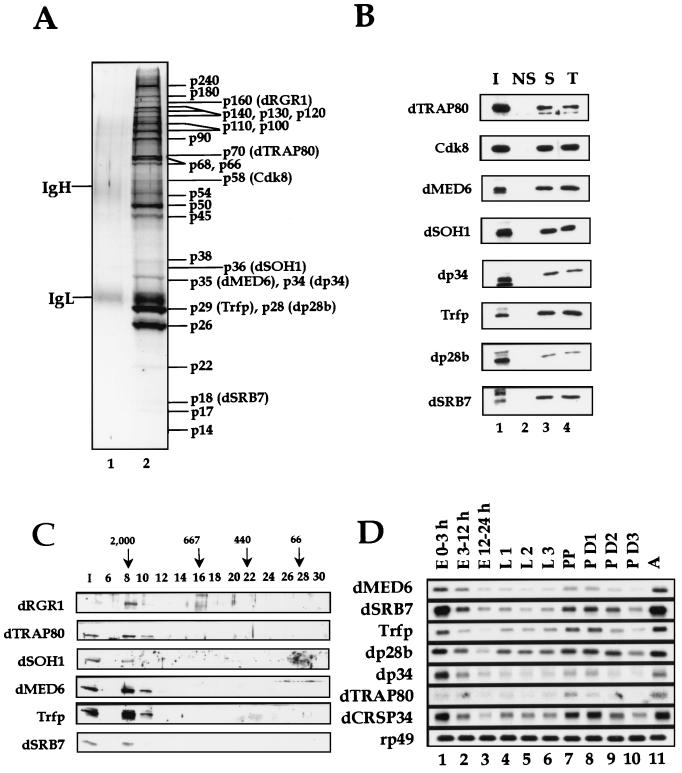
Polypeptide composition and developmental expression pattern of dMediator. (A) Immunoprecipitation of dMediator with anti-dSOH1 beads. Proteins immunoprecipitated from buffer IP100 (lane 1) or the Mono S dMediator peak fraction (lane 2) were electrophoresed on SDS–11.5% polyacrylamide gels and silver stained. Identified dMediator components are indicated at the right. Immunoglobulin heavy (IgH) and light (IgL) chains are indicated at the left. (B) Immunoblot analysis of dMediator proteins immunoprecipitated with nonspecific anti-β-galactosidase (NS), anti-dSOH1 (S), and anti-Trfp (T). The input Mono S fraction (I) is shown for comparison. (C) Superose-6 chromatography of the dMediator complex. The Mono S peak fractions (I) were fractionated on a Superose-6 column, and the fractions (numbers above the lanes) were subjected to SDS-PAGE and analyzed by immunoblotting with the Abs indicated at the left. The elution positions of size markers (in kilodaltons) are indicated by arrows. The size markers used were blue dextran (2,000 kDa; void volume), thyroglobulin (667 kDa), ferritin (440 kDa), and bovine serum albumin (66 kDa). (D) Developmental expression pattern of dMediator homologs. Poly(A) RNA (4 μg per lane) from Drosophila embryos (E), first (L 1)-, second (L 2)-, and third (L 3)-instar larvae, white prepupae (PP), day 1 (P D1), day 2 (P D2), and day 3 (P D3) pupae, and adults (A) were electrophoresed on a formaldehyde agarose gel and probed with radiolabled DNA fragments derived from the dMediator genes indicated at the left. rp49 was used as a positive control.
FIG. 5
FIG. 5
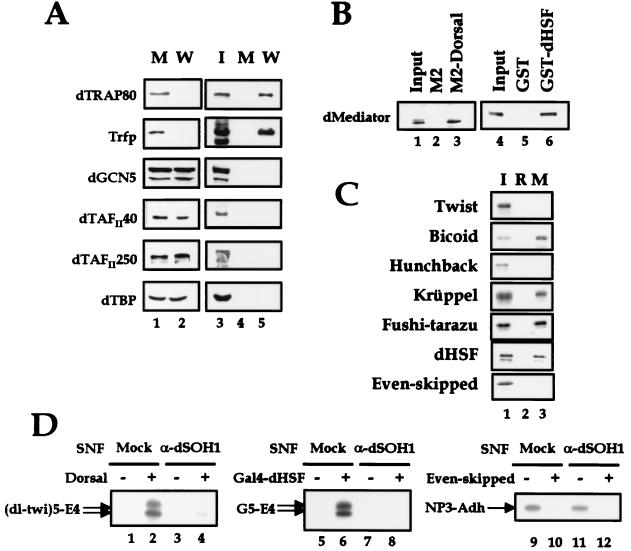
Interaction of dMediator with sequence-specific transcription factors. (A) Physical interaction of Drosophila coactivator proteins with the VP16 activation domain. Nuclear extract was incubated with GST beads containing the wild-type (W) and Δ456FP442 (M) VP16 activation domains. Proteins in unbound fractions (lanes 1 and 2), bead-bound proteins (lanes 4 and 5), and the input extract (I; lane 3) were analyzed by SDS-PAGE and then immunoblotted with the Abs specific for the coactivator proteins indicated on the left. (B) Physical interaction of dMediator with Dorsal and dHSF. FLAG-Dorsal and GST-dHSF fusion proteins were immobilized on beads and used in pulldown assays as in panel. A. Binding of dMediator to each bead was monitored by immunoblotting with anti-Trfp (lanes 1 to 3) and anti-dTRAP80 (lanes 4 to 6) Abs. (C) Physical interaction of dMediator with several sequence-specific transcription factors. dMediator was immobilized on anti-dSOH1 beads and incubated with the 35S-labeled transcription factors indicated at the left. The input sample (I) and proteins bound to blank resin (R) and dMediator-immobilized beads (M) were separated by SDS-PAGE and analyzed by autoradiography. (D) Requirement of dMediator for transcriptional regulation by Dorsal, dHSF, and Even-skipped. Plasmid templates containing the respective binding sites for Dorsal, Gal4-dHSF, and Even-skipped were used in transcription reactions. Transcriptional activation by Dorsal and Ga14-dHSF and transcriptional repression by Even-skipped in soluble nuclear fraction (SNF) immunodepleted with anti-β-galactosidase (Mock) and anti-dSOH1 (α-dSOH1) were analyzed as in Fig. 2C. (dl-twi)5, five copies of the Dorsal-Twist binding sites.
FIG. 6
FIG. 6
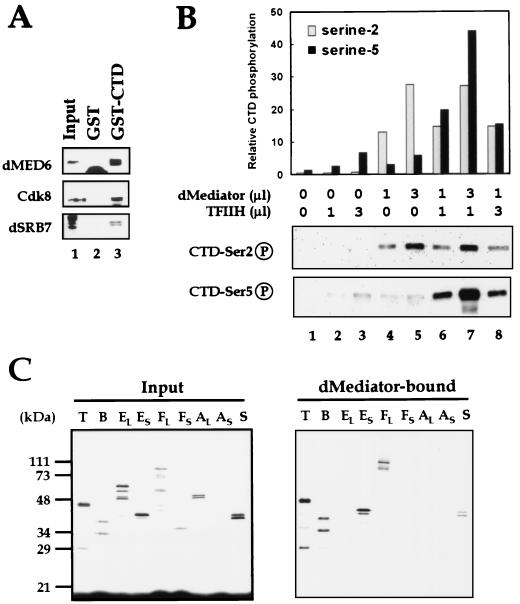
Interaction of dMediator with the basal transcription machinery. (A) Interaction of dMediator with the Pol II CTD. GST-pulldown assays were carried out as for Fig. 5A and B. dMediator proteins in the input (Mono S fraction 24), GST-bound, and GST-CTD-bound fractions were analyzed by immunoblotting with the antibodies indicated at the left. (B) Phosphorylation of the Pol II CTD by dMediator and TFIIH. GST fusion protein containing Drosophila Pol II CTD was incubated with TFIIH (purified from Drosophila embryo extracts and provided by Gaku Mizuguchi) and/or dMediator and analyzed by immunoblotting with monoclonal Abs that specifically recognize phosphorylated serine 2 (H5) and serine 5 (H14) within the CTD. (C) Physical interaction of dMediator with general transcription factors. 35S-labeled general transcription factors, namely, TBP (T), TFIIB (B), TFIIE-L (EL) and -S (ES), TFIIF-L (FL) and -S (FS), TFIIA-L (AL) and -S (AS), and TFIIS (S), were synthesized in reticulocyte lysates (left) and incubated with bead-bound dMediator as for Fig. 5C. The sizes of molecular weight markers are indicated at the left. Proteins bound to dMediator beads were analyzed by SDS-PAGE and autoradiography (right).
FIG. 7
FIG. 7
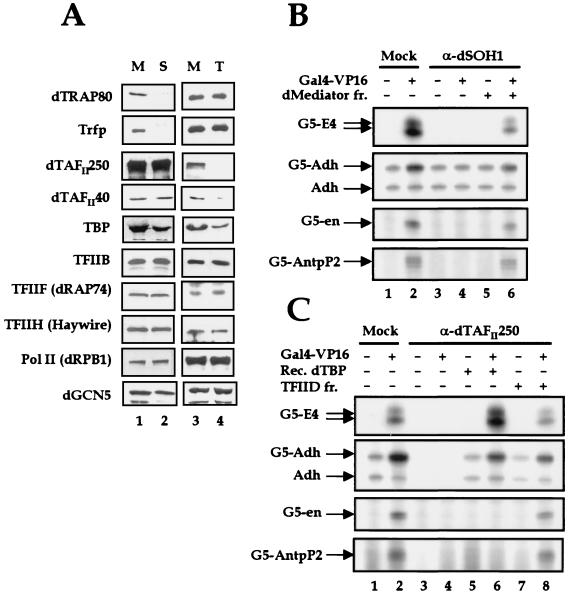
Differential requirement of mediator proteins and TAFs for transcriptional activation. (A) Immunodepletion of dMediators and TFIID from nuclear extract. Extract was immunodepleted with anti-β-galactosidase (M), anti-dSOH1 (S), and anti-dTAFII250 (T). Each extract was analyzed by immunoblotting to examine the relative amounts of the proteins indicated at the left. (B) Transcriptional activation of the E4, Adh, en, and AntpP2 promoter constructs by Gal4-VP16 in dMediator-deficient extracts. Extracts were immunodepleted with anti-β-galactosidase or anti-dSOH1. Transcription assays were performed and the results analyzed as for Fig. 3C. (C) Different effects of TAF depletion on the activated transcription of the E4, Adh, en, and AntpP2 promoter constructs. The addition of Gal4-VP16, recombinant dTBP, and partially purified TFIID (TFIID fr.) to each reaction is indicated by + on the corresponding lanes.

References

    1. Austin R J, Biggin M D. A domain of the even-skipped protein represses transcription by preventing TFIID binding to a promoter: repression by cooperative blocking. Mol Cell Biol. 1995;15:4683–4693. - PMC - PubMed
    1. Becker P B, Rabindran S K, Wu C. Heat shock-regulated transcription in vitro from a reconstituted chromatin template. Proc Natl Acad Sci USA. 1991;88:4109–4113. - PMC - PubMed
    1. Björklund S, Kim Y-J. Mediator of transcriptional regulation. Trends Biochem Sci. 1996;21:335–337. - PubMed
    1. Boube M C, Faucher, Joulia L, Cribbs D L, Bourbon H-M. Drosophila homologs of transcriptional mediator complex subunits are required for adult cell and segment identity specification. Genes Dev. 2000;14:2906–2917. - PMC - PubMed
    1. Boyer T G, Martin M E D, Lees E, Ricciardi R P, Berk A J. Mammalian Srb/Mediator complex is targeted by adenovirus E1A protein. Nature. 1999;399:276–279. - PubMed

Publication types