


Adenoviral gene transfer of Caenorhabditis elegans n--3 fatty acid desaturase optimizes fatty acid composition in mammalian cells
- PMID: 11259654
- PMCID: PMC31177
- DOI: 10.1073/pnas.061040198
Adenoviral gene transfer of Caenorhabditis elegans n--3 fatty acid desaturase optimizes fatty acid composition in mammalian cells
Abstract
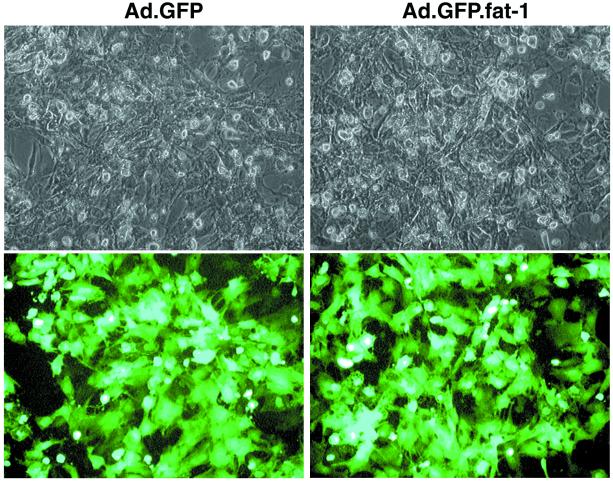
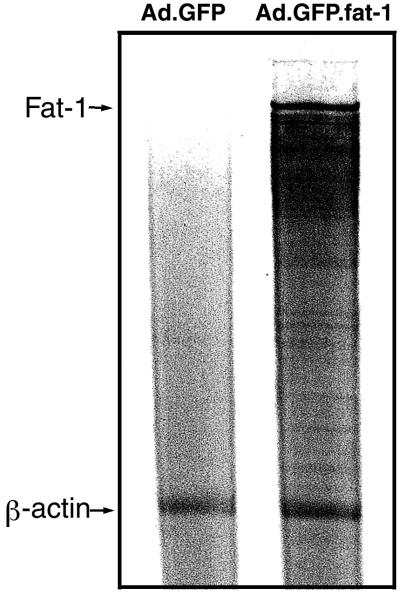
Omega--3 polyunsaturated fatty acids (PUFAs) are essential components required for normal cellular function and have been shown to exert many preventive and therapeutic actions. The amount of n--3 PUFAs is insufficient in most Western people, whereas the level of n--6 PUFAs is relatively too high, with an n--6/n--3 ratio of >18. These two classes of PUFAs are metabolically and functionally distinct and often have important opposing physiological functions; their balance is important for homeostasis and normal development. Elevating tissue concentrations of n--3 PUFAs in mammals relies on chronic dietary intake of fat rich in n--3 PUFAs, because mammalian cells lack enzymatic activities necessary either to synthesize the precursor of n--3 PUFAs or to convert n--6 to n--3 PUFAs. Here we report that adenovirus-mediated introduction of the Caenorhabditis elegans fat-1 gene encoding an n--3 fatty acid desaturase into mammalian cells can quickly and effectively elevate the cellular n--3 PUFA contents and dramatically balance the ratio of n--6/n--3 PUFAs. Heterologous expression of the fat-1 gene in rat cardiac myocytes rendered cells capable of converting various n--6 PUFAs to the corresponding n--3 PUFAs, and changed the n--6/n--3 ratio from about 15:1 to 1:1. In addition, an eicosanoid derived from n--6 PUFA (i.e., arachidonic acid) was reduced significantly in the transgenic cells. This study demonstrates an effective approach to modifying fatty acid composition of mammalian cells and also provides a basis for potential applications of this gene transfer in experimental and clinical settings.
Figures


References
-
- Connor W E. Am J Clin Nutr. 2000;71, 1 Suppl.:171S–175S. - PubMed
-
- Simopoulos A P. Am J Clin Nutr. 1999;70, 3 Suppl.:560S–569S. - PubMed
-
- Salem N Jr, Simopoulos A P, Galli C, Lagarde M, Knapp H R, editors. Lipids. 1996;31,Suppl.:S1–S326.
-
- De Caterina R, Endres S, Kristensen S D, Schmidt E B, editors. n−3 Fatty Acid and Vascular Disease. London: Springer; 1993.
-
- O'Keefe J H, Jr, Harris W S. Mayo Clin Proc. 2000;75:607–614. - PubMed
Publication types
MeSH terms
Substances
Grants and funding
LinkOut - more resources
Full Text Sources
Other Literature Sources
