. 2001 Mar 27;98(7):3904-8.
doi: 10.1073/pnas.071061998. Epub 2001 Mar 20.

The contribution of trait-mediated indirect effects to the net effects of a predator

Affiliations

The contribution of trait-mediated indirect effects to the net effects of a predator

S D Peacor et al. Proc Natl Acad Sci U S A. .

Abstract

Many prey modify traits in response to predation risk and this modification of traits can influence the prey's resource acquisition rate. A predator thus can have a "nonlethal" impact on prey that can lead to indirect effects on other community members. Such indirect interactions are termed trait-mediated indirect interactions because they arise from a predator's influence on prey traits, rather than prey density. Because such nonlethal predator effects are immediate, can influence the entire prey population, and can occur over the entire prey lifetime, we argue that nonlethal predator effects are likely to contribute strongly to the net indirect effects of predators (i.e., nonlethal effects may be comparable in magnitude to those resulting from killing prey). This prediction was supported by an experiment in which the indirect effects of a larval dragonfly (Anax sp.) predator on large bullfrog tadpoles (Rana catesbeiana), through nonlethal effects on competing small bullfrog tadpoles, were large relative to indirect effects caused by density reduction of the small tadpoles (the lethal effect). Treatments in which lethal and nonlethal effects of Anax were manipulated independently indicated that this result was robust for a large range of different combinations of lethal and nonlethal effects. Because many, if not most, prey modify traits in response to predators, our results suggest that the magnitude of interaction coefficients between two species may often be dynamically related to changes in other community members, and that many indirect effects previously attributed to the lethal effects of predators may instead be due to shifts in traits of surviving prey.


Figures
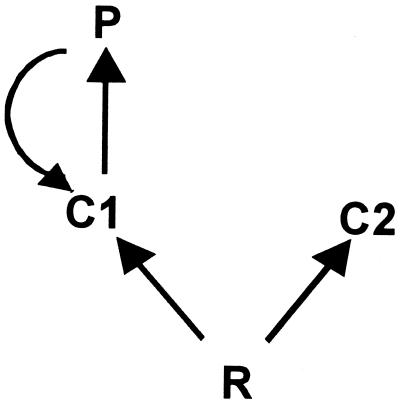
Figure 1
Figure 1
The model food web. Straight arrows represent consumer–resource interactions and point in the direction of energy flow; the curved arrow represents a predator-induced change in prey traits that are associated with a reduction in foraging activity. The straight and curved arrows thus represent the lethal and nonlethal effect of the predator, respectively. In the experiment, C1, C2, and P were represented by small bullfrog tadpoles, large bullfrog tadpoles, and larval dragonflies, respectively. R were primarily periphyton and detritus.
Figure 2
Figure 2
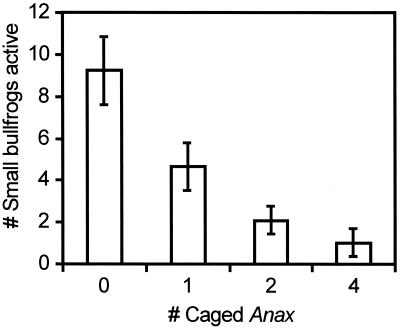
Behavioral response of small bullfrog tadpoles to caged Anax. The number of tadpoles active (swimming or feeding) was lower in tanks with caged Anax throughout the experiment (data presented here were collected early in the experiment on July 7).
Figure 3
Figure 3
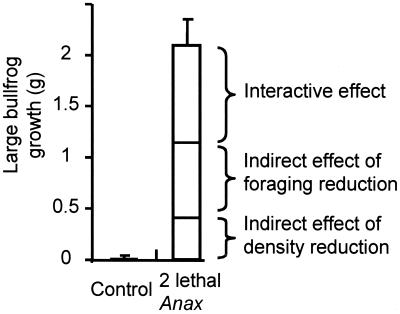
Growth (final minus initial mass) of large bullfrog tadpoles with and without two lethal Anax. Additional treatments allowed us to decompose the net indirect effect of the Anax into contributions due to foraging reduction, density reduction, and an interaction between these two effects (see text).
Figure 4
Figure 4
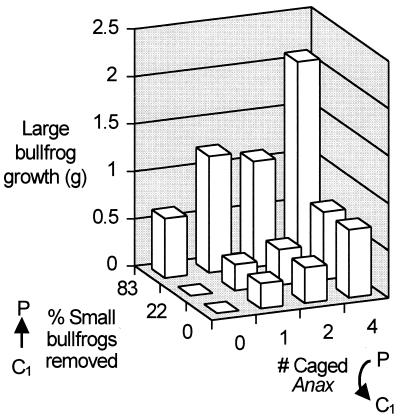
Average large bullfrog tadpole growth (g, final minus initial mass) as a function of small bullfrog tadpole (C1) density reduction (using nets) and foraging rate reduction (using caged Anax). For clarity, error bars are not included. The average SE = 0.1 g.
Figure 5
Figure 5
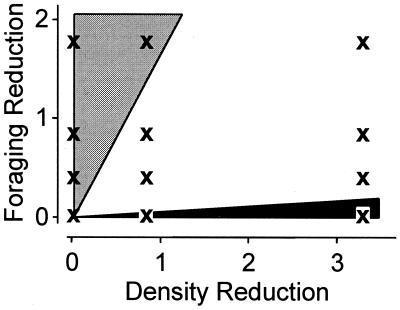
Representation in predator–prey effect space of the contribution of foraging reduction and density reduction to the total indirect effect of the predator on large bullfrog tadpoles. Units for both density and foraging reduction represent one lethal Anax in the experimental tank environment and were calibrated by extrapolating from the effect of Anax in the lethal Anax treatment on density and behavior of the small tadpoles. Xs correspond to the 12 combinations of density reduction and foraging reduction probed by the 3 × 4 factorial design. The light and dark shaded regions represent regions in predator–prey effect space where foraging reduction and density reduction represent >95% of the total effect of the predator, respectively, whereas the nonshaded region represents parameter combinations for which both effects contribute >5%. We derived these regions by examining the impact of foraging reduction and density reduction in the factorial design treatments (Fig. 4).

References

    1. Brooks J L, Dodson S I. Science. 1965;150:28–35. - PubMed
    1. Paine R T. Am Nat. 1966;100:65–75.
    1. Estes J A, Palmisan J F. Science. 1974;185:1058–1060. - PubMed
    1. Oksanen L, Fretwell S, Arruda J, Niemala P. Am Nat. 1981;118:240–261.
    1. Carpenter S R, Kitchell J F, Hodgson J R, Cochran P A, Elser J J, Elser M M, Lodge D M, Kretchmer D, He X, Vonende C N. Ecology. 1987;68:1863–1876. - PubMed

Publication types

LinkOut - more resources